DUBAI: Selections from London-based rare-book dealer Peter Harrington’s offering at the UAE fair, Sept. 13 to 18.
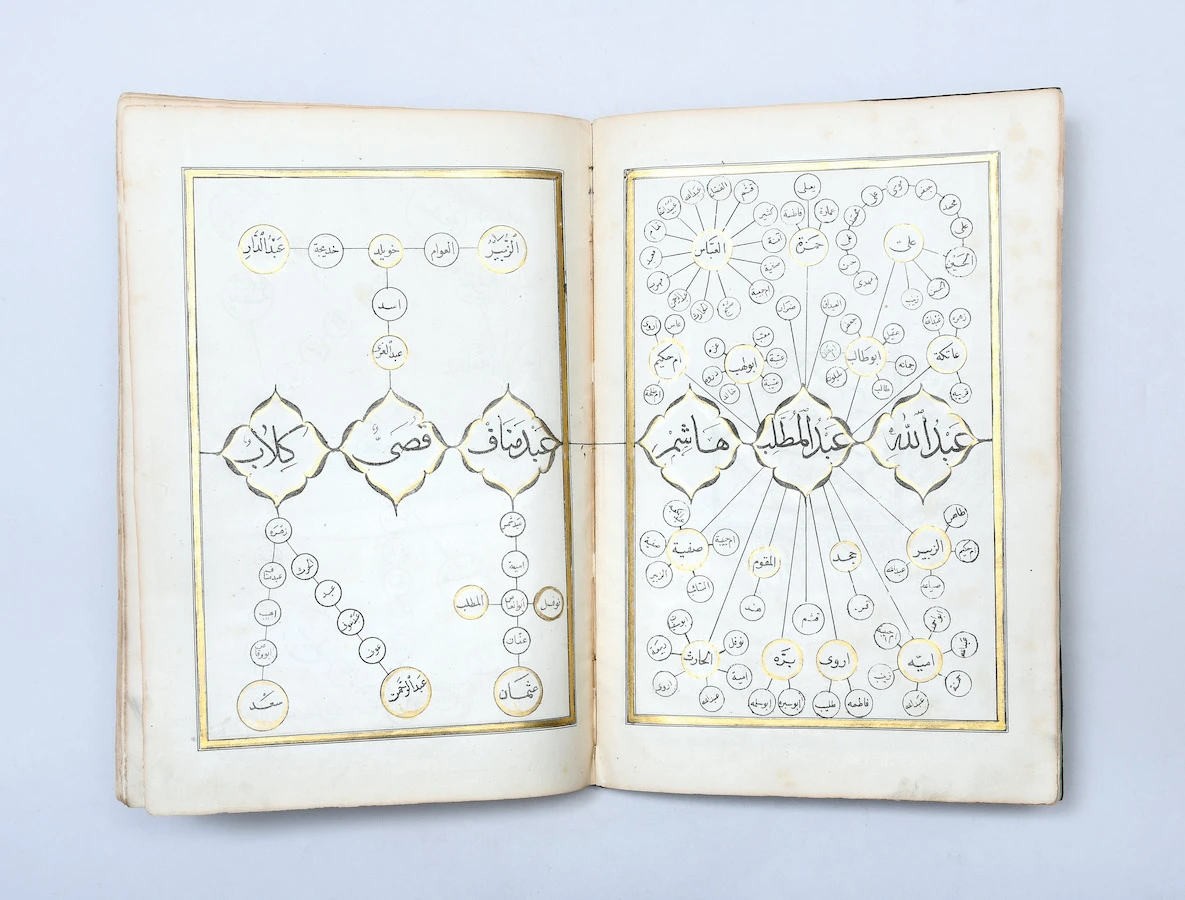
‘Genealogy of the House of Saud’ (1968)
The dealer’s notes describe historian Muhammad Amin al-Tamimi’s document as a “monumental and visually striking genealogy of the House of Saud,” which documents the family from its earliest recorded ancestor, “Mani’ Al-Muraydi, from the Mrudah clan, considered descendants of the Banu Hanifah tribe, and proceeds through the rulers of the first, second, and third Saudi states, including all the recorded secondary branches.”
Al-Tamimi’s color-coded tree is divided into 31 branches and “identifies male and female family members, as well as those who died childless, accident victims, university graduates, crown princes, martyrs, and office holders.”
Al-Tamimi worked as a government official in Jeddah in the 1920s, before spending several years working in the Egyptian archives in Cairo. This genealogy is, the notes state, “considered one of his major achievements; the pedigree was based on probably the earliest detailed examination of archival sources on the Saud royal family, seeking to identify and corroborate the names and information of even the most distant family members.”

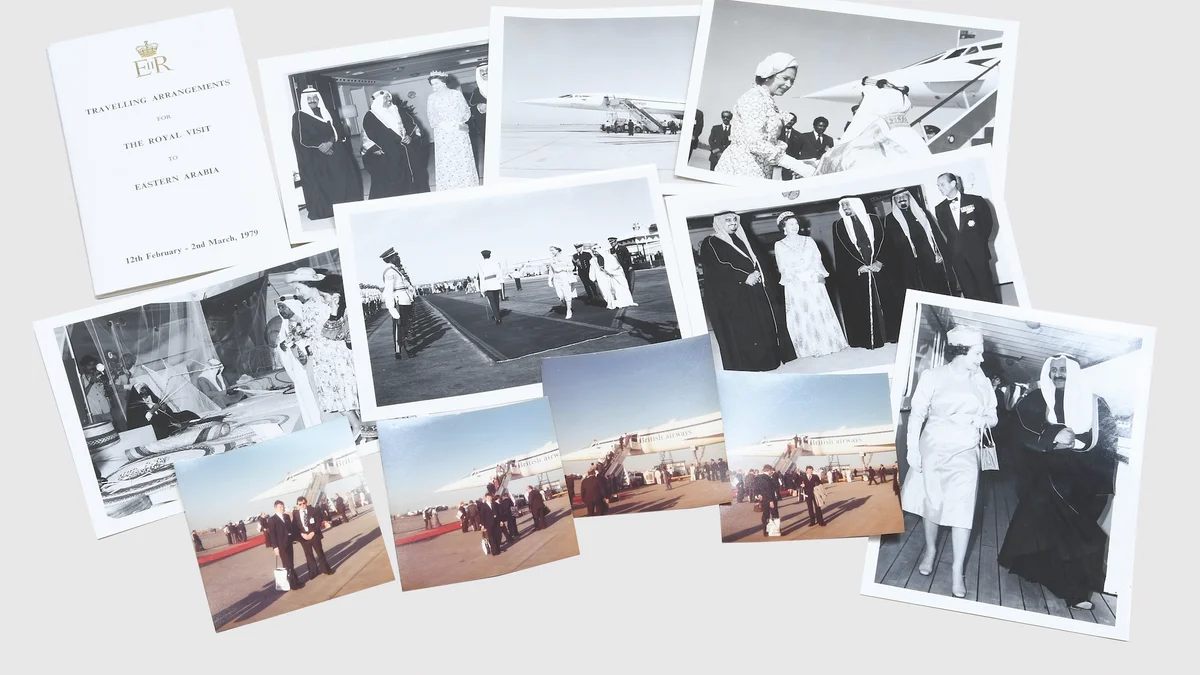
Archive of Queen Elizabeth II’s visit to Eastern Arabia (1979)
This photographic archive of Queen Elizabeth II and Prince Philip’s two-week visit to Saudi Arabia in 1979 — the first visit to the Gulf by a female head of state — includes the official printed program that was originally issued for internal circulation only, which includes information on the composition of the party and their travel arrangements, alongside the full logistics of the royal tour, which took in Kuwait, Bahrain, Saudi Arabia, Qatar, Abu Dhabi, Dubai, and Oman. The images include the landing of the British Airways Concorde in Bahrain, the welcome delegation led by Sheikh Isa bin Salman Al Khalifa of Bahrain, and the Saudi royal welcome by King Khalid, Prince Fahd, and Prince Abdullah.

‘Photo map of the city of Jeddah’ (1956)
“An impressive aerial view of Jeddah and its environs, which shows Jeddah’s urban development less than 10 years from the demolition of the old walls in 1947 and the start of the oil boom in 1950,” the dealer’s notes state. The aerial photograph was commissioned by US geology specialist Glen F.Brown. “Hired by Ibn Saud in 1945, Brown carried out geological investigations in Saudi Arabia until well into the 1950s, to identify sites with water, oil, and minerals. The ground-breaking cartographic and photographic surveys prepared by Brown were the basis for the most detailed maps of Saudi Arabia ever produced up to that time.” The photography was carried out by the Philadelphia-based company Aero Services Corporation.

‘Field Notes on Saudi Arabia’ (1935)
Described by the dealer as “a superbly detailed account of the emergence of a regional power” and “unquestionably the most important contemporary source on Ibn Saud’s newly consolidated kingdom,” this book is a collection of documents produced by the UK’s Air Ministry — “the body responsible for Britain’s military operations in the region.” It consists of material mostly supplied by embedded UK intelligence agents, “including perhaps its most talented Special Service Officer, Gerald de Gaury, a trusted ally and personal friend of Ibn Sa’ud.”
“The opening chapter offers a concise history of the region from the Turkish occupation through to the Treaty of Taif,” the notes explain. “The second moves on to an examination of the systems of central and local government, along with an explanation of Wahhabi law, the Mejlis al-Tujjar — or ‘merchant assembly’ — and fiscal policy. Population, the third section, encompasses estimated analyses of nomadic and settled numbers by region, and for non-Arab population groups in the Hejaz, together with more descriptive sections covering tribal characteristics and relations, attitudes of the races to each other and to Europeans, regional religious differences, and the impact of migration.”

‘General Report on the Najd Region’ (1910)
This “detailed regional report” was compiled by Turkish officer Huseyin Husnu, and offers a first-hand account of one of the most significant events in the history of Saudi Arabia: the recapture of Riyadh by Ibn Saud — later to become King Abdulaziz — in 1902. According to the dealer’s notes, it “documents the transition from Ottoman decline to Saudi ascendancy in central Arabia.” The notes continue: “Modern scholarship identifies the text as a fundamental source for understanding the lived context and regional influence of Wahhabism, and as enduring testimony to the historical foundations of Saudi power in central Arabia despite the profound transformations of the 20th century.” The text’s importance “lies not only in Husnu’s direct participation in the military and political events he records, but also in his sensitivity to the interplay of geography, climate, and social life in Najd, showing how environmental conditions shape patterns of belief and daily existence.”