- Airbus, believes the long-term outlook for the regions airlines remains positive
- Airbus believes Riyadh Air will help breathe new life into the region as Saudi Arabia opens up to the world
DUBAI: The Gulf’s aviation boom was built on a powerful combination of geography, accessible airspace, relatively cheap fuel and millions of passengers connecting between Asia, Europe and Africa.
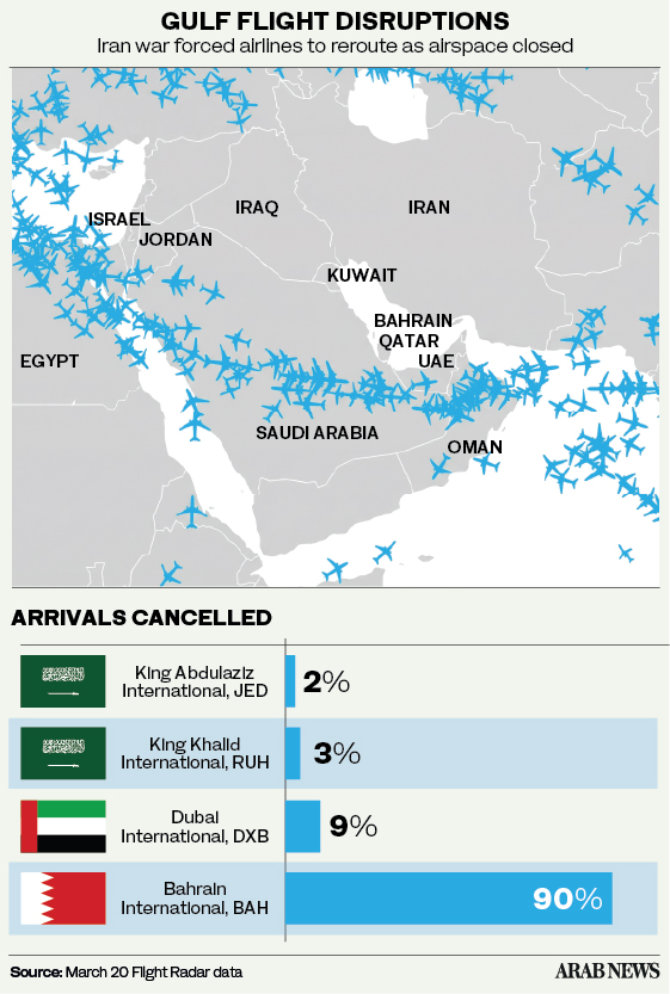
The Iran war has put all of those advantages under pressure at once, spiking oil prices, closing airspaces and damaging the regions burgeouning tourism industry.
According to the International Air Transport Association, Middle Eastern airlines are forecast to swing from a $7.2 billion net profit in 2025 to a $4.3 billion net loss in 2026.
However, despite this, Airbus, one of the worlds largest aircraft manufacturers believes the long-term outlook remains positive with the company revealing that they had yet to cancel a single order for it’s planes since the onset of the war, a sign that confidence is still high.
“People want to fly because flying brings value,” Antonio Teixeira Da Costa, VP Market Analysis and Forecast, at Airbus told Arab News at the launch of the Airbus’s global market outlook report in Dubai on Wednesday.
“What we find is that this region has proven to be resilient and that demand is growing.”
According to the new forecasts, the Middle East will require 3,830 new passenger aircraft over the next 20 years with traffic within the region expected to more than double by 2045.
The European planemaker said they expected Middle Eastern passenger traffic to grow at 4.7 percent annually, significantly faster than its 3.9 percent global forecast.
“We expect that the conflict will find a solution, and we very much look forwards to that. And therefore, once that happens, the growth will be even more unconstrained,” Da Costa said.
There are signs that the recovery is already underway, Middle East scheduled airline capacity in September is only 3.7 percent below a year earlier, according to OAG.
Airbus believed that additional demand would come from within with the region's middle-class population set to increase by another 240 million people to 620 million by 2045 fuelling increasing demand for air travel.
Saudi Arabia the market to watch
Airbus’s executives said Saudi Arabia was one of the largest aviation story in the region, believing the launch Riyadh Air would help breathe new life into the region as Saudi Arabia opened up to the world.
Underpinning this was not only passangers coming to visit the kingdom but what airbus believed would be an enormous domestic population keen to go out and explore the world.
Airbus estimates that annual trips per person in Saudi Arabia are forecast to more than double from 1.6 in 2025 to 4.0 in 2045.
“Riyadh Air is providing a new model, their ambition to connect Riyadh to the world will definitely see quite interesting new routes hit the market in the coming months and years,” Gabriel Semelas, President Africa & Middle East, Airbus told Arab News.
“I think our overall backlog stands around 400 aircraft to be delivered the Kingdom, and I think with Vision 2030 and the ambition of the 330 million passengers by then is definitely exciting.