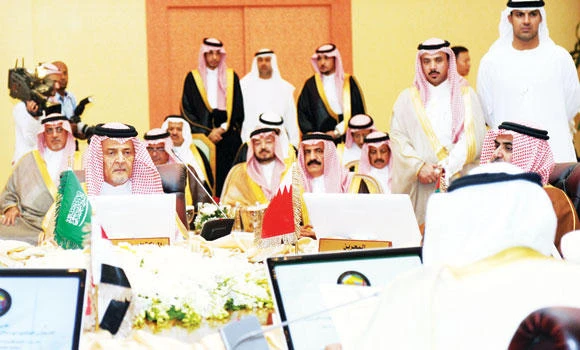
Officials from Gulf Cooperation Council (GCC) states expressed concern at the escalating terror attacks in the region during a meeting held in Jeddah.
“GCC countries are facing an unprecedented terror menace unleashed by groups that commit crimes in the name of Islam but who, in fact, have nothing to do with this peaceful religion,” said Kuwait’s First Deputy Premier and Foreign Minister Sheikh Khaled Al-Hamad Al-Sabah.
The foreign minister, who chaired the meeting, underscored the significance of Custodian of the Two Holy Mosques King Abdullah’s recent call to combat any attempt to hijack Islam and portray it as a religion of hatred, terror and extremism.
The minister affirmed the desire of the GCC bloc to achieve closer solidarity and unity as envisaged by its leaders, the Saudi Press Agency reported.
Sheikh Sabah also commended King Abdullah’s $100 million donation to an international center for combatting terror.
He reiterated the strong condemnation of the murders, dispossession and terrorizing of peaceful communities by terror groups using Islam as a pretext, while welcoming the recent UN Security Council Resolution that urges that no one support terror groups, either financially or militarily.
In his address, the deputy premier also commended the successful role played by Egypt in brokering peace between Israel and Palestinian on Aug. 26.
Sheikh Sabah also called on the international community to implement UN resolutions related to peace in Palestine and take up its humanitarian responsibility of providing international protection and lifting the blockade on Gaza, while also taking part in its reconstruction and making fruitful efforts to resume negotiations for an independent Palestinian state within the 1967 borders with East Jerusalem as its capital.
He stressed the need to uphold the territorial integrity and plurality of Iraq.
The Kuwaiti official also said that the GCC deplored the continuing violence in Syria and appealed to international organizations to provide fast humanitarian aid to Syrian refugees and those trapped in conflict zones.
He reiterated the support of the GCC to Yemeni President Abdu Rabbo Mansour Hadi and his government in their effort to bring about peace in their country.
He also stressed the need to resolve pending issues between GCC countries and Iran and to reach an international agreement on Iran’s nuclear programs, while ensuring Iran’s commitment to cooperate with the International Atomic Energy Agency and Security Council resolutions.
Sheikh Sabah appealed to contending parties in Libya to cooperate in efforts to end violence and return to a constitutional political process.
GCC shores up strength to fight extremist threat