NEAR SINJAR TOWN, Iraq: Kurdish peshmerga forces have started clearing parts of the northern Iraqi town of Sinjar and have established positions along an Daesh supply route between its two main strongholds in Iraq and Syria, the coalition said on Thursday.
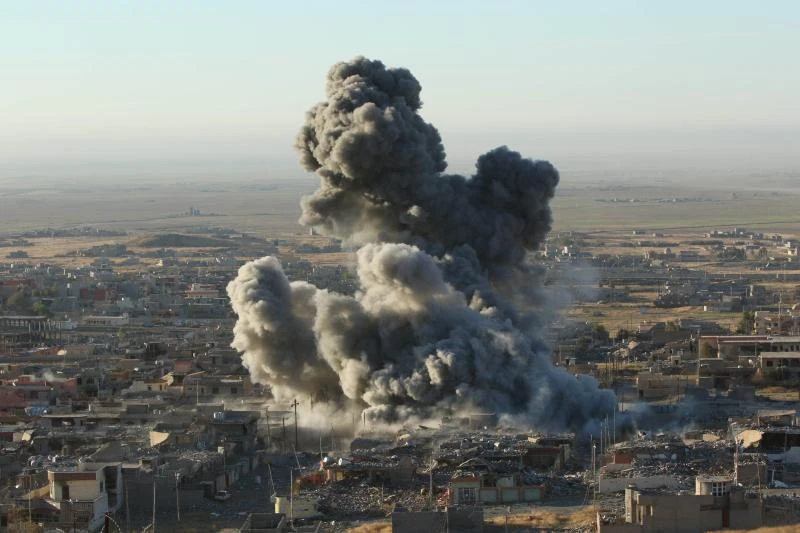
Backed by US-led coalition air strikes, the Kurds launched an offensive in the early morning designed to cordon off Sinjar, take control of strategic routes and establish a buffer zone to protect the town from artillery.
A victory in Sinjar could give the Kurds, government forces and Shiite militias momentum in efforts to defeat Daesh, which controls large areas of Iraq and Syria and has affiliates in Libya and Egypt.
So far the Kurds have captured three villages and penetrated parts of Highway 47, a supply route between Raqqa in Syria and the Iraqi city of Mosul, both of them Daesh bastions.
“The ground assault began in the early morning hours of Nov. 12, when peshmerga units successfully established blocking positions along Highway 47 and began clearing Sinjar,” said the coalition in a statement.
“The peshmerga will continue operations to re-establish government control over key portions of the areas.”
Daesh, a hard-line Sunni group suspected by Western intelligence officials of playing a role in the crash of a Russian passenger plane in Egypt two weeks ago, overran Sinjar more than a year ago.
Daesh’s killing and enslaving of thousands of the northern town’s Yazidi residents focused international attention on the group’s violent campaign to impose its radical ideology and prompted Washington to launch its air offensive.
There were no indications of direct American involvement on the ground in “Operation Free Sinjar.” Iran, which has military advisers in Iraq to support the government, did not appear to have a hand in combat.
Daesh uses Highway 47 to transport weapons, fighters and illicit commodities to fund its operations, said the coalition, which conducted more than 250 air strikes in the past month across northern Iraq.
“Strikes destroyed Daesh fighting positions, command and control facilities, weapon storage facilities, improvised explosive device factories, and staging areas,” said the coalition, referring to Daesh.
Russia’s recent interventions — air strikes against opponents of President Bashar Assad in Syria and intelligence sharing with Baghdad — have raised concerns in Washington that its former Cold War foe is gaining influence in the Middle East.
US-led coalition air strikes pounded Daesh-held areas in the town overnight, as around 7,500 Kurdish special forces, peshmerga and Yazidi fighters descended from the Sinjar mountain toward the front line in a military convoy.
“This operation will degrade Daesh resupply efforts, disrupt funding to the terrorist group’s operations, stem the flow of Daesh fighters into Iraq, and further isolate Mosul from Raqqa,” said the coalition.
“Coalition air strikes will continue to target Daesh leaders, revenue sources, supply routes, command facilities, and weapons caches to dismantle their operations in Iraq and Syria.”
The Kurdish security council said Kurdish forces had captured a village to the west of Sinjar and two others on the eastern outskirts. Reuters could not independently confirm this.
Spirits were high among Kurdish commanders and local officials near the front line.
“It is going according to plan. We are optimistic and we consider today like a celebration,” said Sinjar district mayor Mahma Xelil.
Kurdish forces and the US military said the number of Daesh fighters in the town had increased to nearly 600 after reinforcements arrived in the run-up to the offensive, which has been expected for weeks but delayed by the weather and friction between various Kurdish and Yazidi forces in Sinjar.
The offensive is being personally overseen by Kurdistan regional president Massoud Barzani, who is also head of the Kurdistan Democratic Party (KDP), which other groups in the area accuse of seeking to monopolize power.
Many Yazidis lost faith in the KDP when its forces failed to protect them from Daesh militants, who consider them devil worshippers, when the group attacked Sinjar in August 2014, systematically slaughtering, enslaving and raping thousands of Yazidis.
A Syrian affiliate of the Kurdistan Workers’ Party (PKK) came to the rescue, evacuating thousands of Yazidis stranded on Sinjar mountain and establishing a permanent base there.
Near the front lines on Thursday, a Kurdish officer stood behind a wall of sandbags. Sinjar, about 300 meters (1,000 feet)away, could be seen through a gap in a rampart.
Kurdish officers said an Daesh sniper had taken up position in the town. Coordinates were passed to a joint operations room and within five minutes the position was bombed.
Daesh militants could be heard communicating in Arabic and Turkmen in intercepted walkie-talkie chatter.
“Where are you,” asked one. “Praise be to God,” said another. One fighter noted that a car used by his comrades had been destroyed.
Loqman Ibrahim, head of the eight battalion, made up of Yazidis and under peshmerga command, said he heard militants urging each other to fight to the death and that an order was given not to withdraw.
Most Yazidis have been displaced to camps in the Kurdistan region; several thousand remain in Daesh captivity.
LAND AND HONOUR
The PKK has trained a Yazidi militia in Sinjar, while tribal groups operate independently. Several thousand Yazidis have also joined the peshmerga.
For Yazidi forces taking part, the battle is very much about retribution.
Hussein Derbo, the head of a peshmerga battalion made up of 440 Yazidis, said the men under his command could have migrated to Europe but chose to stay and fight.
“It is our land and our honor. They (Daesh) stole our dignity. We want to get it back,” he told Reuters in a village on the northern outskirts of Sinjar town.
Derbo’s brother, Farman, echoed the sentiment, saying he hoped the militants would not retreat so the Yazidis could kill them all.
The forces, many wearing the thick moustache typical of Yazidis and carrying light weapons, had gathered at a staging position overnight. They traveled in a peshmerga convoy comprised of Humvees on flatbed trucks, heavy artillery, and fighters waving Kurdish flags, flashing peace signs and brandishing their rifles.
Hundreds of vehicles wound slowly downhill along the same road Yazidis had fled up last summer seeking safety from Daesh. Abandoned cars and blood-stained clothing on the roadside were reminders of those chaotic scenes.
Around dawn, the fighters piled into their vehicles and headed to the front.
Authorising the first strikes against Daesh in August 2014, US President Barack Obama cited a duty to prevent a genocide of Yazidis by the radical Islamists.
The US-led coalition has carried out dozens of strikes in the past few weeks in support of the peshmerga, apparently coordinated with the Sinjar offensive.
In December 2014, Kurdish forces drove Daesh from north of Sinjar mountain, a craggy strip about 60 km (40 miles) long, but the radical Sunni insurgents of Daesh maintain control of the southern side where the town is located. The peshmerga currently control about 20 percent of the town.
Backed by US air strikes, the peshmerga have also regained most of the ground they consider historically Kurdish. Sinjar is part of the disputed territories to which both the Iraqi federal government and regional Kurdish authorities lay claim.
Kurdish forces launch battle to retake Iraq’s Sinjar town