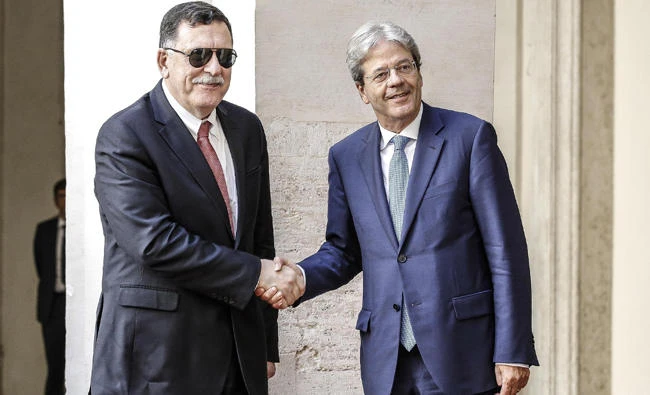
CAIRO/TRIPOLI: Standing beside French President Emmanuel Macron in Paris this week, Khalifa Haftar, the most powerful military leader in eastern Libya, was smiling when he shook on a deal with the country’s prime minister for a cease-fire and spring elections.
But hours later and away from the diplomatic stage, Haftar exposed the reality of deep fractures in Libya’s political landscape, saying any cease-fire was limited, he actually had no interest in elections and Prime Minister Fayez Al-Sarraj’s power-sharing council was in the grip of terrorists.
Keen to expand the French role in ending Libya’s crisis, Macron had applauded the moment as a powerful act for peace among the country’s rival armed factions who have skirmished over the oil-producing desert state since the fall of Muammar Gaddafi in 2011.
Getting the rivals together for only the second time may have been an achievement. But Haftar’s subsequent remarks were a reality check on the complexities of uniting Libya’s fractious players and delivering on the ground after years of failed Western efforts to end the crisis.
The Paris deal was meant to revive a stalled UN-brokered deal to end the chaos in Libya. Yet Paris excluded key stakeholders, left major differences about Haftar’s role to resolve later and, said Middle East analysts, risked emboldening Haftar further in his military campaign by appearing to bolster his international legitimacy over rivals.
Libya’s war is on multiple fronts. Haftar has been battling in the east against an alliance of Islamist militants and ex-rebels in Benghazi and carrying out air strikes on armed groups in Derna.
Clashes among rival brigades sometimes break out over private feuds, but this year, heavy shelling and fighting have erupted several times between forces allied to a previous government and brigades backing Al-Sarraj.
Haftar had rejected Al-Sarraj’s UN-backed presidential council, even saying some members belonged to Al-Qaeda. The commander brands most opponents Islamist militants to be defeated as his self-styled Libyan National Army gains ground backed by powerful allies: Egypt’s President Abdel Fattah El-Sisi, the UAE and Russia.
“The cease-fire is just with moderate parties and youths who have some misdemeanors, we’re in contact with them,” he told France24 Arabic. “I do not care about elections. I care about the future of Libya as a stable and civil state.”
Past attempts to negotiate peace in Libya have been undone by splits within each faction, who are often loose alliances of convenience among brigades of former rebels more loyal to cities, regions or tribes than to the idea of a Libyan nation.
Haftar, a former Gaddafi ally who lived in exile in the US for years, has gained momentum, winning over rivals in Benghazi and taking over key oil ports in a combination of military force and tribal negotiations.
He now hints at pushing closer to the capital of Tripoli. But he still is far from a unifying figure even in the east.
Al-Sarraj, meanwhile, has struggled to extend his own influence, and is widely seen as powerless. He is loosely backed by most of the Misrata western brigades but opposed by other armed groups even within Tripoli. The Misrata brigades despise Haftar as a would-be “military warlord.”
“The outcome of the summit, particularly if it is nothing more than a handshake, could tip the balance in favor of the war faction within Haftar’s camp,” said Mattia Toaldo, a Libya expert at the European Council of Foreign Relations.
Two years ago, Libya had two competing governments and parliaments, one in the east and one in Tripoli after a battle to capture the capital in 2014.
The UN-backed agreement over a unity government has been the main focus of negotiations since.
Diplomats say that despite what Haftar said afterward, the fact that he agreed in principle the best way forward was a political deal, elections and a cease-fire would help to advance UN negotiations.
“All those are steps forward,” said one diplomat close to the talks. “There is room to maneuver here. Neither Haftar nor Al-Sarraj can deliver on the ground. It is up to the UN-led process.”
Still to be resolved though are major differences over the make-up of the presidential council, the role of civilian control over any future Libyan military, and what position Haftar might take in the government of unity.
The Justice and Construction Party — the Libyan political wing of the Muslim Brotherhood — dismissed Paris as a distraction and demanded any amendments to the political deal be through the UN not through deals with individual countries.
Macron’s approach has also caused tensions inside the EU, with Italy upset. Rome previously took the lead in efforts to bring peace to its former colony, throwing its weight behind Al-Sarraj and viewing Haftar with skepticism.
Meanwhile, Haftar was immediately praised by staunch ally Cairo. After the Paris talks, Egypt’s foreign minister stressed the need to enhance the role of Haftar’s Libyan National Army as one of the institutions to expand and restore security.
But hours later and away from the diplomatic stage, Haftar exposed the reality of deep fractures in Libya’s political landscape, saying any cease-fire was limited, he actually had no interest in elections and Prime Minister Fayez Al-Sarraj’s power-sharing council was in the grip of terrorists.
Keen to expand the French role in ending Libya’s crisis, Macron had applauded the moment as a powerful act for peace among the country’s rival armed factions who have skirmished over the oil-producing desert state since the fall of Muammar Gaddafi in 2011.
Getting the rivals together for only the second time may have been an achievement. But Haftar’s subsequent remarks were a reality check on the complexities of uniting Libya’s fractious players and delivering on the ground after years of failed Western efforts to end the crisis.
The Paris deal was meant to revive a stalled UN-brokered deal to end the chaos in Libya. Yet Paris excluded key stakeholders, left major differences about Haftar’s role to resolve later and, said Middle East analysts, risked emboldening Haftar further in his military campaign by appearing to bolster his international legitimacy over rivals.
Libya’s war is on multiple fronts. Haftar has been battling in the east against an alliance of Islamist militants and ex-rebels in Benghazi and carrying out air strikes on armed groups in Derna.
Clashes among rival brigades sometimes break out over private feuds, but this year, heavy shelling and fighting have erupted several times between forces allied to a previous government and brigades backing Al-Sarraj.
Haftar had rejected Al-Sarraj’s UN-backed presidential council, even saying some members belonged to Al-Qaeda. The commander brands most opponents Islamist militants to be defeated as his self-styled Libyan National Army gains ground backed by powerful allies: Egypt’s President Abdel Fattah El-Sisi, the UAE and Russia.
“The cease-fire is just with moderate parties and youths who have some misdemeanors, we’re in contact with them,” he told France24 Arabic. “I do not care about elections. I care about the future of Libya as a stable and civil state.”
Past attempts to negotiate peace in Libya have been undone by splits within each faction, who are often loose alliances of convenience among brigades of former rebels more loyal to cities, regions or tribes than to the idea of a Libyan nation.
Haftar, a former Gaddafi ally who lived in exile in the US for years, has gained momentum, winning over rivals in Benghazi and taking over key oil ports in a combination of military force and tribal negotiations.
He now hints at pushing closer to the capital of Tripoli. But he still is far from a unifying figure even in the east.
Al-Sarraj, meanwhile, has struggled to extend his own influence, and is widely seen as powerless. He is loosely backed by most of the Misrata western brigades but opposed by other armed groups even within Tripoli. The Misrata brigades despise Haftar as a would-be “military warlord.”
“The outcome of the summit, particularly if it is nothing more than a handshake, could tip the balance in favor of the war faction within Haftar’s camp,” said Mattia Toaldo, a Libya expert at the European Council of Foreign Relations.
Two years ago, Libya had two competing governments and parliaments, one in the east and one in Tripoli after a battle to capture the capital in 2014.
The UN-backed agreement over a unity government has been the main focus of negotiations since.
Diplomats say that despite what Haftar said afterward, the fact that he agreed in principle the best way forward was a political deal, elections and a cease-fire would help to advance UN negotiations.
“All those are steps forward,” said one diplomat close to the talks. “There is room to maneuver here. Neither Haftar nor Al-Sarraj can deliver on the ground. It is up to the UN-led process.”
Still to be resolved though are major differences over the make-up of the presidential council, the role of civilian control over any future Libyan military, and what position Haftar might take in the government of unity.
The Justice and Construction Party — the Libyan political wing of the Muslim Brotherhood — dismissed Paris as a distraction and demanded any amendments to the political deal be through the UN not through deals with individual countries.
Macron’s approach has also caused tensions inside the EU, with Italy upset. Rome previously took the lead in efforts to bring peace to its former colony, throwing its weight behind Al-Sarraj and viewing Haftar with skepticism.
Meanwhile, Haftar was immediately praised by staunch ally Cairo. After the Paris talks, Egypt’s foreign minister stressed the need to enhance the role of Haftar’s Libyan National Army as one of the institutions to expand and restore security.