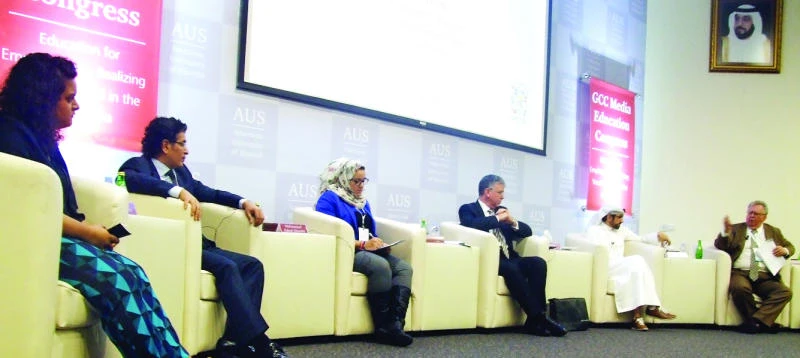
Virtual personalities that we see on social media and real personalities we meet face-to-face may be different, said Mohammed Fahad Al-Harthi, editor in chief of Arab News, Sayidaty and Jameela while participating in a panel session at the American University of Sharjah (AUS) on Wednesday.
“Sometimes we may find a gap between virtual and real personalities. Because the virtual personality is the one that we are trying to be, but the real one may be different,” he explained in a session, entitled The Media Personality of Tomorrow, which was moderated by Ralph Berenger, associate professor of Mass Communications at the AUS.
Sultan Saoud Al-Qassemi, commentator on Arab Affairs and Social Media Influencer, David Butorac, chief executive officer of Orbit Showtime Network were among other attendees at the session.
“Though social media plays an important role, I still believe that traditional and print media is the most powerful. Even social media is utilizing or capitalizing on the content of traditional media. Moreover, most of the social media personalities have a strong background of traditional media,” he added.
Al-Harthi also answered several questions from media students and other professionals. Asked about the freedom of expression, he said on some occasions, some employees of traditional media have lost their jobs because of their comments on social media, which were against their employers’ policies.
Al-Qassemi, said: “One should be careful while tweeting. It is true that it is your account and there is enough freedom on social media, but tweet gently, otherwise, in the future you could be in trouble.”
Sultan has over 250,000 followers and was listed in the 140 best Twitter Feeds of 2011 by Time magazine.
In a panel entitled Bridging the Gap Between Academia and Industry, Ibrahim Al-Abed, director general of the UAE national media, called for narrowing the gap between the theory and practice. He also advised the academic institutions to design the media courses according to the changes in the media industry. “Media is one of the rare jobs that requires real passion. You have to love your job then you will excel, otherwise you will be a bureaucrat,” he said.
Earlier, Sheikh Sultan bin Ahmed Al-Qassimi, chairman of Sharjah Media Corporation, opened the first GCC Media Education Congress (GMEC) with the theme Education for Employment — Realizing Youth Potential in the Arab Media.
Thomas Hochstettler, acting chancellor of the AUS, said: “In today’s world, where communicating effectively is of paramount importance, the dynamism and vitality prevalent in the media industry is not surprising to see.
Mahmoud Anabtawi, dean of the College of Arts and Sciences at the AUS, said: “GMEC is an important platform that highlights the important contributions of higher education and young professionals to the Arab media sector. We are fortunate to have media academics and industry professionals sharing real-world knowledge.”
Among other media figures at the event were Osama Samra, director, Sharjah Media Centre; Philip Seib, professor of journalism and public diplomacy, University of Southern California; Ali M. Jaber, group TV director of MBC Group; Caroline Faraj, CNN Arabic Digital services director and CNN Dubai chief operations director; Rania Barghout, senior TV presenter, MBC Group; and Ahmad Mustafa, editor in chief, Sky News Arabia, were the other prominent personalities who spoke on different sessions.
Social media vital but ‘print media most powerful’