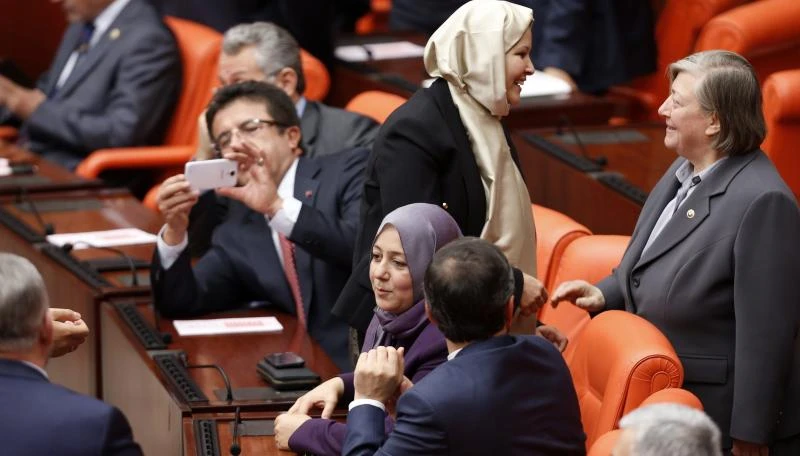
Four female lawmakers wearing head scarves walked into Turkey’s Parliament in Ankara on Thursday, marking an end to the ban on the Muslim symbol in the chamber that was imposed in the early days of the Turkish Republic.
The last time a lawmaker attempted to wear the head scarf in Parliament in 1999 was expelled from the assembly.
The restrictions on head scarves in government buildings were loosened as part of reforms aimed at boosting democracy unveiled by Prime Minister Recep Tayyip Erdogan in September. The ban remains in place for judges, prosecutors and military and security personnel.
The four lawmakers — Sevde Beyazit Kacar, Gulay Samanci, Nurcan Dalbudak and Gonul Bekin Sahkulubey — are members of Erdogan’s Justice and Development Party, abbreviated as AKP, which has Islamist roots and has gained a strong following in this nation of 74 million. The AKP’s reform package has been criticized by Turks fearing the rise of Islam in the official sphere, but lawmakers from the main secular opposition party, CHP, said it had decided not to react to the four lawmakers’ actions Thursday, although some of its members accused the ruling party of trying to exploit the issue for political gain.
The CHP was formed by Turkey’s founding father, Mustafa Kemal Ataturk, who championed head scarf bans in the 1920s.
The secularists’ relatively cool reaction Thursday contrasted with outrage at an earlier incident involving headscarves in parliament.
In 1999, a newly elected member of parliament, Merve Kavakci, tried to take her oath while wearing a head scarf. The left-leaning prime minister at the time, Bulent Ecevit, told lawmakers to “put this woman in her place.” Kavakci left the building while some of her colleagues chanted for her to “get out.” Kavakci lost her seat in 2001. AKP lawmakers cast the ban on head scarves as a civil rights issue that had prevented religious women from expressing themselves freely in Turkish politics.
“I have always said that we overlooked the problem of equality between men and women, but today I think we are finally solving this problem,” said Oznur Calik, a member of the ruling party.
What women can wear has been a political battleground in both Muslim and non-Muslim countries.
Women are required to cover their hair in public in Iran, which is overwhelmingly Muslim, a rule many of them detest. France, meanwhile, in 2011 became the first European nation to ban the public use of face veils, infuriating many Muslims who felt their religious community was being singled out for discrimination.Erdogan called on lawmakers to respect the decision.
“There is no by-law in Parliament that prevents this and everyone must respect the decision taken by our sisters on this subject. They have been elected by the nation and are representatives of the nation in Parliament,” he said.
Some opponents have criticized the timing of the decisions, saying they were aimed at garnering support ahead of an election cycle, an accusation dismissed by Dalbudak who said it had been based solely on personal belief.
“I am very happy and proud because I am completing one of the foremost duties required of me. I am experiencing an inner peace because of this,” she said. “This has nothing to do with investing in an election.”
“We do not know how they will react but we are going to enter Parliament with our head scarves and continue our work,” Nurcan Dalbudak, one of the four Justice and Development Party (AKP) lawmakers, told Reuters earlier. “We are going to witness the start of an important era and we will play the leading role, we will be the standard-bearers, this is very important,” she said.
The head scarf is an emotive symbol in Turkey, viewed by secularists as the emblem of political Islam and its appearance in public life as an affront to the Turkish Republic’s secular foundations set up by founding father Mustafa Kemal Ataturk. While there are no specific restrictions on wearing the head scarf in Parliament, opposition from secularists as well as a ban in other state institutions, which was lifted this month, have previously deterred women from wearing them.
Dalbudak and fellow AKP lawmakers Sevde Beyazit Kacar, Gulay Samanci and Gonul Bekin Sahkulubey were expected to attend the general assembly later on Thursday wearing their head scarves.
Turkey’s main opposition and secularist Republican People’s Party (CHP) has said it will contest the move. “All our members are in agreement, that is, we think the AKP is exploiting religion. We will never remain silent toward actions aimed at eliminating the principle of secularism,” CHP lawmaker Dilek Akagun Yilmaz told Reuters.
She said the party had agreed to show their opposition in a “graceful” manner, and it is unlikely Parliament will witness a repeat of the chaotic scenes from 1999 when Merve Kavakci, an MP from the Islamist Virtue Party, a predecessor of AKP, wore her head scarf to a swearing-in ceremony.
Bulent Ecevit, the prime minister at the time, addressed the packed assembly, saying: “This is not the place to challenge the state. Inform this woman of her limits!,” while half the chamber stood shouting: “Get out! Get out!” to the seated Kavakci.
The assembly was adjourned and Kavakci was forced to leave the chamber without taking her oath. She was later stripped of her Turkish citizenship after she was found to have taken dual American citizenship without informing the authorities.
The Virtue Party was closed down in 2001 for violating the secularist articles of the constitution and several lawmakers, including Kavakci, were banned from politics for five years.
Nazli Ilicak, then a fellow Virtue Party lawmaker who was sitting next to Kavakci in Parliament before she was expelled, welcomed the AKP MPs’ decision and said she did not expect a repeat of 1999.
“This is a positive development. I don’t think there will be similar scenes to the Kavakci incident. People are now a little embarrassed about what they did in the past,” Ilicak said.
The lawmakers’ announcements come only weeks after the AKP lifted a decades-old ban on women wearing the head scarf in state institutions as part of a package of reforms the government says are meant to improve democracy.
But the debate around the head scarf goes to the heart of tensions between religious and secular elites, a fault line in Turkish public life.
Restrictions on head scarves at universities have already been eased under the AKP and critics of Prime Minister Tayyip Erdogan point to this and other policies such as restrictions the sale of alcohol as proof his party is seeking to erode the secular order of the republic built on the ruins of an Ottoman theocracy by Ataturk in 1923.
Supporters of Erdogan, whose wife also wears the head scarf, particularly in Turkey’s pious Anatolian heartlands, say the Turkish leader is simply redressing the balance and restoring freedom of religious expression to a Muslim majority.
Erdogan called on lawmakers to respect the decision.
“There is no by-law in Parliament that prevents this and everyone must respect the decision taken by our sisters on this subject. They have been elected by the nation and are representatives of the nation in Parliament,” he said.
Some opponents have criticized the timing of the decisions, saying they were aimed at garnering support ahead of an election cycle, an accusation dismissed by Dalbudak who said it had been based solely on personal belief.
“I am very happy and proud because I am completing one of the foremost duties required of me. I am experiencing an inner peace because of this,” she said. “This has nothing to do with investing in an election.”
Turkish MPs attend assembly in scarves, first time in 15 years