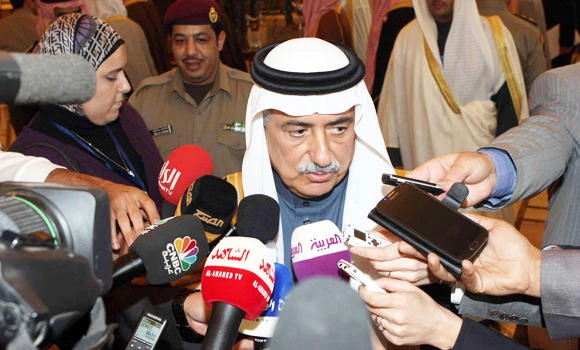
Finance Minister Ibrahim Al-Assaf said that yesterday’s positive rating announced by Fitch Ratings, an international agency, would enhance confidence in the strength of Saudi economy and its continued growth.
His remarks came after Fitch Ratings affirmed Saudi Arabia’s Long-Term foreign and local currency Issuer Default Ratings (IDRs) at “AA-” and revised the Outlook to Positive from Stable. In addition, Fitch has affirmed Saudi Arabia’s Country Ceiling at ‘AA’ and its Short-Term foreign currency IDR at ‘F1+.’
“This is the result of successful financial and economic policies followed by the Kingdom on the directives of Custodian of the Two Holy Mosques King Abdullah,” he said.
Al-Assaf also underscored the policy of increased government spending on infrastructure and development projects such as housing and public transport and the Kingdom’s efforts to bring public debts to its lowest in history.
Fahd Al-Mubarak, governor of Saudi Arabian Monetary Agency, said the latest ratings reaffirms the success of the Kingdom’s judicious monetary policies and excellent supervision of financial organizations.
“This has boosted the stability and development of the financial sector, enabling the Kingdom to strengthen its financial reserves,” he said.
The Fitch statement earlier said: The government’s balance sheet is very strong. High oil revenues enabled further accumulation of sovereign assets and reduction in government debt in 2012. Net general government debt, at 55.3 percent of GDP, is the lowest of all rated sovereigns. With a general government surplus of 6 percent of GDP forecast for 2013, fiscal buffers will be strengthened further. A rising break-even oil price, estimated by Fitch $ 76 per barrel in 2012, is a challenge over the medium term, though if capital spending is excluded the break-even price falls to a more comfortable 50 per barrel.
Saudi Arabia’s external position is extremely robust, Fitch said.
A record current account surplus in 2012 contributed to an increase in sovereign net foreign assets equivalent to 10 percent of GDP.
At a forecast 12.7 percent of GDP, 2013 will see the tenth double-digit current account outturn since 2003.
There is no sovereign external debt and reported private sector external debt is low.
Al-Assaf: Fitch move boosts Kingdom’s global standing