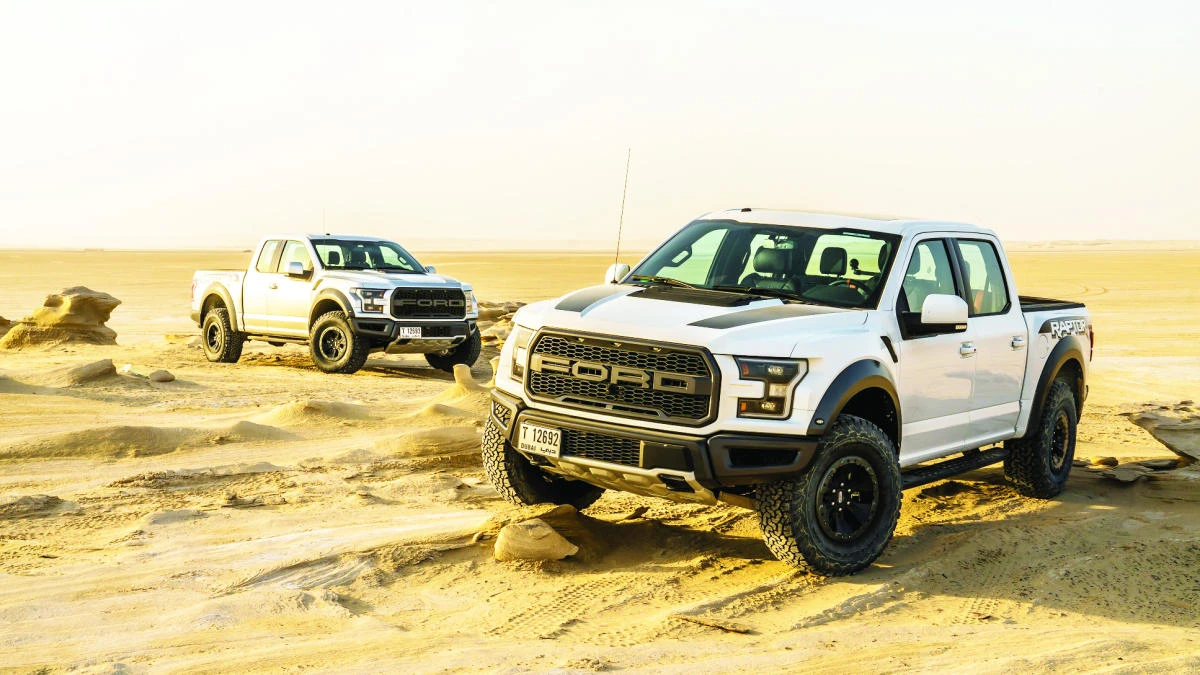
Ford, America’s truck leader, has introduced the all-new 2017 F-150 Raptor to the Middle East.
Developed with the DNA of a Baja race truck, F-150 Raptor is unique among off-road and performance vehicles, with a purpose-built engine, chassis and suspension that enables it to travel fast over challenging desert landscapes or crawl over rocky terrains.
It uses the same high-strength, aluminum alloy body and a fully boxed high-strength steel frame as the current F-150 trucks. The 2017 Raptor is up to 227-kg lighter than the 2014 model.
Combined with a high-output second-generation EcoBoost engine and 10-speed transmission, it delivers a 21 percent improved average torque-to-weight ratio and a 23 percent improvement in EPA-rated combined fuel economy compared with the previous generation Raptor. The new engine produces more power with greater efficiency than the current 6.2-liter V8, delivering 421 PS at 6,000rpm and 678 Nm of torque at 3,750rpm.
“Raptor was designed to be a no-compromise, off-road performance machine,” said Thierry Sabbagh, managing director of Ford Middle East. “The 2017 Raptor is the best high-performance off-roading pick-up truck available, and as one of the most successful and popular trucks in the world, represents Ford’s willingness to consistently sit on top of the truck food chain.”
The F-150 Raptor starts with a purpose-built fully boxed frame — the backbone of the truck — that is the strongest in the F-150 line-up, featuring more high-strength steel than the outgoing Raptor.
The second-generation high-output 3.5-liter EcoBoost engine produces more power with greater efficiency than the outgoing 6.2-liter V8.
Within performance circles, Ford’s EcoBoost engine has gained a following among truck enthusiasts and racing fans alike.
Among the high-output EcoBoost performance enhancements for Raptor are more aggressive turbo compressors with increased boost calibrations, cast stainless steel manifolds and full dual exhaust, oil-cooled pistons and more aggressive engine control calibrations.
The off-road driving mode technology has evolved into an all-new Terrain Management System that enables the driver to select modes to optimize driving dynamics to environmental conditions — from snow to mud, sand and more.
Developed with the DNA of a Baja race truck, F-150 Raptor is unique among off-road and performance vehicles, with a purpose-built engine, chassis and suspension that enables it to travel fast over challenging desert landscapes or crawl over rocky terrains.
It uses the same high-strength, aluminum alloy body and a fully boxed high-strength steel frame as the current F-150 trucks. The 2017 Raptor is up to 227-kg lighter than the 2014 model.
Combined with a high-output second-generation EcoBoost engine and 10-speed transmission, it delivers a 21 percent improved average torque-to-weight ratio and a 23 percent improvement in EPA-rated combined fuel economy compared with the previous generation Raptor. The new engine produces more power with greater efficiency than the current 6.2-liter V8, delivering 421 PS at 6,000rpm and 678 Nm of torque at 3,750rpm.
“Raptor was designed to be a no-compromise, off-road performance machine,” said Thierry Sabbagh, managing director of Ford Middle East. “The 2017 Raptor is the best high-performance off-roading pick-up truck available, and as one of the most successful and popular trucks in the world, represents Ford’s willingness to consistently sit on top of the truck food chain.”
The F-150 Raptor starts with a purpose-built fully boxed frame — the backbone of the truck — that is the strongest in the F-150 line-up, featuring more high-strength steel than the outgoing Raptor.
The second-generation high-output 3.5-liter EcoBoost engine produces more power with greater efficiency than the outgoing 6.2-liter V8.
Within performance circles, Ford’s EcoBoost engine has gained a following among truck enthusiasts and racing fans alike.
Among the high-output EcoBoost performance enhancements for Raptor are more aggressive turbo compressors with increased boost calibrations, cast stainless steel manifolds and full dual exhaust, oil-cooled pistons and more aggressive engine control calibrations.
The off-road driving mode technology has evolved into an all-new Terrain Management System that enables the driver to select modes to optimize driving dynamics to environmental conditions — from snow to mud, sand and more.