France’s Macron sends senior diplomat to Iran to defuse US tensions

France’s Macron sends senior diplomat to Iran to defuse US tensions
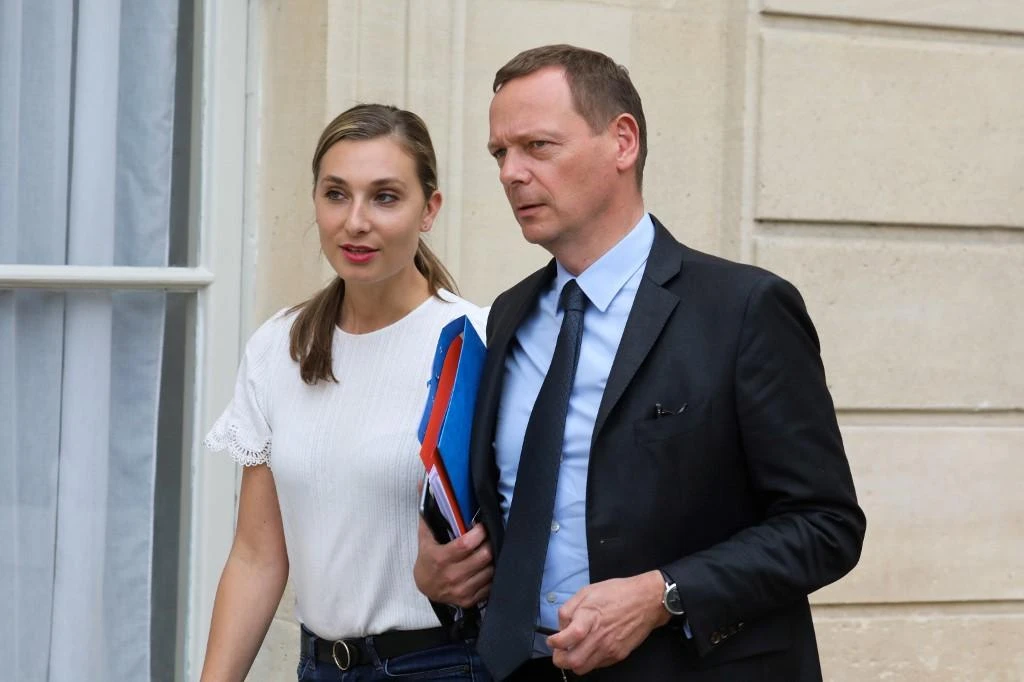
Presidential press advisor Nathalie Baudon, left, and diplomatic advisor Emmanuel Bonne stand in the court of the Elysee Palace in Paris. (AFP file photo)
Updated 20 June 2019

France’s Macron sends senior diplomat to Iran to defuse US tensions

France’s Macron sends senior diplomat to Iran to defuse US tensions
  • Emmanuel Bonne held ‘high-level meetings’ Wednesday in Tehran
  • The French presidency refused to say whom the top diplomatic adviser met

PARIS: President Emmanuel Macron sent his top diplomatic adviser to Iran this week as part of European efforts to defuse tensions between Tehran and Washington, the French presidency said Thursday.
The adviser, Emmanuel Bonne, held “high-level meetings” Wednesday in Tehran, “with the aim of contributing to the de-escalation of tensions in the region,” Macron’s office said.
The presidency refused to say whom Bonne met, adding only that he left Tehran on Wednesday evening.
The strains between Washington and Tehran increased Thursday with Iran’s announcement that it had shot down a US “spy drone” that violated Iranian airspace near the Strait of Hormuz.
The United States has yet to respond.
The incident marks the latest escalation in tensions following last week’s attacks on two oil tankers in the Strait of Hormuz, which the United States blamed on Iran.
Tehran has denied any involvement.
Tensions between the longtime foes, who have had no relations since the hostage crisis that followed the 1979 Islamic revolution, have increased sharply since US President Donald Trump last year abandoned a landmark 2015 nuclear agreement with Iran and re-imposed sanctions.
Macron, who is traveling to a G20 summit in the Japanese city of Osaka on June 28-29, will “have contact with the main players” in the standoff, his office said.
Before that he will pay an official visit to Japan on June 26-27, during which he will hold talks with Prime Minister Shinzo Abe, who recently traveled to Iran to try mediate in the crisis.
Abe met with Iran’s supreme leader, Ayatollah Ali Khamenei, who categorically refused to hold talks with Trump.
The EU is under pressure from Tehran to try salvage the 2015 deal, with Iran threatening to breach its nuclear enrichment limits.
On Tuesday, Macron urged Tehran to be “patient and responsible.”
Marib governor rallies troops for decisive battle in north Yemen

Marib governor rallies troops for decisive battle in north Yemen
Updated 29 April 2021

Marib governor rallies troops for decisive battle in north Yemen

Marib governor rallies troops for decisive battle in north Yemen
  • Gov. Sultan Al-Arada vowed that the people of Marib, the Yemeni army and the Saudi-led Arab coalition would defeat the Iran-backed militia.

AL-MUKALLA: The governor of the battleground Marib province in Yemen rallied troops on Wednesday to defend it against a Houthi advance amid potentially decisive fighting for the provincial capital.
Gov. Sultan Al-Arada vowed that the people of Marib, the Yemeni army and the Saudi-led Arab coalition would defeat the Iran-backed militia.
“We will not allow those who raise pictures of Qassem Soleimani to rule us,” the governor said. Soleimani was the commander of Iran’s Quds Force who was killed in an American airstrike in January last year.
Yemeni army spokesperson Maj. Gen. Abdu Abdullah Majili told Arab News on Wednesday that the Houthis had been pushed back from government-controlled areas to the west of Marib city, with many attackers killed or injured.
Marib is the Yemeni government’s last bastion in the north of the country, and is rich in oil and gas reserves. The Houthis are desperate to capture the province to increase their leverage in eventual peace talks, but loyalist forces are equally determined to defend it.
A senior Yemeni military official was killed and several soldiers were wounded on Wednesday as the Houthis stepped up their shelling of targets in Marib city.
Yemen’s Defense Ministry said that Brig. Gen. Abul Ghani Mohammed Salman, director of the ministry’s officers’ affairs department, died while “confronting” Houthi militia.
A Houthi missile that landed in the Rawda area of Marib province on Wednesday morning caused a large explosion that rocked the city and neighboring displacement camps. A local health official told Arab News that no one was injured.
The Houthis have intensified drone and missile strikes on densely populated Marib as their ground forces press ahead toward the city.
Thousands of Houthis and government troops have been killed in fierce fighting in the province, which began in February when the rebel group renewed a major offensive to seize control of Marib.
On Tuesday, two Houthi military commanders of a major battlefield in Marib were killed in fighting with government forces and in Arab coalition airstrikes over the last seven days.
Meanwhile, the Houthis have continued their air attacks on civilian and energy infrastructure targets in Saudi Arabia.
On Wednesday, Saudi air defenses intercepted and destroyed another armed drone fired from northern Yemen toward the city of Khamis Mushayt in the south of the Kingdom.
The Houthis have rejected a Saudi proposal for an immediate ceasefire and talks on a lasting political solution to the Yemen conflict. Instead, the Iran-backed group have demanded the re-opening of Sanaa airport for unchecked flights between Yemen and Iran.


Assad is indulging in “sham elections” as Syrians continue to suffer, UN told

Assad is indulging in “sham elections” as Syrians continue to suffer, UN told
Updated 28 April 2021

Assad is indulging in “sham elections” as Syrians continue to suffer, UN told

Assad is indulging in “sham elections” as Syrians continue to suffer, UN told
  • US envoy says until all Syrians, including refugees, can vote ‘we will not be fooled;’ accuses regime of ‘weaponizing’ humanitarian aid
  • UN’s special envoy for Syria says elections fail to comply with Security Council resolution; highlights suffering of women during conflict

NEW YORK: The permanent US representative to the UN, Linda Thomas-Greenfield, on Wednesday accused the Assad regime of blocking the drafting of a new constitution. She also warned that the “so-called May 26 elections (will) be neither free nor fair, and will not be representative of the Syrian people.”
“While the Assad regime run their sham elections, the people of Syria continue to suffer,” she said.
Elections in Syria must be held under the auspices of a new constitution and supervised by the UN, as was mandated unanimously by the Security Council, Thomas-Greenfield said.
“The Assad regime must secure steps to enable the participation of refugees, internally displaced people and the diaspora in any Syrian election,” she added. “Until then we will not be fooled.”
She reiterated that Washington “will not support reconstruction aid that benefits the regime absent progress in achieving the political reforms called for in (Security Council) Resolution 2254.”
She also condemned Assad for “hindering and weaponizing” the delivery of aid supplies. As the humanitarian situation continues to deteriorate, the envoy urged council members to reauthorize the Bab Al-Hawa crossing and reinstate the crossings at Bab Al-Salam and Yaroubiyah, a move that has been vetoed by Russia and China.
“Should the UN lose access to cross-border mechanisms, the COVID crisis in Syria will go from dire to disastrous,” said Thomas-Greenfield.
“Four million people inside northwest Syria depend on the 1,000 UN trucks that use the crossing each month. There is no alternative. Nothing can match the scope and the scale of the UN cross-border humanitarian mechanism. In fact, it’s quite clear that one sole crossing point is insufficient for the vast needs.”
She also highlighted what she described as a “deep moral wrong” that is unfolding in the Rukban refugee camp.
“For 16 months the camp’s residents have been without medical aid because the Assad regime and Russia will not allow the UN to make deliveries to these people in need,” she said.
“We urge the Assad regime and Russia to allow unhindered humanitarian access to the camp. These people are not pawns. Aid cannot be politicized.”
Her Russian counterpart on the Security Council, Vassily Nebenzya, responded by defending the Syrian regime and repeating its rhetoric. He blamed the worsening humanitarian situation on “relentless sanctions pressure exerted by the collective West,” and the deteriorating security situation on “terrorists using civilians as human shields.”
He also welcomed the prospect of next month’s elections as part of the Syrian government’s efforts to “ensure the state is functioning.”
“We lament the fact that some countries are up in arms against the very idea of upcoming elections and are ready declaring them illegitimate,” Nebenzya said. “(The) interference in the internal affairs of the Syrians is unacceptable and contradicts the existing norms of international law.”
He added that “the negative background information on the upcoming elections” has nothing to do with the work of the constitutional committee. 
Geir Pedersen, the UN’s special envoy for Syria, reiterated that the elections scheduled for May 26 were called under the auspices of the existing Syrian Constitution, and are not part of the political process established by Security Council Resolution 2254.
“The UN is not involved in this election and has no mandate to be,” he told the council. “Resolution 2254 mandates the UN to facilitate a political process that culminates in the holding of free and fair elections in accordance with a new constitution, administered under United Nations supervision to the highest international standards of transparency and accountability, with all Syrians, including members of the diaspora, eligible to participate.”
He urged council members to prioritize a “proactive search” for a political settlement to the conflict, saying that events in the past month have demonstrated how easily the situation could deteriorate, despite a year of relative calm “by Syrian standards.”
There has been a significant escalation of fighting in northwest Syria, including air strikes on a UN-supported hospital in western Aleppo close to densely populated camps for internally displaced persons, where UN humanitarian aid is delivered. Residential areas in the city have also been shelled.
Meanwhile Daesh continued its assaults in central and northeastern Syria. In one incident dozens of civilians were kidnapped in rural Hama.
“It is all too easy to become immune to these kinds of developments and the dangers they could lead to,” said Pedersen.
He also said that he met with The Syrian Women’s Advisory Board in Geneva this week, and its members voiced fears that “differences among external actors would perpetuate the Syrian conflict.”
“Let us not forget that, in addition to challenges facing all Syrians, many women have also experienced sexual and gender-based violence, early and forced marriage, and trafficking,” he added.
“And with men killed and injured in large numbers, more women than ever are heading households — against the backdrop of violence, terrorism, displacement, instability, destitution and pandemic.”
Pedersen said the women he talked to also stressed the need for progress to be made on the issue of the thousands of people who remain locked up, abducted or missing, as there has been little so far.
“Allow me to stress again the importance of unblocking progress on detainees, abductees and missing persons,” he said. “As long as this file remains largely frozen, many Syrians will be unable to even begin to think of moving on, and Syria’s social fabric cannot begin to be restored.”
Pedersen also expressed concern about the economic destitution that Syrians face, with food prices at historic highs and no sign of inflation abating.
“12.4 million (people) are now food insecure, an increase of 4.5 million in the past year alone,” he said. “Fuel shortages remain a key concern as well.
“A large-scale, cross-border response for an additional 12 months remains essential to save lives. I appeal for the members of the council to focus on achieving consensus to that end.”


UAE FM praises Saudi relations on 5-year anniversary of Vision 2030

UAE FM praises Saudi relations on 5-year anniversary of Vision 2030
Updated 28 April 2021

UAE FM praises Saudi relations on 5-year anniversary of Vision 2030

UAE FM praises Saudi relations on 5-year anniversary of Vision 2030
  • Abdullah bin Zayed says relations are ‘exceptional and strengthened by ties of common blood and destiny’

LONDON: UAE Minister of Foreign Affairs and International Cooperation praised Saudi Arabia’s “tireless efforts and its main role in the region’s prosperity and stability,” state-run WAM reported on Wednesday.
Sheikh Abdullah bin Zayed said the Kingdom, under the leadership of King Salman and Crown Prince Mohammed bin Salman, was looking to the future and strengthening its position among developed countries in all fields through its Vision 2030 plan.
He was speaking a day after a TV interview to mark the 5-year anniversary of the development program, in which the Saudi crown prince reviewed its most important achievements.
Sheikh Abdullah praised the depth of Saudi-Emirati ties, which “constitute a distinct and unique model for relations between Arabs” that is “not only strategic and historic, but rather exceptional and strengthened by ties of common blood and destiny.”
He said he valued Prince Mohammed’s confirmation that the Kingdom’s foreign policy was keen to strengthen its alliances with its partners around the world, in order to achieve regional and international prosperity, saying that Saudi Arabia’s success, prosperity and stability is in the interest of the UAE and the region.
He also praised the crown prince’s statements on sovereignty, and moderation and confronting extremist ideologies in the region, regardless of there nature.
He congratulated the Kingdom’s leadership, government and people on the occasion and said that the vision has made progress in all aspects of life, especially on the economic side.


Blinken says Turkey, others, should refrain from new purchases of Russian weapons

Blinken says Turkey, others, should refrain from new purchases of Russian weapons
Updated 28 April 2021

Blinken says Turkey, others, should refrain from new purchases of Russian weapons

Blinken says Turkey, others, should refrain from new purchases of Russian weapons
  • US-Turkish relations have been strained over issues including Turkey’s purchase of Russian S-400 air defense systems

WASHINGTON: US Secretary of State Antony Blinken warned Turkey and all US allies on Wednesday to refrain from making further purchases of Russian weaponry, saying this could trigger more sanctions.
US-Turkish relations have been strained over issues ranging from Turkey’s purchase of Russian S-400 air defense systems — over which it was the target of US sanctions — to policy differences over Syria, human rights and a US court case targeting Turkey’s majority state-owned Halkbank.
“It’s also very important going forward that Turkey, and for that matter all US allies and partners, avoid future purchases of Russian weaponry, including additional S-400s,” Blinken said at a virtual event at Washington’s Foreign Press Center.
“Any significant transactions with Russian defense entities, again, could be subject to the law, to CAATSA, and that’s separate from and in addition to the sanctions that have already been imposed,” he said, referring to the Countering America’s Adversaries through Sanctions Act, which is designed to dissuade countries from buying military equipment from the NATO foe.
Blinken also said that given President Joe Biden’s widely-known views, his declaration on Saturday that the 1915 massacres of Armenians in the Ottoman Empire amounted to genocide should not have come as a surprise.
Turkey’s presidential spokesman said on Sunday Biden’s declaration was “simply outrageous” and Turkey would respond over the coming months.


Christian parties demand restoration of Lebanon’s sovereignty from Hezbollah

Christian parties demand restoration of Lebanon’s sovereignty from Hezbollah
Updated 28 April 2021

Christian parties demand restoration of Lebanon’s sovereignty from Hezbollah

Christian parties demand restoration of Lebanon’s sovereignty from Hezbollah
  • “The Lebanese are paying the price of the coexistence between the state and the statelet,” Moawad said
  • He demanded that Hezbollah “leave us alone”

BEIRUT: Christian parties in Lebanon called for the collective resignation of Parliament on Wednesday, accusing Hezbollah of dominating the country.
The head of the Independence Movement, Michel Moawad, a former MP and son of former President Rene Moawad, said at a press conference: “With each passing day, we are more convinced that we are dealing with a criminal, corrupt and conspiratorial authority.
“The Lebanese are paying the price of the coexistence between the state and the statelet,” he added, demanding Hezbollah “leave us alone.”
Moawad, who resigned from Parliament following the Beirut Port explosion on Aug. 4, noted that “retaking the state from the mafia and the militia happens through the restoration of sovereignty over all our borders and regaining control over the decision making.
“What interest do we have in belonging to one axis against the other? What interest do we have in being hostile toward countries that do not attack us? What interest do we have in being hostile toward Arabs or the international community and fighting in Yemen and elsewhere? What interest do we have in exporting rockets, militias and drugs? How do we build a productive economy? How do we protect Lebanese nationals abroad?”
He added: “Sovereignty means enforcing the Lebanese state’s authority, using its own capabilities, over the entirety of the territory. This means that there should not be guarded areas, illegal weapons inside or outside of refugee camps, weapon warehouses, rockets, camps to train Houthis and non-Houthis and Captagon factories.” 
Moawad called for “the formation of a clear, capable and united opposition to face the mafia and the militia and focus on retaking the state.”
After meeting Maronite Patriarch Bechara Al-Rahi, the parliamentary bloc of the Lebanese Forces’ MPs renewed their calls for the holding of early parliamentary elections.
Sethrida Geagea MP expressed her support for Al-Rahi’s call for neutrality. “Our country is a small one located in a troubled region. It was not wise to place it in the middle of the region’s conflicts, leading to it being completely isolated from its Arab surroundings and its international friends.
“There is no hope from any government that the ruling majority forms because, even if formed, it will be an exact replica of the ones that came before, which means that true reforms are not an option with this majority. The solution resides in reproducing the ruling class in order to put an end to this parliamentary majority’s hegemony over the country following the disastrous situation they lead us to. This can be done through the only practical step available, which is the holding of early parliamentary elections.”
The Kataeb Party’s political office stressed that “the prevailing state of chaos confirms the blatant collusion between the mafia and the militia, which is aimed at turning Lebanon into a failed state, dragging it into agendas that serve foreign interests at the expense of the country’s identity and historic role, and isolating it from countries that can help it overcome the current crisis in order to further stifle it.
“The situation will not change as long as Lebanon has a parliament that has surrendered to Hezbollah’s will, is unable to prevent violations and has lost its national legitimacy.”
Camille Chamoun, new head of the National Liberal Party, added “Lebanon is in trouble.”
Arab News asked the former opposition MP Fares Saeed if the steps being taken by Christian political parties are an attempt to establish a new Lebanese Front in the face of the authorities and Hezbollah, which would be similar to the Lebanese Front that was established during the civil war.
“The steps taken by these parties are natural. However, I think that the main goal should be to put an end to the Iranian occupation of Lebanon, and anything else would be less than what is required,” Saeed answered.
“What is required is for Hezbollah to hand over its weapons in line with the constitution and the resolutions of international legitimacy. This solution is not feasible currently, which is why Al-Rahi called for an international conference to be held to ensure Lebanon’s neutrality. This is a serious proposition that could lead us to the desired solution. Late Patriarch Nasrallah Sfeir demanded the departure of the Syrian forces that were occupying Lebanon in 2000. This demand was fulfilled in 2005,” he added.
Regarding the Free Patriotic Movement’s position in light of the Christian parties’ call to restore Lebanon’s sovereignty away from Hezbollah, Saeed said there is no doubt that Hezbollah still has a lot of supporters among the Christians due to the alliance in place. “If this alliance is broken, the political scene could change.”