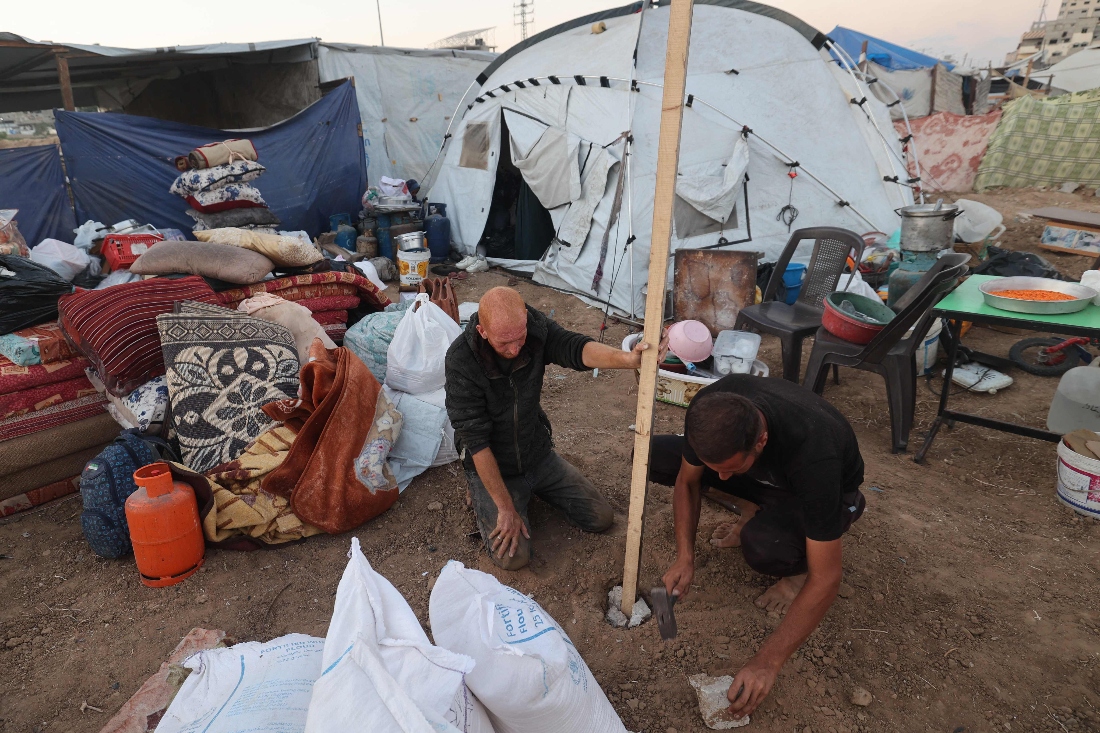
- Israel launched the offensive in Gaza City on August 10, in what Prime Minister Benjamin Netanyahu says is a plan to defeat Hamas militants once and for all in the part of Gaza where Israeli troops fought most heavily in the war’s initial phase
- The campaign has prompted international criticism because of the dire humanitarian crisis in the area, and has provoked unusual expressions of concern within Israel
CAIRO: Israeli bombardment pushed more Palestinians out of their homes in Gaza City on Thursday, while thousands of residents defied Israeli orders to leave, remaining behind in the ruins in the path of Israel’s latest advance.
Gaza health authorities said Israeli fire across the enclave had killed at least 28 people on Thursday, most of them in Gaza City, where Israeli forces have advanced through the outer suburbs and are now a few km (miles) from the city center.
Israel launched the offensive in Gaza City on August 10, in what Prime Minister Benjamin Netanyahu says is a plan to defeat Hamas militants once and for all in the part of Gaza where Israeli troops fought most heavily in the war’s initial phase.
The campaign has prompted international criticism because of the dire humanitarian crisis in the area, and has provoked unusual expressions of concern within Israel, including accounts of tension over strategy between some military commanders and political leaders.
“This time, I am not leaving my house. I want to die here. It doesn’t matter if we move out or stay. Tens of thousands of those who left their homes were killed by Israel too, so why bother?” Um Nader, a mother of five from Gaza City, told Reuters via text message.
Residents said Israel bombarded Gaza City’s Zeitoun, Sabra and Shejaia districts from ground and air. Tanks pushed into the eastern part of the Sheikh Radwan district northwest of the city center, destroying houses and causing fires in tent encampments.
There was no immediate Israeli comment on those reports. The Israeli military has said it is operating on the outskirts of the city to dismantle militants’ tunnels and locate weapons.
Much of Gaza City was laid to waste in the war’s initial weeks in October-November 2023. About a million people lived there before the war, and hundreds of thousands are believed to have returned to live among the ruins, especially since Israel ordered people out of other areas and launched offensives elsewhere.
Israel, which has now told civilians to leave Gaza City again for their safety, says 70,000 have done so, heading south. Palestinian officials say less than half that number have left, and many thousands are still in the path of Israel’s advance.
’MOST DANGEROUS DISPLACEMENT’ OF THE WAR
Displacement could further endanger those most vulnerable, including many children who are suffering from malnutrition, said Amjad Al-Shawa, the head of the Palestinian NGOs Network, an umbrella group of Palestinian NGOs that coordinates with the UN and international humanitarian agencies.
“This is going to be the most dangerous displacement since the war started,” said Shawa. “People’s refusal to leave despite the bombardment and the killing is a sign that they have lost faith.”
Palestinian and UN officials say there is no safe place in Gaza, including areas Israel designates as humanitarian zones.
The war has caused a humanitarian crisis across the territory. Health officials in Gaza say 370 people, including 131 children, have so far died of malnutrition and starvation caused by acute food shortages, most in recent weeks. Israel says it is taking measures to improve the humanitarian conditions in Gaza, including increasing aid into the enclave.
The war began on October 7, 2023, when gunmen led by Hamas attacked southern Israel, killing some 1,200 people, most of them civilians, and taking 251 hostages into Gaza.
Israel’s offensive has since killed more than 63,000 Palestinians, most of them civilians, according to local health officials, and left much of the territory in ruins.
Prospects for a ceasefire and a deal to release the remaining 48 hostages, 20 of whom are thought to still be alive, appear dim.
Protests in Israel calling to end the war and reach a deal to release the hostages have intensified in the past few weeks.