South Sudan opposition calls for mobilization of forces for ‘regime change’

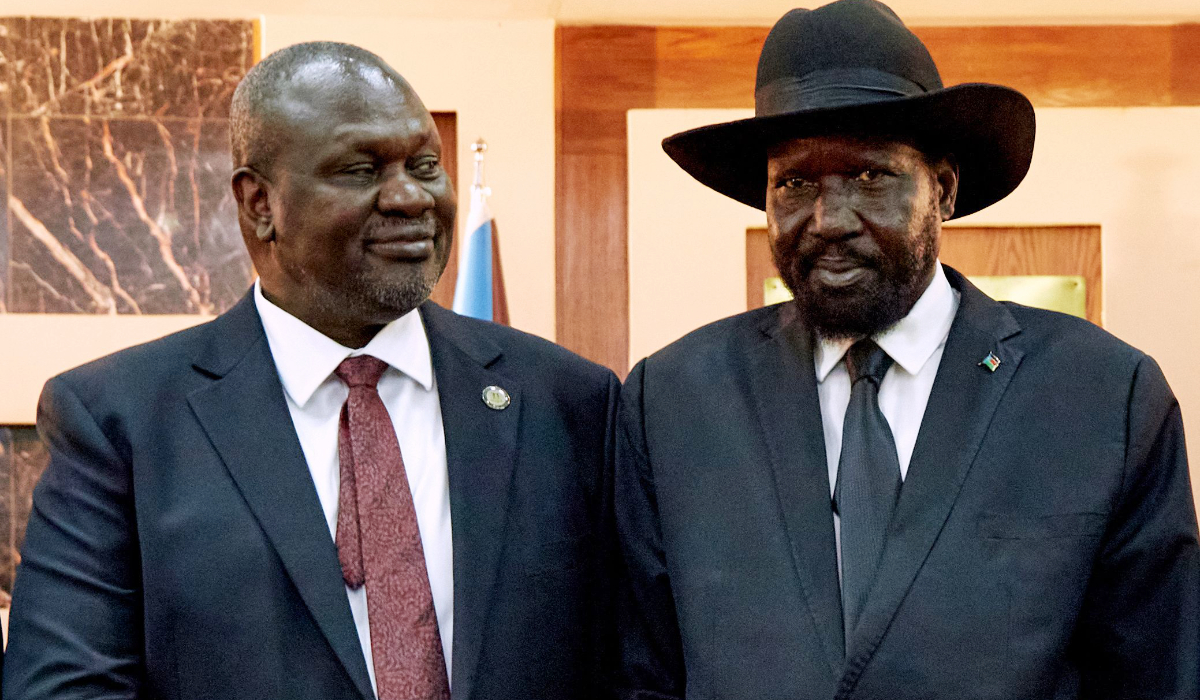
South Sudanese President Salva Kiir (R) shakes hands with First Vice President Riek Machar as he attends his swearing-in ceremony at the State House in Juba,on February 22, 2020, South Sudan. (AFP)
Short Url
Updated 15 September 2025
Follow

South Sudan opposition calls for mobilization of forces for ‘regime change’

South Sudan opposition calls for mobilization of forces for ‘regime change’
  • South Sudan gained independence from Sudan in 2011 but was quickly plunged into a devastating conflict between Kiir and Machar

JUBA: South Sudan’s opposition on  Monday called for an armed mobilization to carry out “regime change” in response to plans to put its leader on trial for treason and crimes against humanity.
A fragile power-sharing deal between President Salva Kiir and his long-time rival, Riek Machar, has been unraveling for months, threatening to return the young nation to a civil war that left 400,000 dead in the 2010s.
On Thursday, Machar was charged with murder, treason and crimes against humanity and stripped of his position as first vice president in the unity government, having already spent months under house arrest.

BACKGROUND

A fragile power-sharing deal between President Salva Kiir and his long-time rival, Riek Machar, has been unraveling for months.

He was accused of ordering an ethnic militia’s attack on a military base in March that the government said killed more than 250 soldiers.
Machar’s faction denies the charges and says they are part of Kiir’s efforts to sideline the opposition and consolidate power.
“The current regime ... is a setup of dictatorship, peace spoilers and state capture that is holding power illegally and by violence,” his party said in a statement, signed by acting chairman Oyet Nathaniel Pierino and shared on social media.
The party and its armed forces “shall work to effect in the Republic of South Sudan a regime change,” the statement said, calling on all supporters “to report for National Service in defense of the citizens and the country.”
South Sudan gained independence from Sudan in 2011 but was quickly plunged into a devastating conflict between Kiir and Machar.
The five-year war ended with a peace deal in 2018 but attempts by the international community to ensure a democratic transition have failed.
Elections due to have taken place in December 2024 were again postponed to 2026 and the two sides have not merged their armed forces.
Daniel Akech, a senior analyst on South Sudan for the International Crisis Group, said Monday’s mobilization call was not a major event in itself since Machar’s supporters were already mobilized.
“It’s more of a political statement,” he said, adding that Machar’s faction also lacked the “capacity” to seriously challenge the government.
But it serves as a “red warning” to global partners who thought the power-sharing deal could still be salvaged, he said.
The attack on the military base in March took place in Upper Nile State, one of Machar’s strongholds, by a loose band of fighters from his ethnic Nuer community known as the White Army.
But Machar’s supporters dismiss the charges against him and blame the government for destroying the peace deal.
The government “has been arresting senior members of the (opposition). It has been waging war against us,” Pal Mai Deng, a spokesman for Machar’s faction, told AFP.
With Machar “being forced to appear before a kangaroo court and imposing charges against him, (it) is a clear indication that the SPLM-IG has chosen instability over peace,” he added.
The United Nations Mission in South Sudan called in a statement on “the parties to work together to resolve political deadlocks, reduce violence and recommit to the full implementation of the” power-sharing agreement.


Truckers defy death to supply militant-hit Mali with fuel

Truckers defy death to supply militant-hit Mali with fuel
Updated 3 sec ago
Follow

Truckers defy death to supply militant-hit Mali with fuel

Truckers defy death to supply militant-hit Mali with fuel
TENGRELA: Tanker driver Baba steeled himself for yet another perilous journey from Ivory Coast to Mali loaded up with desperately needed fuel — and fear.
“You never know if you’ll come back alive,” he said.
Even before they hit the road, the mere mention of a four-letter acronym is enough to scare Baba and his fellow drivers.
JNIM, the Al-Qaeda-linked Group to Support Islam and Muslims, known by its Arabic acronym, declared two months ago that no tanker would cross into Mali from any neighboring country.
Hundreds of trucks carrying goods from the Ivorian economic hub Abidjan or the Senegalese capital Dakar have since been set on fire.
The JNIM’s strategy of economic militant aims to choke off Mali’s capital Bamako and the ruling military junta, which seized power in back-to-back coups in 2020 and 2021.
The fuel blockade has made everyday life in the west African country all but impossible.
“By economically strangling the country, the JNIM is looking to win popular support by accusing the military government of incompetence,” Bakary Sambe from the Dakar-based Timbuktu Institute think tank said.
On top of that, Mali has a “structural problem of insecurity,” he added.
Despite it all, dozens of tanker truckers still brave the roads, driven on by “necessity” and “patriotism,” they say.
AFP spoke to several along the more than 300-kilometer (185-mile) road between the northern Ivorian towns of Niakaramandougou and Tengrela, the last one before the Malian border.

- Dying ‘for a good cause’ -

“We do it because we love our country,” Baba, whose name AFP has changed out of security concerns, said.
“We don’t want Malians to be without fuel,” added the 30-year-old in a Manchester United shirt.
Taking a break parked up at Niakaramandougou, five hours from the border, Mamadou Diallo, 55, is similarly minded.
“If we die, it’s for a good cause,” he confided.
Further north at Kolia, Sidiki Dembele took a quick lunch with a colleague, their trucks lined up on the roadside, engines humming.
“If the trucks stop, a whole country will be switched off,” he said, between mouthfuls of rice.
Two years ago, more than half of the oil products exported by Ivory Coast went to Mali.
Malian trucks load up at Yamoussoukro or Abidjan and then cross the border via Tengrela or Pogo, traveling under military escort once inside Mali until their arrival in Bamako.
Up to several hundred trucks can be escorted at a time, but even with the military by their side, convoys are still frequently targeted, especially on two key southern axes.
“Two months ago, I saw militants burn two trucks. The drivers died. I was just behind them. Miraculously they let me through,” Moussa, 38, in an oil-stained red polo T-shirt, said.
Bablen Sacko also narrowly escaped an ambush.
“Apprentices died right behind us,” he recalled, adding firmly: “Everyone has a role in building the country. Ours is to supply Mali with fuel. We do it out of patriotism.”


- ‘Risk premium’ -

But their pride is mixed with bitterness over their working conditions.
“No contract, no insurance, no pension. If you die, that’s that. After your burial, you’re forgotten,” Sacko said.
With monthly pay of barely 100,000 CFA francs ($175, 152 euros) and a small bonus of 50,000 CFA francs per trip, Yoro, one of the drivers, has called for a risk premium.
Growing insecurity has prompted some Ivorian transport companies to halt road travel into Mali.
In Boundiali, Broulaye Konate has grounded his 45-strong fleet.
“I asked a driver to deliver fertilizer to Mali. He refused. The truck is still parked in Abidjan,” he said.
Ivorian trucker Souleymane Traore has been driving to Mali for seven years but said lately “you take to the road with fear in your heart.”
He recently counted 52 burnt-out tankers on his way back to Ivory Coast and another six on a further stretch of road.
Malian Prime Minister Abdoulaye Maiga has referred to the fuel that manages to get through as “human blood,” in recognition of the soldiers and drivers killed on the roads.
Analyst Charlie Werb from Aldebaran Threat Consultants said he did not anticipate the fuel situation easing in the coming days but said the political climate was more uncertain.
“I do not believe JNIM possesses the capability or intent to take Bamako at this time, though the threat it now poses to the city is unprecedented,” he added.