Lebanese president calls for unity on death anniversary of Hezbollah leaders

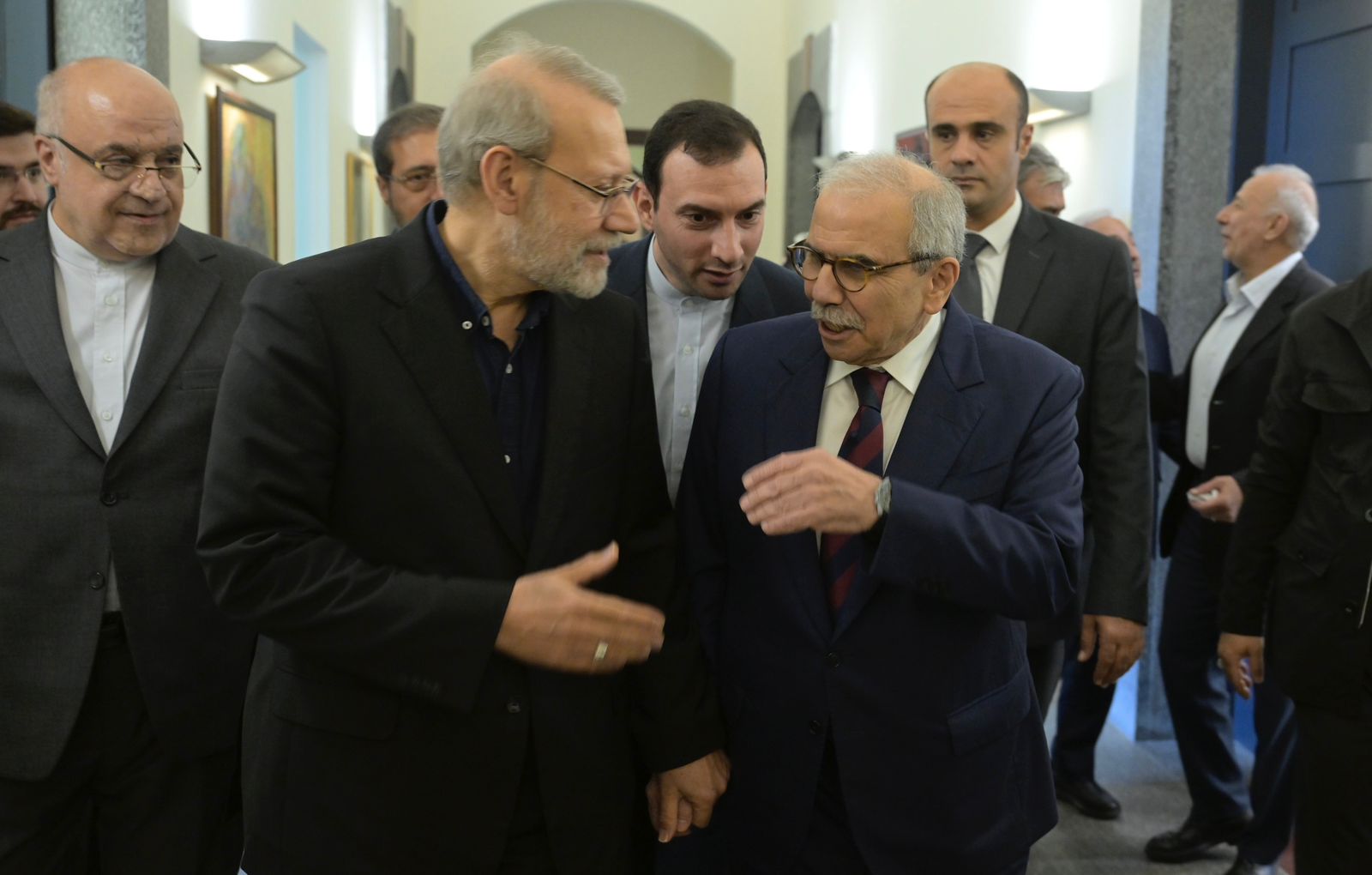
Lebanese President Joseph Aoun on Saturday urged citizens to “safeguard the sacrifices made by our people” as he led a ceremony to mark the first anniversary of the deaths of Hezbollah leaders Hassan Nasrallah and Hashem Safieddine. (Supplied)
Short Url
Updated 27 September 2025
Follow

Lebanese president calls for unity on death anniversary of Hezbollah leaders

Lebanese president calls for unity on death anniversary of Hezbollah leaders
  • Joseph Aoun urges citizens to ‘rally around a unified, strong and just state’
  • Event attended by head of Iran’s Supreme National Security Council

BEIRUT: Lebanese President Joseph Aoun on Saturday urged citizens to “safeguard the sacrifices made by our people” as the country marked the first anniversary of the deaths of Hezbollah leaders Hassan Nasrallah and Hashem Safieddine.

The militant group held a memorial event where an Iranian delegation, led by the head of the Supreme National Security Council, Ali Larijani, was present alongside large numbers of Hezbollah supporters waving the organization’s flags with Lebanese, Iranian and Palestinian banners.

The ceremony followed days of political friction, during which time Hezbollah projected images of the slain leaders, who were assassinated during the group’s war with Israel, onto Raouche Rock without authorization.

The move prompted protests from lawmakers in Beirut and a government directive from Prime Minister Nawaf Salam requiring official approval for such displays.

Just back from the UN General Assembly in New York, Aoun called for cohesion in honoring the legacy of victims of the war and urged the Lebanese people to “rally around a unified, strong and just state.”

His statements came as the government seeks to disarm Hezbollah and other non-state organizations.

“Today’s threats to Lebanon, whether security related, political or economic, can only be addressed through national unity while rejecting division,” he said.

He stressed the need for “one state, one army and constitutional institutions that uphold sovereignty and dignity.”

Lebanese authorities restricted Iranian participation at the event by refusing landing permits to two aircraft carrying would-be attendees — a decision influenced by Israeli warnings against Iranian flights to Beirut during the recent hostilities.

In a meeting with Larijani, Parliament Speaker Nabih Berri and Salam stressed the need to respect Lebanese sovereignty.

“Lebanese-Iranian relations must be built on mutual respect for both nations’ sovereignty and non-interference in domestic affairs,” Salam said.

Larijani did not respond to Salam’s comments but after talks with Berri — a Hezbollah ally — expressed Tehran’s desire for “all regional nations to be strong and independent.”

He urged countries in the region to work closely together amid “Israeli conspiracies.”

“Even if past disagreements existed, (countries) should minimize these differences and base their relationships on cooperation,” he said.

“Lebanon, despite its small geographical area, is distinguished by the greatness and strength of its people and is today considered an impregnable trench against the Israeli entity.”

When asked about the threat of an Israeli military strike against Iran, Larijani said Tehran was prepared for all possibilities.

“I do not believe the Israelis would act so foolishly. However, if they do, they will face a strong response,” he said.


UN secretary-general warns that war in Sudan is ‘spiraling out of control’

UN secretary-general warns that war in Sudan is ‘spiraling out of control’
Updated 58 min 35 sec ago
Follow

UN secretary-general warns that war in Sudan is ‘spiraling out of control’

UN secretary-general warns that war in Sudan is ‘spiraling out of control’
  • UN chief offers stark warning about El-Fasher and calls for an immediate ceasefire in the two-year conflict

DUBAI: The United Nations secretary-general warned Tuesday that the war in Sudan is “spiraling out of control” after a paramilitary force seized the Darfur city of El-Fasher.

Speaking at a UN summit in Qatar, Antonio Guterres offered a stark warning about El-Fasher and called for an immediate ceasefire in the two-year conflict that’s become one of the world’s worst humanitarian crises.

“Hundreds of thousands of civilians are trapped by this siege,” Guterres said. “People are dying of malnutrition, disease and violence. And we are hearing continued reports of violations of international humanitarian law and human rights.”

He added that there also were “credible reports of widespread executions since the Rapid Support Forces entered the city.”

UN officials have warned of a rampage by the paramilitary Rapid Support Forces after it took over the city of El-Fasher, reportedly killing more than 450 people in a hospital and carrying out ethnically targeted killings of civilians and sexual assaults.

The RSF has denied committing atrocities, but testimonies from those fleeing, online videos and satellite images offer an apocalyptic vision of the aftermath of their attack. The full scope of the violence remains unclear because communications are poor in the region.

The RSF besieged El-Fasher for 18 months, cutting off much of the food and other supplies needed by tens of thousands of people. Last week, the paramilitary group seized the city.

Asked if he thought there was a role for international peacekeepers in Sudan, Guterres said it was important to “gather all the international community and all those that have leverage in relation to Sudan to stop the fighting.”

“One thing that is essential to stop the fighting is to make sure that no more weapons come into Sudan,” he said. “We need to create mechanisms of accountability because the crimes that are being committed are so horrendous.”

The war between the RSF and the Sudanese military has been tearing apart Sudan since April 2023. More than 40,000 people have been killed, according to UN figures, but aid groups say the true death toll could be many times higher. The fighting has driven more than 14 million people from their homes and fueled disease outbreaks. Meanwhile, two regions of war-torn Sudan are enduring a famine that is at risk of spreading.

“It is clear that we need a ceasefire in Sudan,” Guterres said. “We need to stop this carnage that is absolutely intolerable.”