Saudi Arabia highlights mining reforms and investment drive at Peru conference

Saudi Arabia highlights mining reforms and investment drive at Peru conference
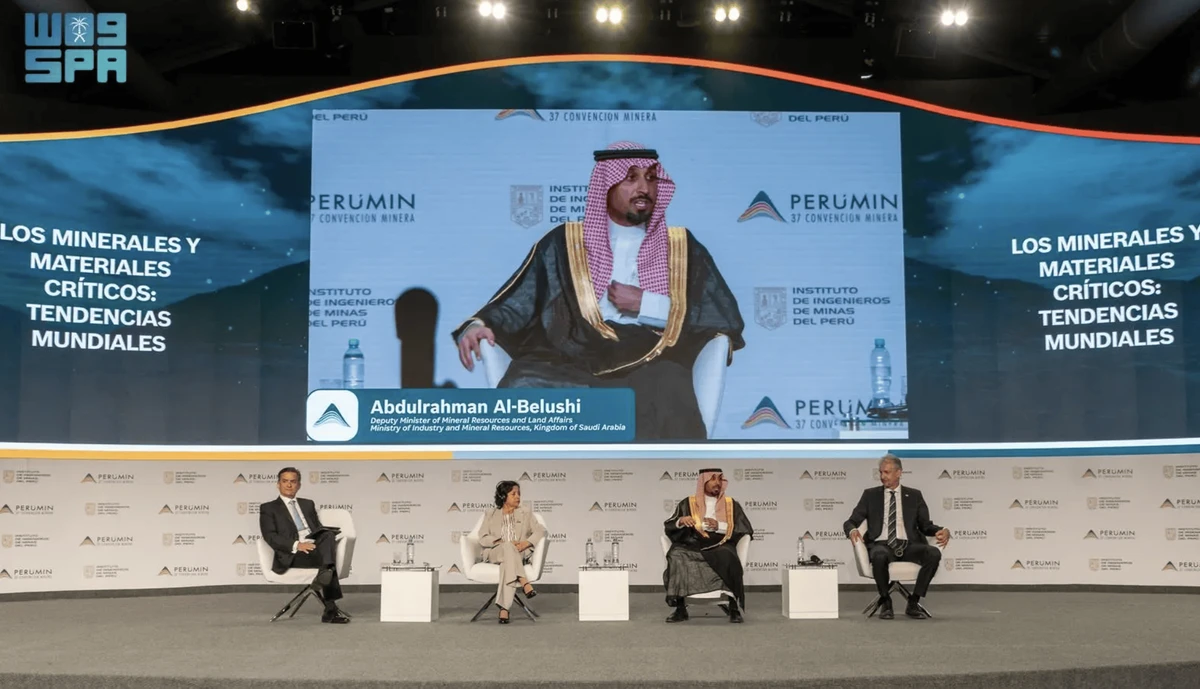
The Saudi delegation emphasized the Kingdom’s interest in expanding strategic partnerships with Latin American nations, especially Peru. SPA
Short Url
Updated 06 October 2025
Follow

Saudi Arabia highlights mining reforms and investment drive at Peru conference

Saudi Arabia highlights mining reforms and investment drive at Peru conference

RIYADH: Saudi Arabia showcased its mining reforms and investment opportunities at the PERUMIN 37 Mining Conference in Arequipa, Peru, aiming to position the Kingdom as a global hub for minerals and downstream processing.

A delegation comprising representatives from the Ministry of Industry and Mineral Resources, the Saudi Geological Survey, and the Saudi Mining Services Co. highlighted Saudi Arabia’s commitment to sustainable mineral resource development, the Saudi Press Agency reported.

The group also emphasized the upcoming fifth edition of the Future Minerals Forum, scheduled for January 2026 in Riyadh. 

The Kingdom’s participation comes amid a sharp rise in mining exports, which have surged by about 80 percent due to increased production of key minerals including phosphate, iron, aluminum, copper, and gold.  

According to a report in August, current and planned investments in the sector are estimated at SR180 billion ($48 billion), as Saudi Arabia intensifies its strategy to position itself as a global hub for mineral resources.  

This expansion aligns with broader government efforts to boost exports and attract high-quality foreign investment into downstream processing industries. 

During PERUMIN 37, Abdulrahman Al-Belushi, deputy minister for Mining Resource Development, stated that Saudi Arabia and Peru share a strong commitment to leveraging mining as a driver of economic growth.  

“He explained that Saudi Arabia’s participation in PERUMIN 37 reflects its belief in the importance of cooperation and knowledge exchange to support mineral supply chains, serving the goals of global digital and energy transitions,” the SPA report added. 

Al-Belushi reiterated the Kingdom’s strategic objective of transforming mining into a third pillar of the national economy under Vision 2030.  

He noted that Saudi Arabia holds mineral resources valued at over SR9.4 trillion and has enacted policies to enhance investment attractiveness. 

These include the development of integrated infrastructure from mine to market and the pursuit of international partnerships to strengthen global supply chain resilience. 

Recent initiatives presented by the Saudi delegation include the launch of mining exploration license rounds via the digital Tadween platform, which ensures transparency and equal opportunity for investors.  

The ministry has also introduced the Mining Exploration Enablement Program to support companies with valid licenses for less than five years, offering up to SR7.5 million per project to mitigate early-stage investment risk. 

“The Kingdom also offers competitive incentives through its mining investment regime, including full foreign ownership, in addition to financing provided by the Industrial Development Fund to support mining exploration,” Al-Belushi said, as reported by SPA. 

He highlighted the National Geological Database, which compiles over 80 years of geological data, alongside a comprehensive regional survey program to deepen knowledge of the Arabian Shield. 

The Saudi delegation emphasized the Kingdom’s interest in expanding strategic partnerships with Latin American nations, especially Peru — a leading global producer of copper, silver, and zinc. 

Discussions between Saudi and Peruvian officials explored collaboration in exploration technologies, artisanal mining challenges, and joint investments to strengthen global supply chains. 

On the sidelines of the event, the Saudi team held several bilateral meetings with leading Peruvian and international exploration and mining companies to showcase investment opportunities in Saudi Arabia and promote available incentives. 

Philippines in talks to add flights, develop joint tourism promotion with Saudi Arabia

Philippines in talks to add flights, develop joint tourism promotion with Saudi Arabia
Updated 14 November 2025
Follow

Philippines in talks to add flights, develop joint tourism promotion with Saudi Arabia

Philippines in talks to add flights, develop joint tourism promotion with Saudi Arabia
  • Philippines developing halal travel as part of its tourism strategy
  • Saudi market is one of Philippines’ most dynamic and high-value markets

MANILA: Philippine officials are in talks with Saudi tourism players to add more flights between their countries and develop a joint travel promotion campaign, the department of tourism said as Manila seeks to strengthen tourism ties with the Kingdom. 

Tourism Undersecretary Verna C. Buensuceso led the Philippine delegation at the 26th UN Tourism General Assembly earlier this month in Riyadh. On the sidelines of the event, she met with Saudia Airlines’ sales general manager, Abdulrahman Alabdulwahab, and Riyadh Air Vice President for Network Planning and Partnerships Wolfgang Reuss.  

They held “separate discussions … on the expansion of air connectivity and the development of joint tourism promotion initiatives,” the tourism department said in a statement. 

With tourism being a key sector for the Philippines, its government has been trying to attract more Middle Eastern visitors by creating Muslim-friendly destinations and ensuring that they have access to halal products and services. 

Saudi travelers are among those contributing to a recent surge in international tourism arrivals from countries in the Middle East and the GCC.

“Saudi Arabia has emerged as one of the world’s fastest-growing outbound tourism markets, driven by a young and affluent population with high disposable income for travel. It represents one of our most dynamic and high-value markets in the Middle East,” Tourism Secretary Christina Frasco said in a statement. 

“As a destination, the Philippines continues to gain ground among Saudi travelers, recognized for its warm hospitality, competitive value, English-speaking service culture, and growing halal-friendly tourism infrastructure.”

Tourism receipts from the Kingdom were more than $37 million last year, a 46 percent rise from 2023, ministry data showed. While Manila continues to be a top destination for Saudi travelers, Cebu, Boracay, and Pampanga are also among their top choices. 

The predominantly Catholic country — where Muslims constitute about 10 percent of the almost 120 million population — last year also launched a beach dedicated to Muslim women travelers in Boracay, the country’s top resort island and one of the world’s most popular.

Last month, the Philippines launched a “Muslim-Friendly Travelogue,” an official guide for tourists planning trips to the country, covering its Islamic history and heritage, recommendations for destinations, and halal culinary products available in all parts of the archipelago.

In 2024, the Philippines was recognized as a rising Muslim-friendly non-Organization of Islamic Cooperation Destination by the Mastercard-CrescentRating Global Muslim Travel Index, an annual report benchmarking destinations in the Muslim travel market. 

Known for its white-sand beaches, diving spots and rich culture, the Philippines received a similar recognition in 2023.