- Trump suggests United States could ditch USMCA trade agreement
- Canadian government plays down chances of imminent trade deal
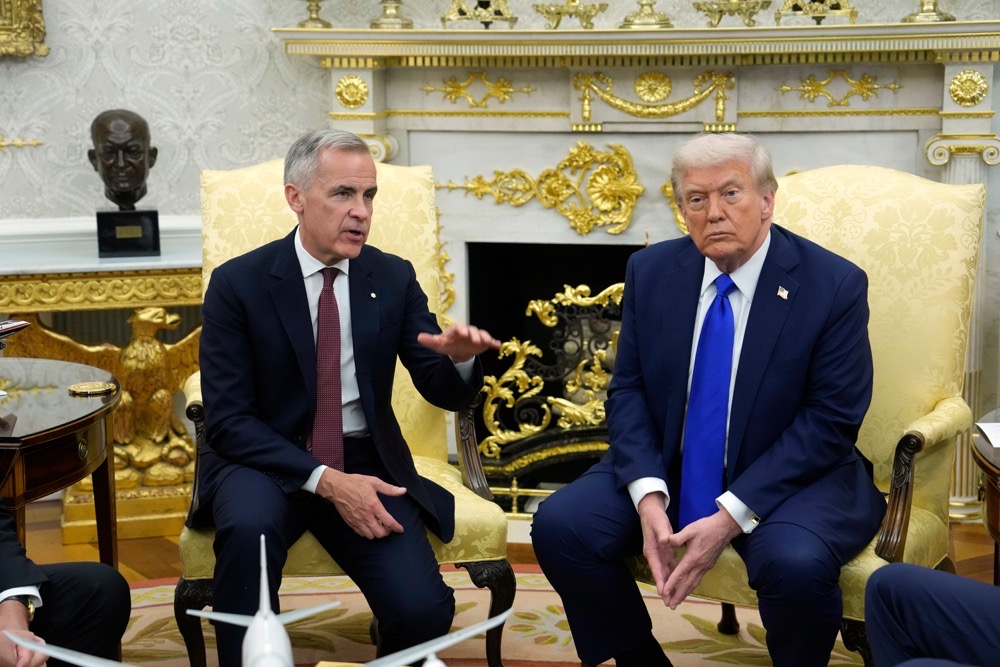
WASHINGTON: US President Donald Trump on Tuesday promised to treat Canada fairly in talks over painful US tariffs on Canadian goods, but was less committed about a continental trade deal that also includes Mexico.
“I think they’re going to walk away very happy,” Trump said, referring to Canada, in Oval Office remarks ahead of a meeting with Prime Minister Mark Carney. “We’re going to treat people fairly. We’re going to especially treat Canada fairly.”
The Canadian minister in charge of bilateral trade later said the two sides had made progress during what he called a successful, positive, and substantive conversation with Trump, while making clear any potential deals were not close.
“I’m happy and content because I think we have a momentum now that we did not have when we woke up this morning ... but we have not yet finished our work,” Dominic LeBlanc told reporters.
LeBlanc said officials could meet again as soon as Tuesday evening.
Carney, who made his second visit to the White House in five months, this time at Trump’s request, faces increasing pressure to address US tariffs on steel, autos, and other goods.
“ left us very much with the sense that there is a desire to see how we can, starting with the steel and aluminum sectors, structure something that would be in the economic and security interests of both countries,” said LeBlanc, who had said beforehand that a breakthrough was unlikely.
Trump, complaining “we’re the king of being screwed” by trading partners, said Washington would continue to target some Canadian exports.
Carney initially responded to tariffs by pushing for a separate trade and security deal with the United States, but as talks stalled, he focused on a review of the US-Canada-Mexico free trade deal scheduled for 2026.
“We can renegotiate it, and that would be good, or we could just do different deals,” said Trump. “We might make deals that are better for the individual countries.”
Asked for his preference, he replied: “I don’t care. I want to make whatever the best deal is for this country, and also very much with Canada in mind.”
In March, Carney took over as prime minister from Justin Trudeau, who had famously bad relations with Trump.
Carney and Trump have since underlined how well they get on.
“From the beginning, I liked him, and we’ve had a good relationship,” Trump said.
“We have natural conflict. We also have mutual love ... you know we have great love for each other,” he added.
In response, Carney called Trump a transformative president. Trump interrupted Carney as he listed the president’s accomplishments to add: “the merger of Canada and the United States,” drawing laughter from reporters before adding, “I’m only kidding.” Carney, also laughing, responded: “That wasn’t where I was going.”
Canada sends 75 percent of all exports to the United States and is vulnerable to US trade action. Trump said the two countries had agreed to work together on a missile defense shield dubbed Golden Dome.
“There are areas where we compete, and it’s in those areas where we have to come to an agreement that works. But there are more areas where we are stronger together, and that’s what we’re focused on,” said Carney. The prime minister last visited the Oval Office in May, when he bluntly said Canada would never be for sale in response to Trump’s repeated threat to purchase or annex Canada. Since then, he has made numerous concessions, including dropping some counter-tariffs and scrapping a digital services tax aimed at US tech companies.
While most Canadian exports enter the United States duty-free under the USMCA, tariffs have pummeled the steel, aluminum, and auto sectors and a number of small businesses.
Doug Ford, premier of the Canadian industrial province of Ontario, reiterated calls for Carney to be prepared to be tougher with Trump.
“We seem to be weakening our case by continuously pulling off tariffs. I’d take a different approach — try to get a deal. If you can’t, we got to hit him back hard and never stop hitting him back hard,” he told reporters.
Canada’s main opposition leader, Pierre Poilievre, criticizes Carney’s approach, noting the prime minister’s earlier pledge to “negotiate a win” by July 21. He said on Monday it did not look like Carney would accomplish much.
The trade war is straining bilateral ties. Ford in March threatened to cut off electricity exports to New York state and has ordered provincial liquor stores to boycott US alcohol.
Canadians are also shunning travel to the United States. Trump, though, seemed unconcerned.
“I think the people of Canada, they will love us again. Most of them still do,” he said.