Ukraine strikes put pressure on Russian oil

Ukraine strikes put pressure on Russian oil
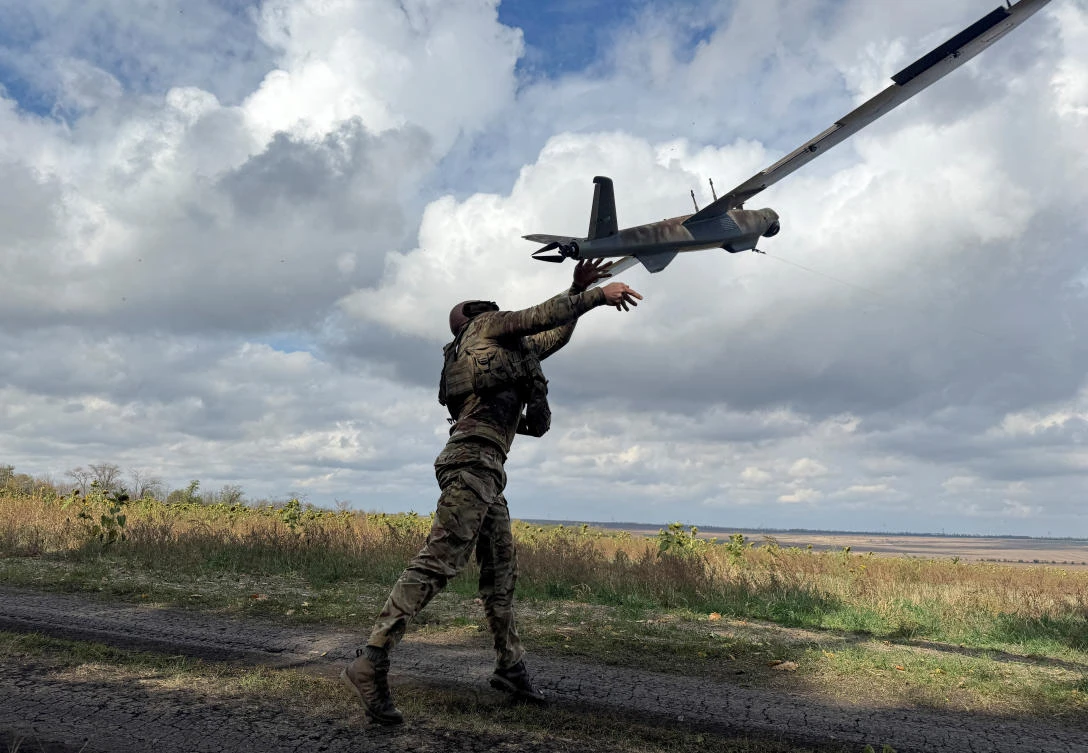
Above, a Ukrainian serviceman launches a reconnaissance drone near the frontline town of Pokrovsk in Donetsk region on Oct. 6, 2025. (Reuters)
Short Url
Updated 08 October 2025
Follow

Ukraine strikes put pressure on Russian oil

Ukraine strikes put pressure on Russian oil
  • Russia is the world’s third-largest producer and second-biggest exporter of crude oil
  • Oil and gas revenues represented about 30 percent of its budget in 2024

LONDON: Ukraine is intensifying strikes on Russian refineries and oil infrastructure, with more than 30 attacks since early August, aimed at weakening Moscow’s ability to finance war against its neighbor.
Current consequence?
Russia is the world’s third-largest producer and second-biggest exporter of crude oil. Oil and gas revenues represented about 30 percent of its budget in 2024, or largest source of state funds according to the Oxford Institute for Energy Studies.
Kyiv’s attacks have so far been “quite effective,” with Russian refinery production rates having “dropped around 10 percent,” Homayoun Falakshahi, analyst at energy research group Kpler, told AFP.
Faced with a risk of shortages, Moscow recently restricted exports of petroleum products until the end of the year and extended a ban on gasoline exports.
Rystad Energy analyst Janiv Shah said that Russia’s refinery production dropped to an average of 4.9 million barrels per day by mid-September, down about 400,000 bpd compared to the first half of 2025.
The scarcity of Russian refined products has significantly widened the gap between the price of a barrel of Russian crude oil and that of refined products.
The impact on pump prices is already being felt. As of September 1, retail gasoline cost 6.7 percent more compared to the end of 2024, according to Russia’s official statistics agency Rosstat.
This despite a sharp drop in the price of a barrel of crude oil over the same period.
Long-term impact?
Russia’s situation risks worsening because damaged infrastructure typically takes an “extended time” to return to normal operations, Shah explained.
This at a time when revenue from Russian crude oil is primarily affected by falling global prices as markets expect abundant supplies in the coming months.
SEB bank analyst Bjarne Schieldrop believes the “situation will likely become worse... as Ukraine becomes better at attacking Russian refineries,” forecasting an end to exports of all Russian oil products as well as the introduction of domestic rationing.
The US envoy to Ukraine, Keith Kellogg, has floated the possibility of long-range strikes by Ukraine against Russia using American weapons.
In trying to export some of the oil intended for its refineries Russia has come up against difficult logistical problems, while the number of countries willing to import more of its crude is limited.
Strikes versus sanctions?
So far, international sanctions aimed at weakening Moscow “are not working,” according to Adi Imsirovic, director of the Surrey Clean Energy consultancy.
Delayed implementation of certain sanctions gave Russia’s President Vladimir Putin time “to build a parallel trading system,” he said.
Washington’s doubling of tariffs on many of India’s products has failed to curb the country’s purchase of Russian crude.
On the other hand, with the withdrawal of Western oil companies from Russia, investment in the nation’s energy infrastructure has declined considerably, limiting its ability to increase crude output over the coming years.
Russia, which produces “around 9.25 million barrels per day,” according to Falakshahi, has a “maximum production capacity of 9.45 mbpd” compared to around 10 mbpd before the war.
Russia’s Kaliningrad puts on brave face as isolation bites

Russia’s Kaliningrad puts on brave face as isolation bites
Updated 09 November 2025
Follow

Russia’s Kaliningrad puts on brave face as isolation bites

Russia’s Kaliningrad puts on brave face as isolation bites
  • The Baltic states surrounding Kaliningrad, all NATO members, have been some of Ukraine’s staunchest backers since Moscow launched its offensive in February 2022
KALININGRAD: Standing in the center of rainy Kaliningrad, the isolated Russian exclave surrounded by NATO countries, Russian factory worker Alexander felt confident.
Economically hit by being cut-off from its EU neighbors and physically isolated from the rest of Russia, officials and locals are putting on a brave face amid claims they are under siege from neighbors Poland and Lithuania.
The Baltic states surrounding Kaliningrad, all NATO members, have been some of Ukraine’s staunchest backers since Moscow launched its offensive in February 2022.
Poland and Lithuania “want to show off, display their strength, reinforce their borders,” said Alexander, 25, who did not give his surname.
But his city is “certainly not one that surrenders,” he added, taking pride that Russia had far more weapons than its smaller neighbors.
His defiance echoes the Kremlin’s relentless criticism of NATO.
Russian leader Vladimir Putin has for years accused the military alliance of breaking an apparent promise not to expand eastwards.
In June, he said Russians had been “tricked, duped on the subject of NATO’s non-expansion.”
Ukraine and the West reject that narrative as a pretext advanced by Putin to justify the offensive, which has become Europe’s largest conflict since World War II.
In Russia’s neighbors, the intensity of the confrontation is palpable.
Poland and Lithuania, which have a land border with Kaliningrad, have virtually closed their borders for Russians, bar limited exceptions.
In recent weeks, Estonia and Lithuania have reported Russian jets violating their airspace.
And Poland’s new president Karol Nawrocki said he believed Russia was “ready to hit at other countries” after NATO scrambled jets to shoot down Russian drones flying through Polish airspace.

- ‘Let them bark’ -

Kaliningrad — a previously German city called Konigsberg until it became Soviet after WWII — is strategic for Moscow.
It is home to Russia’s Baltic Fleet, as well as Iskander ballistic missiles, the same kind that Moscow regularly fires on Ukraine.
The region’s governor did not respond to an AFP request for an interview.
The Kremlin’s hard-line messages run deep with many.
Marina, a 63 year-old who works in a clothes shop, mocked the region’s EU neighbors, saying they should focus on their own problems.
“Let them bark,” she said. “I am 100 percent protected in Kaliningrad. I am not scared of NATO.”
Showing Russian tourists round the tomb of philosopher Immanuel Kant, guide Anna Dmitrik was relieved that Kaliningrad had not been targeted by the Ukrainian retaliatory drone attacks that have hit many other regions.
“It’s calm here. We are not scared for now,” she said, adding: “I don’t know what will happen next.”
Still, reminders of the war are everywhere.
Banners encouraged men to sign up to fight in Ukraine for Russia’s “victorious army.” Giant Zs — the symbol of Moscow’s forces in Ukraine — decorated buildings.

- ‘Life was better then’ -

But behind the defiance, Kaliningrad’s locals struggled with the feeling of being more isolated, and worse off, than before February 2022.
Banned from EU airspace, planes connecting the exclave to the rest of Russia must take a long detour northwards via the Gulf of Finland.
A train linking it to Moscow is physically sealed as it crosses Lithuania, with Russian passengers requiring a visa or transit permit to board.
And Vilnius has closed its border with key Russian ally Belarus for at least a month over the intrusion of balloons carrying thousands of illegal cigarettes into the EU state.
Before “you could go to Poland to shop or just take a walk. Buses and trucks were running,” said mechanic Vitaly Tsypliankov, 48.
“Life was better then,” he added.
“Now everything is closed. Everything is more expensive, absolutely everything has become costlier.”
Inflation has surged across Russia amid the Ukraine offensive, but complicated logistics hit Kaliningrad especially hard.
While Poland’s border is technically open, only Russians with EU residency can enter. Traffic into the country has virtually stopped.
Most petrol stations near the border are empty if not shut down.
The giant Baltia shopping mall, on the road to the airport, is sparsely frequented.
“Kaliningrad’s economic situation is very bad,” said Irina, a saleswoman there.
“Logistics are very complicated to bring in products from (the rest of) Russia,” she said, puffing on a cigarette.
“Everything is more expensive.”