Jordan court sentences suspects in rocket, drone plots targeting national security

Jordan court sentences suspects in rocket, drone plots targeting national security
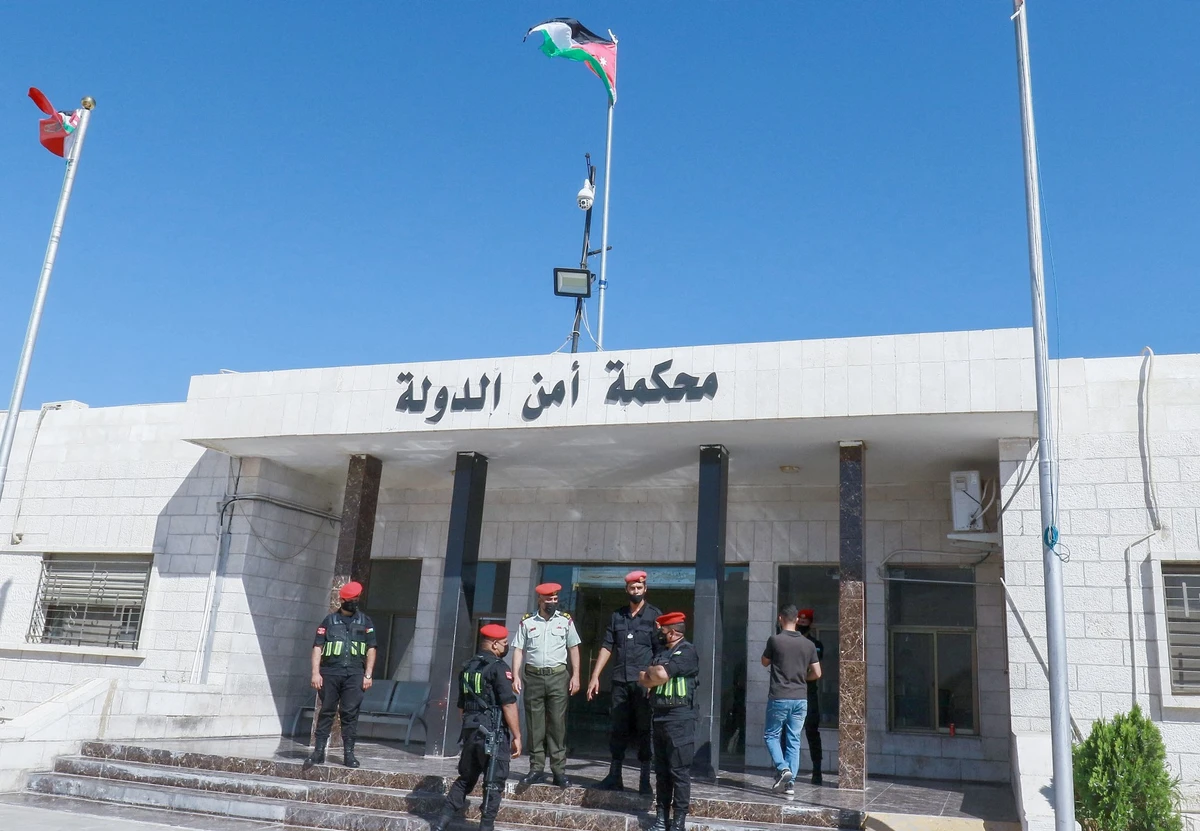
Officers stand guard outside Jordan's State Security Court. (File/AFP)
Short Url
Updated 08 October 2025
Follow

Jordan court sentences suspects in rocket, drone plots targeting national security

Jordan court sentences suspects in rocket, drone plots targeting national security
  • The cases are related to arrests announced by Jordan’s security services in April

AMMAN: Jordan’s State Security Court on Wednesday handed down prison sentences to several defendants convicted in cases linked to plots to manufacture rockets and drones for use inside the country.

The cases are related to arrests announced by Jordan’s security services in April, when 16 people were detained for allegedly planning attacks aimed at destabilizing the kingdom.

The defendants were found guilty of manufacturing weapons for illegal use and of acts that endangered public safety and national security, according to court documents.

In the missile manufacturing case, defendants Abdullah Hisham and Moaz Ghanem were sentenced to 15 years of temporary hard labor, while a third defendant, Mohsen Ghanem, received a sentence of seven and a half years. 

The court said the men had established warehouses in Amman and Zarqa to produce and store short-range rockets, with funding and training from abroad.

In the recruitment case, defendants Marwan Al-Hawamdeh and Anas Abu Awad were sentenced to three years and four months in prison for attempting to recruit individuals for illegal activities and coordinating with foreign parties.

In the training case, defendants Khader Abdel Aziz, Ayman Ajawi, Mohammed Saleh, and Farouk Al-Salman received similar sentences for training others to carry out security-related operations inside Jordan.

In the drone case, the court acquitted four defendants, ruling that prosecutors had not proven criminal intent. The men, Ali Ahmed Qasim, Abdel Aziz Haroun, Abdullah Al-Hadar, and Ahmed Khalifa, were ordered to be released.

The April arrests, announced by the General Intelligence Department, had accused the suspects of forming four interconnected cells that sought to “target national security and sow chaos” using rockets, drones, and explosives. 

Officials said some of the suspects had ties to the Muslim Brotherhood, an allegation the group denied.

International forces in Gaza should ensure Palestinians and Israelis don’t pose threat to each other, Qatar PM tells CNN

International forces in Gaza should ensure Palestinians and Israelis don’t pose threat to each other, Qatar PM tells CNN
Updated 14 min 37 sec ago
Follow

International forces in Gaza should ensure Palestinians and Israelis don’t pose threat to each other, Qatar PM tells CNN

International forces in Gaza should ensure Palestinians and Israelis don’t pose threat to each other, Qatar PM tells CNN
  • Sheikh Mohammed bin Abdulrahman Al-Thani says International Stabilization Force should have clearly defined mandate
  • PM reaffirms: ‘There is no solution except the two-state solution’

DUBAI: International forces to be deployed in Gaza under the US-brokered ceasefire plan should ensure that Palestinians and Israelis do not pose a threat to each other, Qatar’s Prime Minister Sheikh Mohammed bin Abdulrahman Al-Thani told CNN.

Sheikh Mohammed added that the International Stabilization Force should have a clear mandate, which “we are working together with the United States in order to define.”

Speaking to CNN’s Fareed Zakaria, he said: “When we are talking about international presence;… there should be a defined mandate. And we are working together with the United States in order to define the mandate of the international forces. And basically, the international forces’ role should be securing the Palestinians and the Israelis that both of them … don’t pose a threat for each other.”

Under the ceasefire between Hamas and Israel, a coalition of mainly Arab and Muslim nations is expected to deploy forces in the Palestinian territory.

Sheikh Mohammed also spoke about the recent truce violations in Gaza, which he said were “happening every day,” recalling the Jan. 25 ceasefire, which Israel was also accused of violating.

“A lot of Palestinians (were) being killed during that ceasefire,” he said.

“The violations are happening every day. And we have, like we have in the deconfliction room, the operation room that we did together with Egypt and the United States. We register everything over there.

“The attack was really disproportionate and was about to jeopardize the deal. But what we have seen, we have seen that, then both parties, we work together very closely with them in order to make sure that the ceasefire stay intact.” 

Sheikh Mohammed reiterated Qatar’s support for the Palestinian Authority to be the “single agency” that presides over Gaza and the West Bank.

“Right now, there (are) ongoing talks between all the Palestinian factions, including Fatah and the PA, in order to make sure that this technocratic committee, it’s apolitical. It will take care of Gaza in this transition period, and it will be linked somehow to the Palestinian Authority … Once the reforms are in place, the Palestinian Authority should take over the governance in Gaza and the West Bank together,” he said.

“We cannot separate those two units. Those are one unit. Those are the future Palestinian state. Look, Fareed, whatever we do, whatever we say, there are wishful thinking from some politicians, maybe in Israel, that there are other solutions other than the two-state solution. There is no solution except the two-state solution. How can we figure out the formula where two people, they can live side by side together and feel safely?”