Who are the prominent Palestinians held in Israeli jails?

Who are the prominent Palestinians held in Israeli jails?
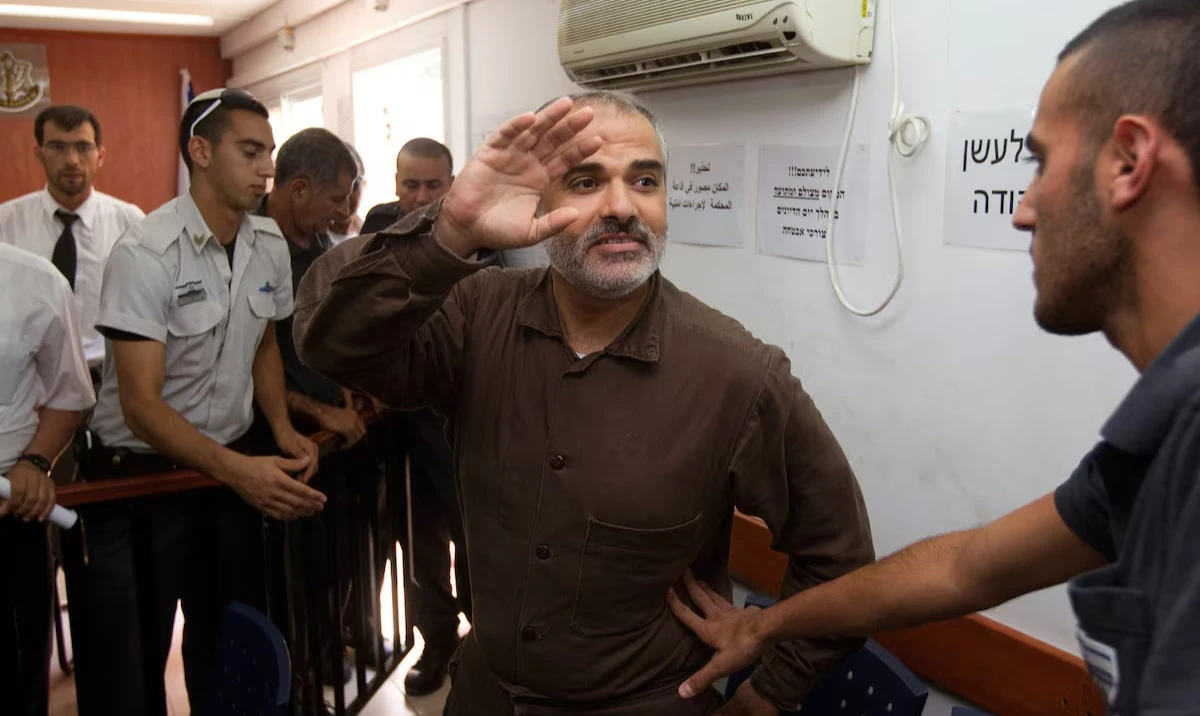
Ibrahim Hamed, who had been on Israel’s wanted list for eight years before his arrest, was the top West Bank commander of the Izz El-Deen Al-Qassam Brigades, the Hamas military wing. (Reuters/File)
Short Url
Updated 08 October 2025
Follow

Who are the prominent Palestinians held in Israeli jails?

Who are the prominent Palestinians held in Israeli jails?

JERUSALEM: A senior Hamas official said on Wednesday that negotiators from his group and Israel had exchanged lists of prisoners and hostages who would be released should a deal be reached during the ongoing Gaza ceasefire talks in Egypt.

Following are some of the most prominent Palestinian prisoners held by Israel. It is not yet clear if any of them will be released:

Abdullah Al-Barghouti: He was sentenced to 67 life terms in 2004 by an Israeli military court for his involvement in a series of suicide attacks in 2001 and 2002 that killed dozens of Israelis.  

A father of three, he was born in Kuwait in 1972. In 1996, he moved with his family to live in Beit Rima village near Ramallah in the West Bank.

Ibrahim Hamed: He was handed 54 life terms after he was arrested in 2006 in Ramallah. He is accused by Israel of planning suicide attacks that killed dozens of Israelis. 

Hamed, who had been on Israel’s wanted list for eight years before his arrest, was the top West Bank commander of the Izz El-Deen Al-Qassam Brigades, the Hamas military wing. 

Hassan Salama: Born in Gaza’s Khan Younis refugee camp in 1971, Salama was convicted of orchestrating a wave of suicide bombings in Israel in 1996 that killed dozens of Israelis and wounded hundreds more. 

He was sentenced to 48 life terms in jail. Salama said the attacks were a response to the assassination of Hamas bombmaker Yahya Ayyash in 1996. Salama was arrested in Hebron in the West Bank later that year.

Marwan Al-Barghouti: A leading member of the Fatah movement that controls the Palestinian Authority, Barghouti is seen as a possible successor to Palestinian President Mahmoud Abbas. 

He made his name as a leader and organizer in both of the Intifadas, or uprisings, waged by the Palestinians in the Israeli-occupied West Bank and Gaza Strip since 1987. 

He was arrested in 2002, charged with orchestrating gun ambushes and suicide bombings and sentenced to five life terms in 2004. 

Ahmed Saadat: Saadat, leader of the Popular Front for the Liberation of Palestine, was accused by Israel of ordering the assassination of Israeli Tourism Minister Rehavam Zeevi in 2001. 

Pursued by Israel, he took shelter at the Ramallah headquarters of Arafat. Under a deal with the Palestinian Authority in 2002, Saadat stood trial in a Palestinian court and was incarcerated at a Palestinian Authority jail, where he was held under international supervision. 

The Israeli military seized Saadat in 2006 following the withdrawal of the foreign monitors, and put him on trial in a military court. He was sentenced to 30 years in jail in 2008.
US sanctions official says time is right to cut Iran’s Hezbollah funding

Updated 36 sec ago
Follow

US sanctions official says time is right to cut Iran’s Hezbollah funding

US sanctions official says time is right to cut Iran’s Hezbollah funding
ISTANBUL: The United States seeks to take advantage of a “moment” in Lebanon in which it can cut Iranian funding to Hezbollah and press the group to disarm, the US Treasury Department’s top sanctions official said.
In a late Friday interview, John Hurley, the undersecretary for terrorism and financial intelligence, said Iran has managed to funnel about $1 billion to Hezbollah this year despite a raft of Western sanctions that have battered its economy.
The US has adopted a “maximum pressure” campaign on Tehran meant to curb its uranium enrichment and regional influence, including in Lebanon where Iran-backed Hezbollah is also weakened after Israel shattered its military power in a 2023-24 war.
Late last week Washington sanctioned two individuals accused using money exchanges to help fund Hezbollah, which is deemed a terrorist group by several Western governments and Gulf states.
“There’s a moment in Lebanon now. If we could get Hezbollah to disarm, the Lebanese people could get their country back,” Hurley said.
“The key to that is to drive out the Iranian influence and control that starts with all the money that they are pumping into Hezbollah,” he told Reuters in Istanbul as part of a tour of Turkiye, Lebanon, the United Arab Emirates and Israel meant to raise pressure on Iran.

IRANIAN ECONOMY HIT BY SNAPBACK UN SANCTIONS
Tehran has leaned on closer ties with China, Russia and regional states including the UAE since September, when talks to curb its disputed nuclear activity and missile program broke down, prompting the reinstatement of United Nations sanctions.
Western powers accuse Iran of secretly developing nuclear weapons capability. Tehran, whose economy now risks hyperinflation and a severe recession, says its nuclear program is wholly for civilian power purposes.
US ally Israel says Hezbollah is trying to rebuild its capabilities and on Thursday carried out heavy airstrikes in southern Lebanon despite a ceasefire deal agreed a year ago.
Lebanon’s government has committed to disarming all non-state groups, including Hezbollah, which was founded in 1982 by Iran’s Revolutionary Guards, spearheaded the Iran-backed “Axis of Resistance,” and opened fire on Israel declaring solidarity with Palestinians when war began in Gaza in 2023.
While the group, which is also a political force in Beirut, has not obstructed Lebanese troops confiscating its caches in the country’s south, it has rejected disarming in full.
Hurley, in his first trip to the Middle East since taking office under President Donald Trump’s administration, has pressed the case against Iran in meetings with government officials, bankers and private sector executives.
“Even with everything Iran has been through, even with the economy not in great shape, they’re still pumping a lot of money to their terrorist proxies,” he said.