61 bodies of migrants recovered in west of Libya’s Tripoli, medics center says

61 bodies of migrants recovered in west of Libya’s Tripoli, medics center says
At least 61 bodies of migrants have been recovered over the past two weeks on the coast west of the Libyan capital Tripoli, a medical center said in a statement on Saturday. (X/@Lyobserver)
Short Url
Updated 11 October 2025
Follow

61 bodies of migrants recovered in west of Libya’s Tripoli, medics center says

61 bodies of migrants recovered in west of Libya’s Tripoli, medics center says
  • The bodies were recovered from the area from Zuwara to Ras Ijdir, near the border with Tunisia
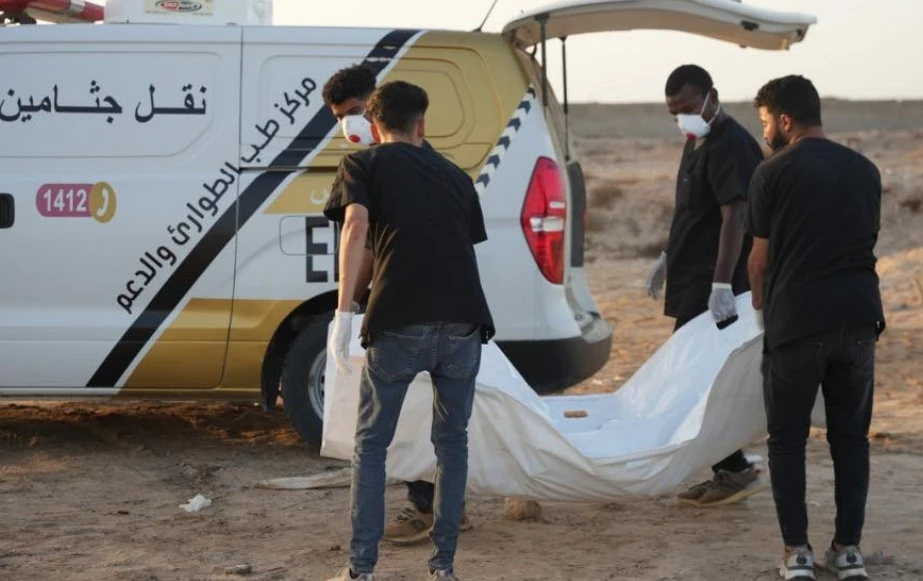
  • Pictures of medics were posted on the center’s verified Facebook page showing them recovering the bodies from the beaches and placing them in white plastic bags

TRIPOLI: At least 61 bodies of migrants have been recovered over the past two weeks on the coast west of the Libyan capital Tripoli, a medical center said in a statement on Saturday.
The Emergency Medicine and Support Center, under the health ministry, said that the bodies were recovered from the area from Zuwara to Ras Ijdir, near the border with Tunisia.
“Remains of three bodies were found in Mellitah and 12 bodies in Zuwara, all of them belonging to irregular migrants,” the center said.

Another group of 34 bodies was recovered in Zuwara, Abu Kammash and Mellitah, the center added.
It added that 12 bodies were buried, but some others were transported to the morgue for autopsies and documentation.
Pictures of medics were posted on the center’s verified Facebook page showing them recovering the bodies from the beaches and placing them in white plastic bags.
In mid-September, the International Organization for Migration (IOM) said at least 50 people had died after a vessel carrying 75 Sudanese refugees caught fire off Libya’s coast.
According to IOM data, a total of 894,890 migrants from 45 nationalities across 100 Libyan municipalities were residing in the country.
Libya has become a transit route for migrants fleeing conflict and poverty to Europe across the Mediterranean since the fall in 2011 of dictator Muammar Qaddafi during a NATO-backed uprising.
UN secretary-general warns that war in Sudan is ‘spiraling out of control’

UN secretary-general warns that war in Sudan is ‘spiraling out of control’
Updated 04 November 2025
Follow

UN secretary-general warns that war in Sudan is ‘spiraling out of control’

UN secretary-general warns that war in Sudan is ‘spiraling out of control’
  • UN chief offers stark warning about El-Fasher and calls for an immediate ceasefire in the two-year conflict

DUBAI: The United Nations secretary-general warned Tuesday that the war in Sudan is “spiraling out of control” after a paramilitary force seized the Darfur city of El-Fasher.

Speaking at a UN summit in Qatar, Antonio Guterres offered a stark warning about El-Fasher and called for an immediate ceasefire in the two-year conflict that’s become one of the world’s worst humanitarian crises.

“Hundreds of thousands of civilians are trapped by this siege,” Guterres said. “People are dying of malnutrition, disease and violence. And we are hearing continued reports of violations of international humanitarian law and human rights.”

He added that there also were “credible reports of widespread executions since the Rapid Support Forces entered the city.”

UN officials have warned of a rampage by the paramilitary Rapid Support Forces after it took over the city of El-Fasher, reportedly killing more than 450 people in a hospital and carrying out ethnically targeted killings of civilians and sexual assaults.

The RSF has denied committing atrocities, but testimonies from those fleeing, online videos and satellite images offer an apocalyptic vision of the aftermath of their attack. The full scope of the violence remains unclear because communications are poor in the region.

The RSF besieged El-Fasher for 18 months, cutting off much of the food and other supplies needed by tens of thousands of people. Last week, the paramilitary group seized the city.

Asked if he thought there was a role for international peacekeepers in Sudan, Guterres said it was important to “gather all the international community and all those that have leverage in relation to Sudan to stop the fighting.”

“One thing that is essential to stop the fighting is to make sure that no more weapons come into Sudan,” he said. “We need to create mechanisms of accountability because the crimes that are being committed are so horrendous.”

The war between the RSF and the Sudanese military has been tearing apart Sudan since April 2023. More than 40,000 people have been killed, according to UN figures, but aid groups say the true death toll could be many times higher. The fighting has driven more than 14 million people from their homes and fueled disease outbreaks. Meanwhile, two regions of war-torn Sudan are enduring a famine that is at risk of spreading.

“It is clear that we need a ceasefire in Sudan,” Guterres said. “We need to stop this carnage that is absolutely intolerable.”