Protests force prison transfer of UK woman held in Iran

Protests force prison transfer of UK woman held in Iran
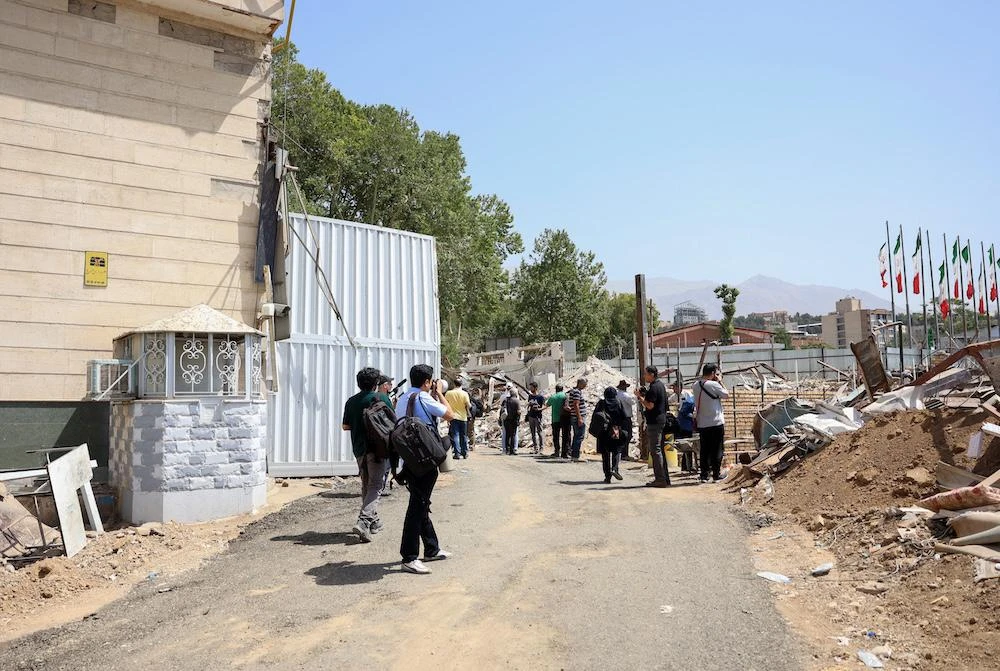
Above, the gate of Evin prison in Tehran on July 1, 2025 after being hit by Israeli air strikes. (AFP)
Short Url
Updated 14 October 2025
Follow

Protests force prison transfer of UK woman held in Iran

Protests force prison transfer of UK woman held in Iran
  • Lindsay and Craig Foreman have been held since January as they passed through Kerman, in central Iran, while on a round-the-world motorbike trip

LONDON: A British woman held in Iran on spying charges has been moved into the same prison as her husband after protests reportedly flared in her women’s jail, her family said Tuesday.
Lindsay and Craig Foreman, both 52, have been held since January after Iranian authorities seized the couple as they passed through Kerman, in central Iran, while on a round-the-world motorbike trip.
Lindsay Foreman was transferred last week from Qarchak women’s prison to Evin prison in Tehran, where her husband Craig is also detained, the family said in a statement sent to AFP.
They were told of the move by the couple’s state-appointed lawyer in Tehran.
While the family said it was “relieved” that Lindsay Foreman had left Qarchak, it noted Evin remains “one of the most notorious prisons in the world. We cannot let slight relief turn into complacency.”
The couple’s son Joe Bennett said the family had been “sick with worry” over reports of the treatment of prisoners in Qarchak.
Iran Human Rights, a Norway-based NGO, said in late September that 19 women had gone on hunger strike “due to serious problems with illness and access to medical care” in the prison.
And the New York-based Center for Human Rights in Iran (CHRI) said three women had died there through lack of medical care.
Human rights groups have repeatedly criticized the prison’s reportedly dire conditions.
“Mum being moved to Evin might mean a little more access, maybe a phone call, maybe slightly better treatment, but this doesn’t change the bigger picture,” Bennett said.
“She is still an innocent British woman, wrongfully imprisoned in Iran.”
Relatives only spoke to the pair for the first time in early August and have grown increasingly frustrated at the handling of their case.
The couple is still waiting to hear their verdict after they appeared in court on September 27 on the spying charges.
Bennett said the family was due to meet Foreign Minister Yvette Cooper on Thursday.
“We need a clear plan from the UK government. They cannot allow this to drift any longer,” Bennett said.

’No one could stop it’: Sudanese describe mass rapes while fleeing El-Fasher

Updated 3 sec ago
Follow

’No one could stop it’: Sudanese describe mass rapes while fleeing El-Fasher

’No one could stop it’: Sudanese describe mass rapes while fleeing El-Fasher
TAWILA: Sudanese mother Amira wakes up every day trembling, haunted by scenes of mass rapes she saw while fleeing the western city of El-Fasher after it was overrun by paramilitaries.
Following an 18-month siege marked by starvation and bombardment, El-Fasher — the last army stronghold in the western Darfur region — fell on October 26 to the paramilitary Rapid Support Forces (RSF), which have been at war with the military since April 2023.
Reports have since emerged of mass killings, sexual violence, attacks on aid workers, looting and abductions in a city where communications have largely been cut off.
“The rapes were gang rapes. Mass rape in public, rape in front of everyone and no one could stop it,” Amira said from a makeshift shelter in Tawila, some 70 kilometers (43 miles) west of El-Fasher.
The mother of four spoke during a webinar organized by campaign group Avaaz with several survivors of the recent violence.
Avaaz gave the survivors who participated in the webinar pseudonyms for their safety.
Doctors Without Borders (MSF) said more than 300 survivors of sexual violence had sought care from its teams in Tawila after a previous RSF assault on the nearby Zamzam camp, which displaced more than 380,000 people last spring.
“The RSF have carried out widespread sexual violence across towns and villages in Sudan to humiliate, assert control and to forcefully displace families and communities from their homes,” Amnesty International warned in April.
The rights group has documented conflict-related sexual violence by both the army and RSF — particularly in the capital Khartoum and Darfur — and denounced “over two decades of impunity for such crimes, particularly by the RSF.”

- Nighttime assaults -

In Korma, a village about 40 kilometers northwest of El-Fasher, Amira said she was detained for two days because she could not pay RSF fighters for safe passage.
Those unable to pay, she said, were denied food, water and the ability to leave, and mass assaults took place at night.
“You’d be asleep and they’d come and rape you,” she said.
“I saw with my own eyes people who couldn’t afford to pay and the fighters took their daughters instead.
“They said, ‘Since you can’t pay, we’ll take the girls.’ If you had daughters of a young age, they would take them immediately.”
Sudan’s state minister for social welfare, Sulimah Ishaq, told AFP that 300 women were killed on the day El-Fasher fell, “some after being sexually assaulted.”
The General Coordination for Displaced People and Refugees in Darfur, an independent humanitarian group, had documented 150 cases of sexual violence since the fall of El-Fasher until November 1.
“Some incidents occurred in El-Fasher and others during the journey to Tawila,” Adam Rojal, the organization’s spokesman, told AFP.

- Raped at gunpoint -

Last week, the UN confirmed alarming reports that at least 25 women were gang-raped when RSF forces entered a shelter for displaced people near El-Fasher University in the city’s west.
“Witnesses confirmed that RSF personnel selected women and girls and raped them at gunpoint,” Seif Magango, spokesperson for the UN human rights office, said in Geneva.
Mohamed, another survivor who joined the Avaaz webinar from Tawila, described how women and girls of all ages were searched and humiliated in Garni, a town between El-Fasher and Tawila.
“If they found nothing on you, they beat you. They searched the girls, even tearing apart their (sanitary) pads,” he said.
In Garni, before reaching Korma, Amira said that RSF leaders would “greet people,” but as soon as they left, the fighters who stayed behind began torturing them.
“They start categorising you: ‘You were married to a soldier.’ ‘You were affiliated with the army,’” she said.
She also described seeing men slaughtered with knives by RSF fighters. “My 12-year-old son saw it himself, and he is now in a bad psychological state,” she said.
“We wake up shivering from fear, images of slaughter haunt us.”
More than 65,000 people have fled El-Fasher since its fall, including more than 5,000 who are now sheltering in Tawila, which was already hosting more than 650,000 displaced people, according to the UN.
In Tawila, hundreds of people have huddled together in makeshift tents in a vast desert expanse, scrounging together what they can to prepare food for their families, AFP video shows.
Rojal of the General Coordination for Displaced People and Refugees in Darfur warned that the situation “needs immediate intervention.”
“People need food, water, medicine, shelter and psychological support,” he said.