Indian business leaders meet Taliban FM for trade, healthcare talks

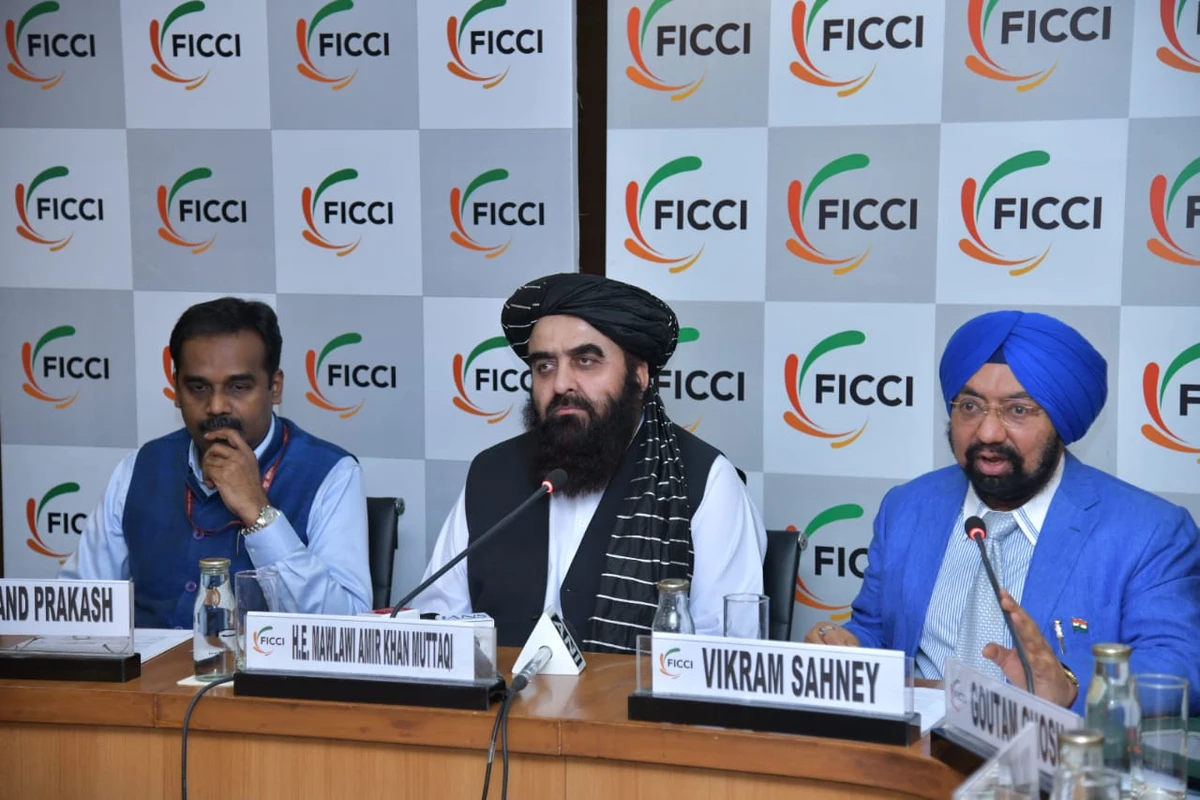
Special Taliban Foreign Minister Amir Khan Muttaqi meets members of the Federation of Indian Chambers of Commerce and Industry in New Delhi on Oct. 14, 2025. (FICCI)
Taliban Foreign Minister Amir Khan Muttaqi meets members of the Federation of Indian Chambers of Commerce and Industry in New Delhi on Oct. 14, 2025. (FICCI)
Short Url
Updated 14 October 2025
Follow

Indian business leaders meet Taliban FM for trade, healthcare talks

Taliban Foreign Minister Amir Khan Muttaqi meets members of the Federation of Indian Chambers of Commerce and Industry.
  • Muttaqi is hosted by Federation of Indian Chambers of Commerce and Industry
  • Several Indian companies have already resumed their operations in Afghanistan

NEW DELHI: Taliban Foreign Minister Amir Khan Muttaqi has met with industry and business leaders in New Delhi to increase India’s economic engagement with Afghanistan, following the Indian government’s decision to reopen the embassy in Kabul and air cargo connectivity.

Muttaqi was hosted by the Federation of Indian Chambers of Commerce and Industry on Monday, on the fifth day of his visit, which included official engagements with top government officials in New Delhi.

“The deliberations with the visiting Afghan Foreign Minister Amir Khan Muttaqi were fruitful,” Vikramjit Sahney, parliamentarian and FCCI Senior Executive Council member, told Arab News.

“They assured all the Indian businesspeople — whether traders or some Indian companies doing projects there ... or companies planning to participate in Afghanistan’s restructuring — of all help, safety. Many Indian companies present vouched for it.”

Muttaqi was accompanied by a delegation that included Deputy Minister of Industry and Commerce Ahmadullah Zahid.

He arrived in India last week — the first senior official from Afghanistan to do so since the Taliban took power after the withdrawal of US-led troops from the country in 2021.

Like most Taliban leaders, he has been sanctioned by the UN, but the Security Council said last month that he was granted “an exemption to the travel ban” to visit New Delhi from Oct. 9 to 16.

Last week, Muttaqi met his counterpart, S. Jaishankar, who announced that India would upgrade what it calls its “technical mission” in Kabul to the status of embassy.

And reopen the India-Afghanistan Air Freight Corridor — a 2017 trade initiative to promote direct air cargo connectivity, bypassing land routes that were often restricted due to political tensions, especially with Pakistan which lies between the two countries.

Sahney said the corridor, which will include flights between Amritsar, Kabul and Kandahar, “was discussed and finalized between the ministers” and that it would also increase tourist traffic, especially health tourism.

Prior to the Taliban takeover, Afghan nationals comprised about 9 percent of foreigners seeking medical services in India, which dropped in 2021 as India withdrew officials from its embassy in Kabul and suspended regular visa services.

“Indian industry representatives highlighted that the visa remains a severe bottleneck and needs to be resolved immediately for smoother movement of businessmen from both sides,” the FICCI said in a statement after the meeting with Muttaqi.

Several Indian companies have already resumed their operations in Afghanistan.

The FICCI listed among them engineering and infrastructure giant KEC and healthcare provider Max Hospitals.

“Afghanistan is trying its level best to enhance India’s collaborations for enhancing bilateral economic engagements,” the FICCI said.

“The Indian industry is keen to engage with Afghanistan in all possible manners, and the Afghan minister assured of creating and maintaining conducive conditions for enhancing economic cooperation.”
Trump’s decision that the US boycott the G20 summit is ‘their loss,’ South African president says

Updated 3 sec ago
Follow

Trump’s decision that the US boycott the G20 summit is ‘their loss,’ South African president says

Trump’s decision that the US boycott the G20 summit is ‘their loss,’ South African president says
CAPE TOWN: US President Donald Trump’s decision that the United States government boycott the Group of 20 summit next weekend in South Africa is “their loss,” South Africa’s leader said Wednesday.
South African President Cyril Ramaphosa added that “the United States needs to think again whether boycott politics actually works, because in my experience it doesn’t work.”
Trump announced last week on social media that no US government official would attend the Nov. 22-23 meeting of leaders from 19 of the world’s richest and leading developing economies in Johannesburg, citing his widely rejected claims that members of a white minority group in South Africa are being violently persecuted and having their land taken from them because of their race.
The US president has for months targeted South Africa’s Black-led government for criticism over that and a range of other issues, including its decision to accuse US ally Israel of genocide against Palestinians in Gaza in an ongoing and highly contentious case at the United Nations’ top court.
“It is unfortunate that the United States decided not to attend the G20,” Ramaphosa told reporters outside the South African Parliament. “The United States by not being at the G20, one must never think that we are not going to go on with the G20. The G20 will go on, all other heads of state will be here. In the end we will take fundamental decisions and their absence is their loss.”
Ramaphosa added that the US is “giving up the very important role that they should be playing as the biggest economy in the world.”
Trump previously confronted Ramaphosa with his baseless claims that the Afrikaner white minority in South Africa were being killed in widespread attacks when the leaders met at the White House in May. At that meeting, Ramaphosa lobbied for Trump to attend this month’s G20 summit, the first to be held in Africa.
The G20 was formed in 1999 to bring rich and developing countries together to address issues affecting the global economy and international development. The US, China, Russia, India, Japan, France, Germany, the UK and the European Union are all members. The US is due to take over the rotating presidency of the G20 from South Africa at the end of the year.
Trump said on Truth Social last week that it was “a total disgrace that the G20 will be held in South Africa” and claimed Afrikaners “are being killed and slaughtered, and their land and farms are being illegally confiscated.”
Trump had already said he would not attend the summit, but Vice President JD Vance was expected to represent the US
Trump’s claims about anti-white violence and persecution in South Africa have reflected those made previously by conservative media commentators in the US as far back as 2018.
Trump and others, including South African-born Elon Musk, have also accused South Africa’s government of being racist against whites because of its affirmative action laws that aim to advance opportunities for the Black majority who were oppressed under the former apartheid system of racial segregation.
Ramaphosa’s government has said the comments are the result of misinformation and a lack of understanding of South Africa.
Relations between the US and its biggest trading partner in Africa are at their lowest since the end of apartheid in 1994, and Washington expelled the South African ambassador to the US in March over comments he made regarding Trump.
The Trump administration has criticized South Africa’s hosting of the G20 from the outset, with US Secretary of State Marco Rubio skipping a G20 foreign ministers meeting in South Africa in February while calling the host’s policies “anti-Americanism” and deriding its focus on issues like climate change and global inequality.