Ivory Coast tightens protest ban ahead of presidential vote

Ivory Coast tightens protest ban ahead of presidential vote
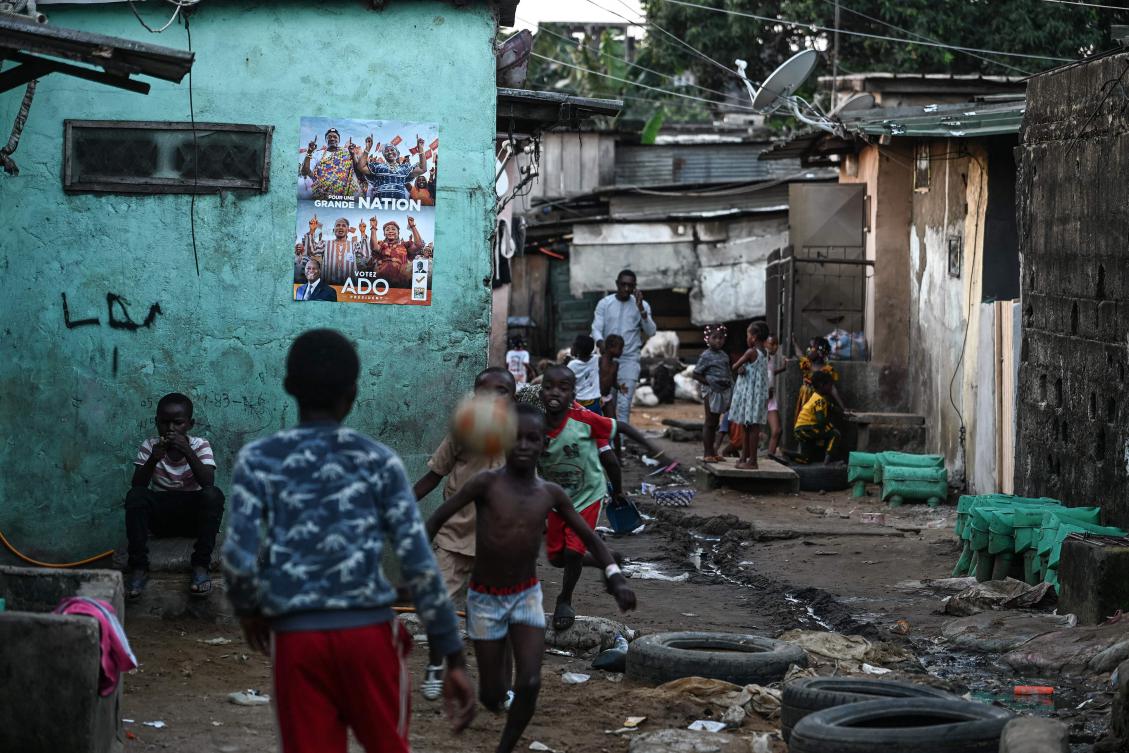
Above, a campaign poster of Ivorian President Alassane Ouattara, who is running for re-election, in a poor sub-neighborhood of the Adjame commune in Abidjan on Oct. 17, 2025. (AFP)
Short Url
Updated 18 October 2025
Follow

Ivory Coast tightens protest ban ahead of presidential vote

Ivory Coast tightens protest ban ahead of presidential vote
  • Ban applies to all political parties and groups except the five candidates officially approved to contest the October 25 vote

ABIDJAN: Ivory Coast authorities have imposed a sweeping two-month ban on political rallies and demonstrations just a week before a presidential election, in a move further restricting opposition activity.
The ban, announced late Friday by the interior and defense ministries, applies to all political parties and groups except the five candidates officially approved to contest the October 25 vote.
It comes amid rising tensions following the exclusion of opposition heavyweights Laurent Gbagbo and Tidjane Thiam from the race.
Hundreds of people rallied at protests in Abidjan last weekend, with security forces dispersing crowds. Sporadic unrest, including road and school blockades, has been reported in several regions.
Around 700 people have been arrested over the past week, according to public prosecutor Oumar Braman Kone, who said phone data revealed calls for attacks on public institutions which he described as “acts of terrorism.”
On Thursday, 26 protesters were sentenced to three years in prison for public order offenses, and another 105 are due to stand trial next week.
The opposition coalition, which includes Gbagbo’s African Peoples’ Party – Ivory Coast (PPA-CI) and Thiam’s Democratic Party of Ivory Coast (PDCI), has denounced President Alassane Ouattara’s bid for a fourth term.
Amnesty International urged authorities to stop “repressing” protests, but Justice Minister Sansan Kambile defended the crackdown, citing national security concerns.
Ouattara faces four challengers, including former minister Jean-Louis Billon and ex-first lady Simone Gbagbo.
Japan observes tiny tsunami following 6.7 magnitude quake

Updated 3 sec ago
Follow

Japan observes tiny tsunami following 6.7 magnitude quake

Japan observes tiny tsunami following 6.7 magnitude quake
TOKYO: Japan said Sunday evening tiny tsunami waves hit its northern Pacific coast after an offshore 6.7-magnitude earthquake.
The first tsunami hit Miyako, Iwate, at 5:37 p.m. (0837 GMT), but it was so small that the Japan Meteorological Agency said it could not measure its size.
Two minutes later, a 10-centimeter (less than four inches) wave reached Ofunato, the JMA said.
The quake struck around 5:03 p.m. (0803 GMT) in waters off Iwate, prompting JMA to issue the advisory for a possible tsunami up to one meter (three feet) high.
The US Geological Survey measured the quake as magnitude 6.8.
“A tsunami advisory has been issued” for the Iwate coast, the JMA said in a bulletin, warning that waves could approach at any moment.
The original quake was followed aftershocks of between 5.3 and 6.3-magnitude, the JMA said.
Live television feeds on Japanese television showed calm seas.
The same region Sunday morning experienced six offshore quakes, ranging between magnitude 4.8 and 5.8, that were barely felt on land and did not prompt tsunami adviseries.
The region is haunted by the memory of a massive 9.0-magnitude undersea quake in 2011, which triggered a tsunami that left around 18,500 people dead or missing.
The tsunami also sent three reactors into meltdown at the Fukushima nuclear plant, causing Japan’s worst post-war disaster and the world’s worst nuclear accident since Chernobyl.
Japan sits on top of four major tectonic plates along the western edge of the Pacific “Ring of Fire” and is one of the world’s most tectonically active countries.
The archipelago, home to around 125 million people, experiences around 1,500 jolts every year.
The vast majority are mild, although the damage they cause varies according to their location and depth below the Earth’s surface.