Alleged victim’s family hails renunciation of Prince Andrew’s royal title

Alleged victim’s family hails renunciation of Prince Andrew’s royal title
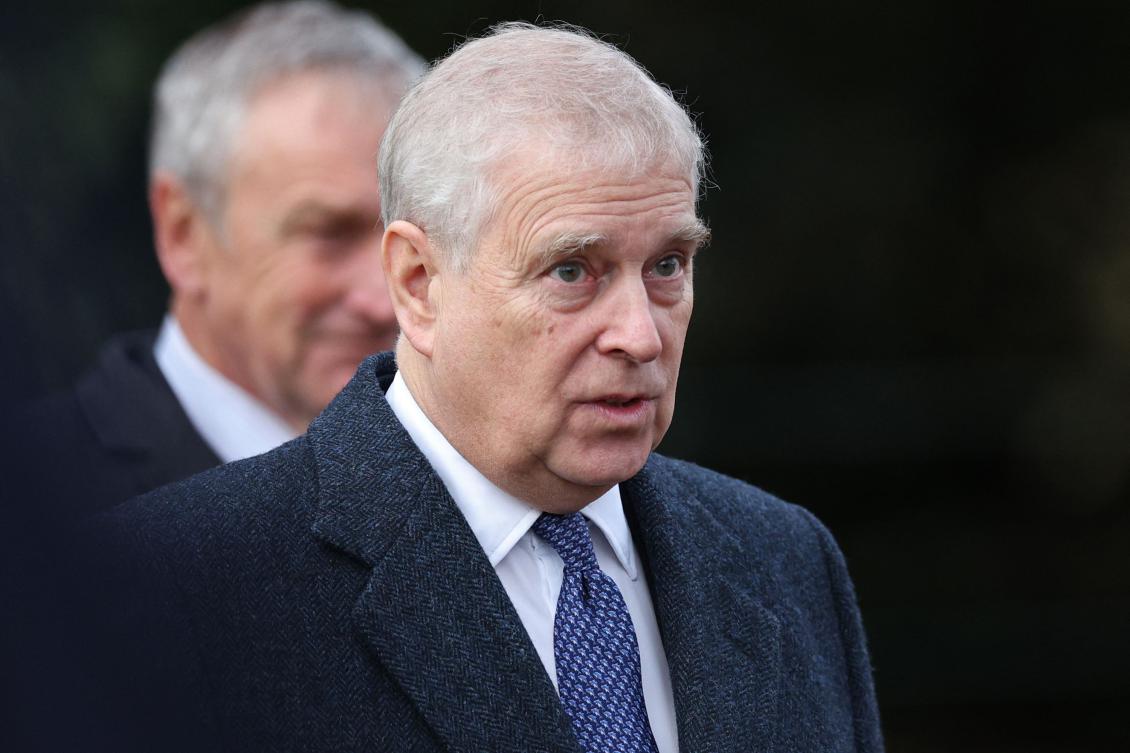
Britain's Prince Andrew, Duke of York leaves after attending for the Royal Family's traditional Christmas Day service at St Mary Magdalene Church in Sandringham in eastern England, on December 25, 2023. (Photo by Adrian DENNIS / AFP)
Short Url
Updated 18 October 2025
Follow

Alleged victim’s family hails renunciation of Prince Andrew’s royal title

Alleged victim’s family hails renunciation of Prince Andrew’s royal title
  • The removal of Prince Andrew’s royal title following further revelations about his ties to US sex offender Jeffrey Epstein “vindicates” his alleged sexual assault victim, her family has said

LONDON: The removal of Prince Andrew’s royal title following further revelations about his ties to US sex offender Jeffrey Epstein “vindicates” his alleged sexual assault victim, her family has said.
Andrew, 65, on Friday renounced his Duke of York title under pressure from his brother King Charles III, who wants to draw a line under the scandal that has embarrassed Britain’s royal family.
Speaking to the BBC, the brother of Virginia Giuffre, whom Andrew denies assaulting when she was 17, said his late sister “would be very proud” of the development.
“We have shed a lot of happy and sad tears today,” he told the broadcaster late on Friday.
“I think happy because in a lot of ways this vindicates Virginia. All the years of work that she put in is now coming to some sort of justice,” he added.
Andrew, who stepped back from public life in 2019 amid the Epstein scandal, will remain a prince, as he is the second son of the late queen Elizabeth II.
He has become a source of deep embarrassment for his brother Charles, following a 2019 television interview in which he defended his friendship with Epstein.
In the interview, Andrew vowed he had cut ties in 2010 with Epstein, who was disgraced after Giuffre accused him of using her as a sex slave.
But in a reported exchange that emerged in UK media this week, Andrew told the convicted sex offender in 2011 that they were “in this together” when a photo of the prince with his arm around Giuffre was published.
He added the two would “play together soon.”
Epstein died by suicide in a New York jail in 2019 while awaiting trial on charges of trafficking underage girls for sex.
Giuffre, a US and Australian citizen, took her own life at her farm in Western Australia on April 25.
New allegations emerged this week in her posthumous memoir in which she wrote that Andrew had behaved as if having sex with her was his “birthright.”
In “Nobody’s Girl: A Memoir of Surviving Abuse and Fighting for Justice,” to be published next week, Giuffre wrote she had sex with Andrew on three separate occasions, including when she was under 18.
Andrew has repeatedly denied Giuffre’s accusations and avoided a trial in a civil lawsuit by paying a multimillion-dollar settlement.
The once-popular royal, who was hailed a hero when he flew as a Royal Navy helicopter pilot during the 1982 Falklands War, was stripped of his military titles in 2022.

Early release granted to Bosnian Croat war criminal

Bruno Stojic. (Supplied)
Updated 13 sec ago
Follow

Early release granted to Bosnian Croat war criminal

Bruno Stojic. (Supplied)
  • “The gravity of Stojic’s crimes is high and weighs against granting early release. However, there are a number of positive factors that weigh in favor of early release,” she noted

THE HAGUE: A United Nations court on Monday granted early release to a former Bosnian Croat defense minister convicted of war crimes, including murdering and deporting Muslims in Bosnia in the early 1990s.
The International Residual Mechanism for Criminal Tribunals, based in The Hague, ordered Bruno Stojic released from detention in Austria to return to Croatia.
The 70-year-old had behaved well in prison, admitted the gravity of his crimes and was unlikely to reoffend, said presiding judge Graciela Gatti Santana in her decision.
“The gravity of Stojic’s crimes is high and weighs against granting early release. However, there are a number of positive factors that weigh in favor of early release,” she noted.
She cited “acceptance of personal responsibility for the crimes,” “expression of regret for the consequences” of his actions, “very good behavior in prison” and “good prospects of successful reintegration.”

Stojic was sentenced to 20 years in jail in 2013 along with former Bosnian Croat President Jadranko Prlic and four others.
He had already surrendered to the International Criminal Tribunal for the former Yugoslavia in April 2004. His sentence was due to expire in September 2027.
In 2013, when convicting Stojic and the others, judge Jean-Claude Antonetti said they had aimed to establish reunification with Croatia.
To achieve that, they wanted to “modify the ethnic composition” of the land claimed by Bosnian Croats.
This, Antonetti said, they achieved by force, intimidation and terror “by conducting mass arrests of Bosnian Muslims who were then either murdered, beaten, sexually assaulted, robbed of their property and otherwise abused.”
The bloody 1992-1995 war in Bosnia mainly pitted Bosnian Muslims against Bosnian Serbs, but for a period also saw vicious fighting between Bosnian Muslims and Bosnian Croats. Some 100,000 people lost their lives in the conflict.
In 1992, the Bosnian Croats established a Croatian entity, known as the HVO, which was both an army and a government. In August 1993, they proclaimed the Croatian “state” of Herceg-Bosna in Bosnia.
Stojic was encouraged to “continue, even following his early release, to reflect on his conduct and responsibility and to consider concrete steps he could take to facilitate reconciliation,” according to the court statement.