UNICEF official warns quality of humanitarian aid to Gaza is as crucial as quantity

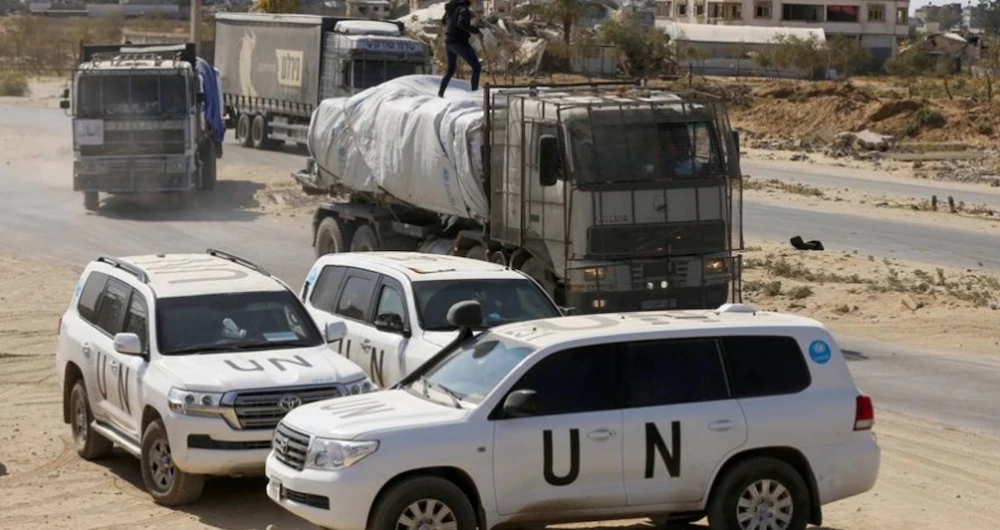
A senior UNICEF official has warned that the quality of relief aid entering Gaza is as vital as its quantity, stressing the need for unrestricted access to essential supplies to meet the enclave’s mounting humanitarian needs. (SANA/File Photo)
Short Url
Updated 18 October 2025
Follow

UNICEF official warns quality of humanitarian aid to Gaza is as crucial as quantity

UNICEF official warns quality of humanitarian aid to Gaza is as crucial as quantity
  • Agency calls for emergency supply deliveries to be stepped up amid worsening shortages of food, shelter
  • Fuel, cooking gas, water, food needed urgently, senior emergency coordinator says

GAZA: A senior UNICEF official has warned that the quality of relief aid entering Gaza is as vital as its quantity, stressing the need for unrestricted access to essential supplies to meet the enclave’s mounting humanitarian needs.

Hamish Young, UNICEF’s senior emergency coordinator, who was speaking to Anadolu Agency, said: “Palestinians in Gaza need tents, plastic sheeting, and clean drinking water.”

He highlighted the urgent need for fuel and equipment necessary for water production and distribution, as well as pipes to repair wells and desalination plants.

Speaking from the road leading to the Kissufim crossing, east of Deir Al-Balah in central Gaza, Young said he and his team were waiting for permission to allow in much-needed aid.

“We have 50 trucks waiting for permission to move and bring in medical supplies and hygiene items essential to save children's lives,” he said.

According to UNICEF, Israel has allowed 653 aid trucks into Gaza since the ceasefire took effect on Oct. 10. This number is far fewer than the 600 trucks per day agreed under the current arrangements.

On Sunday, 173 trucks were permitted to enter, including three carrying cooking gas and six with fuel. No aid entered on Monday or Tuesday, while 480 trucks were allowed through on Wednesday.

Describing conditions in Gaza as “catastrophic,” Young said all hospitals had been either destroyed or severely damaged, while residents faced severe shortages of food and shelter.

He warned that UNICEF urgently needed a “significant amount of food supplies” to address the effects of famine in northern Gaza, adding: “There is an urgent need to make every effort to bring in all these supplies I'm talking about.”

Young continued: “Children in Gaza are in dire need of this support, and we shouldn't sit and wait for these supplies.”

He called for the daily entry of “600 trucks loaded with supplies, including a full range of materials from the private sector and commercial suppliers, in addition to vital humanitarian aid provided by UNICEF, the World Food Programme, the United Nations Population Fund, and the World Health Organization.”

Young added that Gaza also needed around 50 trucks of fuel each day, including cooking gas, which he described as “critical for the population of Gaza,” adding that aid organizations needed freedom of movement throughout Gaza “so that we can deliver supplies to the most vulnerable children, and to their mothers and the families who care for them.”

Lebanon fighting ‘terror financing’, president tells US

Lebanon fighting ‘terror financing’, president tells US
Updated 58 min ago
Follow

Lebanon fighting ‘terror financing’, president tells US

Lebanon fighting ‘terror financing’, president tells US
  • President Aoun called on Sunday for “pressure on Israel to stop its ongoing attacks”
  • Since January 2025, Iran’s Revolutionary Guards have “transferred over $1 billion” to Hezbollah

BEIRUT: Lebanon’s President Joseph Aoun told US officials on Sunday his country was tackling money laundering and the financing of terrorism, days after Washington imposed sanctions on three Hezbollah members.
The trio were accused of money laundering to fund Lebanon’s Hezbollah militant group, designated a terrorist organization by the United States and other Western powers.
The US delegation’s visit to Beirut, headed by senior director for counterterrorism Sebastian Gorka, came as Washington works to cut off Iran-backed Hezbollah’s funding and Lebanon’s government tries to disarm it.
The group was severely weakened in its most recent war with Israel, which was halted by a November 2024 ceasefire.
“Lebanon strictly applies the measures adopted to prevent money laundering, smuggling, or its use in financing terrorism, and severely punishes financial crimes of all kinds,” Aoun said he had told the delegation.
On Thursday, the US imposed sanctions on three Hezbollah members allegedly involved in the transfer of tens of millions of dollars from Iran, the group’s main sponsor.
Part of the funding was via money exchange businesses that operate in cash, said a US Treasury statement.
Since January 2025, Iran’s Revolutionary Guards have “transferred over $1 billion” to Hezbollah, “mostly through money exchange companies,” it added.
“Lebanon has an opportunity to be free, prosperous and secure — but that can only happen if Hezbollah is fully disarmed and cut off from Iran’s funding and control,” deputy director for counter-terrorism John Hurley said Thursday.
Hurley later posted on X that he, Aoun and Gorka had “discussed ways in which we can partner together to stop the flow of money from Iran to Hezbollah and create a safer and more prosperous Lebanon.”
Israel on Sunday carried out new strikes in south Lebanon, killing two people according to the health ministry, putting the toll from Israeli strikes since Saturday at five.
Aoun called on Sunday for “pressure on Israel to stop its ongoing attacks.”