A military-backed party in Myanmar holds rallies as campaigning begins for December election

A military-backed party in Myanmar holds rallies as campaigning begins for December election
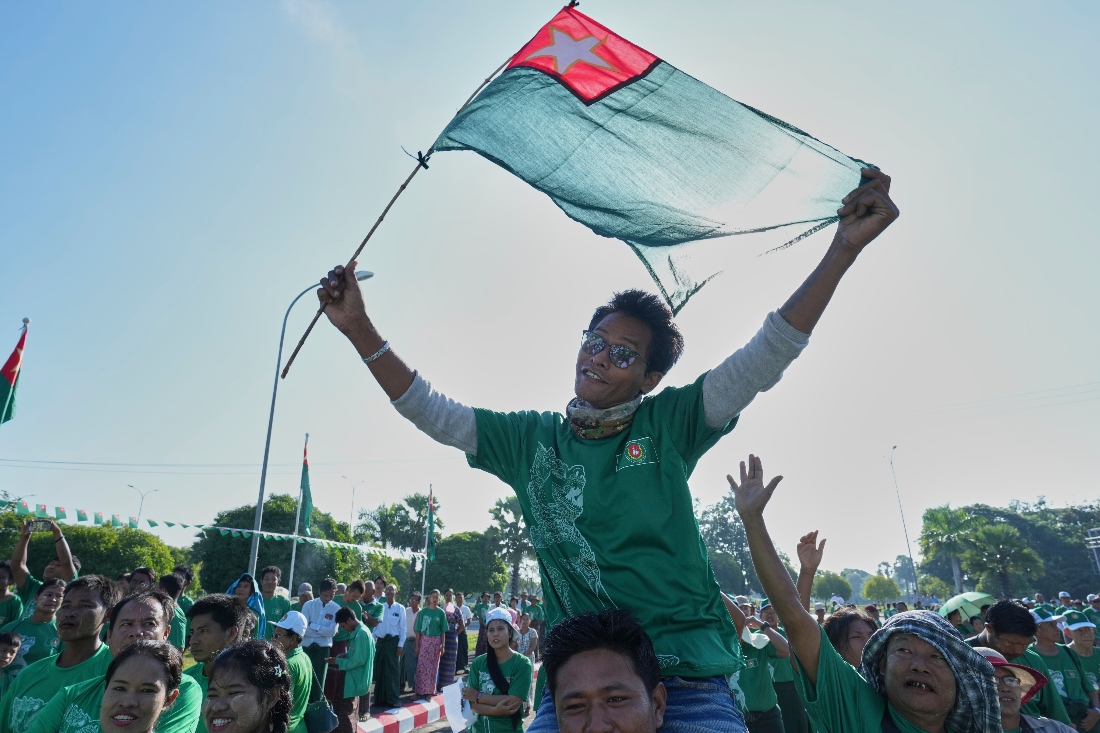
Supporters of the military-backed Union Solidarity and Development Party (USDP) wave the party flags during the first day of campaign for the upcoming general election, in Naypyitaw, Myanmar. (AP)
Short Url
Updated 28 October 2025
Follow

A military-backed party in Myanmar holds rallies as campaigning begins for December election

A military-backed party in Myanmar holds rallies as campaigning begins for December election
  • Campaigning began just a day after UN Secretary-General António Guterres, in a meeting with leaders of Southeast Asian nations, warned that the planned election could cause further instability and deepen Myanmar’s crisis
  • Fifty seven parties have registered for the contest but Aung San Suu Kyi ‘s National League for Democracy, which won the last two elections by landslides only to be ousted by the army, is not among them

BANGKOK: Political parties in military-run Myanmar on Tuesday kicked off their election campaigns, two months ahead of scheduled national polls that are widely seen as an effort to confer legitimacy on the military’s 2021 seizure of power, even as the country’s civil war precludes voting in many areas.
Campaigning began just a day after UN Secretary-General António Guterres, in a meeting with leaders of Southeast Asian nations, warned that the planned election could cause further instability and deepen Myanmar’s crisis.
Critics of the military-led government charge that the polls, which are set to begin on Dec. 28, will be neither free nor fair.
Fifty-seven parties have registered for the contest but Aung San Suu Kyi ‘s National League for Democracy, which won the last two elections by landslides only to be ousted by the army, is not among them. It was one of dozens of parties ordered disbanded by the army-appointed Union Election Commission more than two years ago after it refused to take part in what it saw as a sham process.
On Tuesday, the military-backed Union Solidarity and Development Party held ceremonies in the capital Naypyitaw and Yangon, the country’s largest city, to unveil its campaign slogan “Stronger Myanmar.”
The ceremony in Naypyitaw, attended by hundreds of green-clad supporters, was led by the party’s senior figures, including former generals now serving in the Cabinet of the military government.
USDP chairman Khin Yi, a former general and chief of police, said in his speech that the campaign would follow regulations and the law, declaring that the poll’s results would confer legitimacy.
Other parties have not yet staged campaign events on the ground but are instead focusing their outreach on social media platforms, especially Facebook. State television and radio will carry nightly broadcasts by registered parties through Nov. 24.
Senior Gen. Min Aung Hlaing, who heads the military government, has said that six parties will contest nationwide for seats. However, due to fighting, the polls cannot be held in all 330 townships, he said. Voting will be held in 102 townships in a first phase and 100 in the second.
In the absence of the NLD or any other credible nationwide opposition parties, the military-backed USDP, which is fielding more than 1,000 candidates is expected to win the most seats.
Several opposition organizations, including armed resistance groups, have said they will try to derail the polls. The General Strike Coordination Body, which organizes anti-military protests, announced on its Facebook page Monday that an election boycott would run from Tuesday until the end of the year and urged public participation.
The military seized power in February 2021, claiming the victory of Suu Kyi’s party in the November 2020 election was due to widespread voter fraud. However, they have failed to present convincing evidence to back the allegation.
The takeover sparked a national uprising with fierce fighting in many parts of the country. The military government has stepped up activity ahead of the election to retake areas controlled by opposition forces, with airstrikes killing scores of civilians.
EU in last-minute talks to set new climate goal for COP30

EU in last-minute talks to set new climate goal for COP30
Updated 25 min 49 sec ago
Follow

EU in last-minute talks to set new climate goal for COP30

EU in last-minute talks to set new climate goal for COP30
  • EU ministers meet to try to pass new climate target
  • Bloc’s credibility at risk ahead of COP30 climate talks

BRUSSELS: EU climate ministers will make a last-ditch attempt to pass a new climate change target on Tuesday, in an effort to avoid going to the UN COP30 summit in Brazil empty-handed.
Failure to agree could undermine the European Union’s claims to leadership at the COP30 talks, which will test the will of major economies to keep fighting climate change despite opposition from US President Donald Trump.
Countries including China, Britain and Australia have already submitted new climate targets ahead of COP30.
But the EU, which has some of the world’s most ambitious CO2-cutting policies, has struggled to contain a backlash from industries and governments skeptical that it can afford the measures alongside defense and industrial priorities. EU members failed to agree a 2040 climate target in September, leaving them scrambling for a deal days before European Commission President Ursula von der Leyen meets other world leaders at COP30 in Belem, Brazil, on November 6.
“The geopolitical landscape has rarely been more complex,” EU climate policy chief Wopke Hoekstra told a gathering of climate ministers in Canada on Saturday, adding that he was confident the bloc would approve its new goal.
“The European Union will continue to do its utmost, even under these circumstances, in Belem to uphold its commitment to multilateralism and to the Paris Agreement,” he said.
The starting point for talks is a European Commission proposal to cut net EU greenhouse gas emissions by 90 percent from 1990 levels by 2040, to keep countries on track for net-zero by 2050.
Italy, Poland and the Czech Republic are among those warning this is too restrictive for domestic industries struggling with high energy costs, cheaper Chinese imports and US tariffs.
Others, including the Netherlands, Spain and Sweden, cite worsening extreme weather and the need to catch up with China in manufacturing green technologies as reasons for ambitious goals. The draft compromise ministers will discuss, seen by Reuters, includes a clause demanded by France allowing a weakening of the 2040 goal in future, if it becomes clear EU forests are not absorbing enough CO2 to meet it. Brussels has also vowed to change other measures to attempt to win buy-in for the climate goal. These include controlling prices in an upcoming carbon market and considering weakening its 2035 combustion engine ban as requested by Germany.
A deal on Tuesday will require ministers to agree on the share of the 90 percent emissions cut countries can cover by buying foreign carbon credits — effectively softening efforts required by domestic industries.
France has said credits should cover 5 percent, more than the 3 percent share originally proposed by the Commission. Other governments argue money would be better spent on supporting European industries than buying foreign CO2 credits.
Support from at least 15 of the 27 EU members is needed to pass the goal. EU diplomats said on Monday the vote would be tight and could depend on one or two flipping positions.
Ministers will try first to agree the 2040 goal, and from that derive an emissions pledge for 2035 — which is what the UN asked countries to submit ahead of COP30.