- Traffickers are increasingly using GPS-equipped balloons to move pills across the Syrian-Jordanian border as authorities dismantle laboratories, tighten land routes
- Experts warn the Assad-era captagon industry has not disappeared but fragmented, with production networks beginning to migrate to Yemen, Sudan, Iraq and Turkiye
LONDON: In a sign of the growing pressure on Syria’s embattled captagon networks, smugglers are increasingly taking to the air — not in aircraft, but using balloons in an attempt to bypass tighter border controls and carry the illicit drug into Jordan and beyond.
Increasingly, however, their balloon is being burst.
Almost every month this year, as traffickers have moved away from trucks and human couriers in response to tighter border security, authorities in Syria and Jordan have intercepted balloons carrying shipments of captagon.
Some are crude hot-air balloons, while others are filled with helium. Most appear to be unpowered, relying on prevailing winds to carry them south toward Jordan.
Others are more sophisticated, equipped with GPS trackers and basic control systems allowing smugglers to land them or release their payloads at predetermined locations.
On July 18, a National Guard unit in Sweida governorate in southern Syria spotted and shot down several hot-air balloons near the town of Dhibin, just 10 km from the Jordanian border.
Equipped with GPS devices, the balloons were carrying 11,200 captagon pills.
One of the largest recent seizures came in February, when Syrian security forces carried out a series of raids in the south and confiscated 2 million captagon pills, packets of hashish, 75 balloons, 610 helium canisters, mobile phones and altitude-monitoring devices.
Four suspects were arrested. Authorities also seized a cannon and hollow plastic mortar shells, suggesting that the group may have been exploring yet another method of firing drug shipments across the border.
Jordanian authorities are equally alert to the changing tactics. Border guards and anti-narcotics officers intercepted several balloon-borne shipments in July.
The increasingly unconventional methods point to the pressure being exerted on a trade that flourished under the former Syrian regime but is now being targeted by the country’s new authorities.
Under interim President Ahmad Al-Sharaa, Syria’s government, eager to rebuild regional and international relations, has made dismantling the captagon industry a priority as it seeks to shed the country’s reputation as a narco-state.
During the civil war, a sanctions-stricken Syria became the source of much of the captagon flooding countries across the Middle East, including Saudi Arabia.
“We’ve seen a huge disruption in the general global supply of captagon, given the fact that at least 15 large, industrial-scale laboratories have been disrupted by the new administration,” Caroline Rose, a fellow at The Soufan Center and longtime captagon researcher at the New Lines Institute, told Arab News.
For the Syrian government, the crackdown sends an important political message.
“This shows that they’re committed to having a legitimate, formal economy rather than engaging in illicit drug production like its predecessor did,” Rose said.
“This is something that will capture Washington’s attention and will show and express goodwill.”
The scale of the crackdown can be seen in seizure data collected by the Washington-based New Lines Institute for Strategy and Policy.
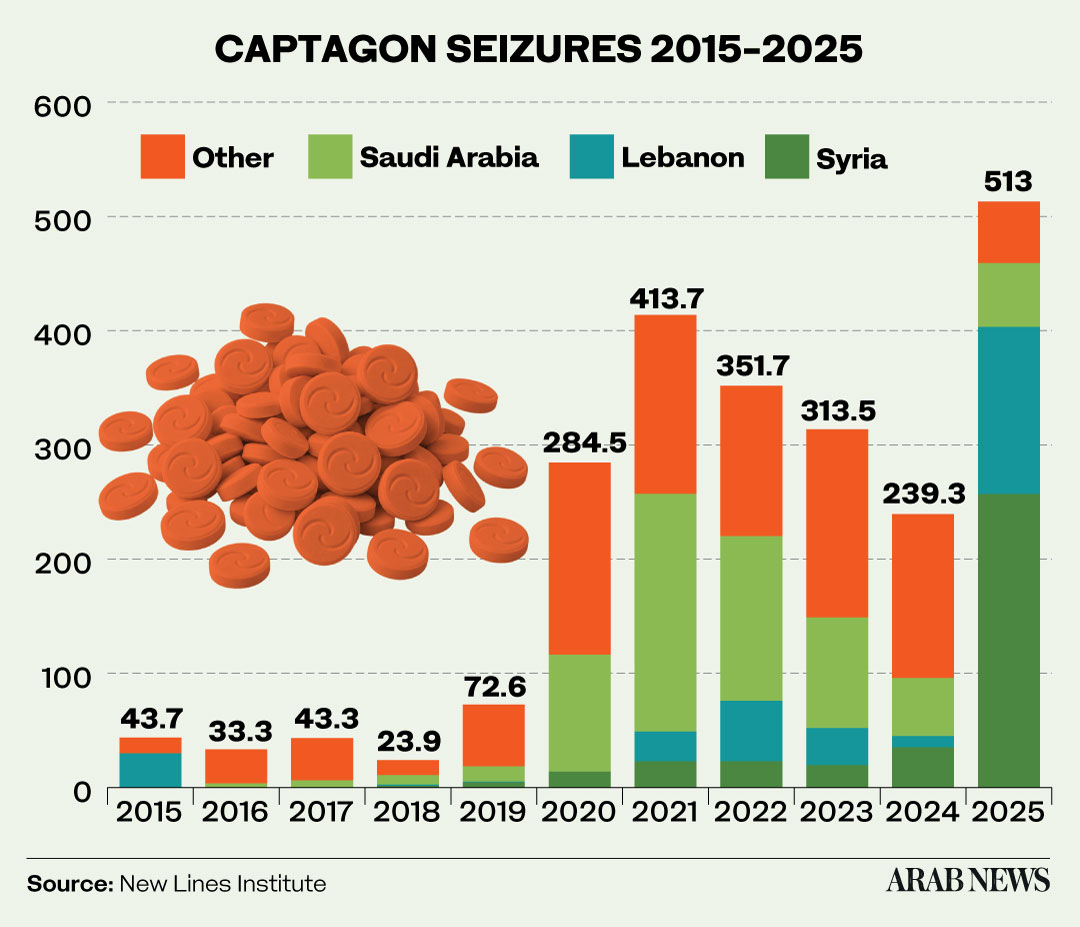
Between 2024 and 2025, captagon seizures inside Syria increased by more than 630 percent, from 35 million tablets to 256 million.
On Aug. 13, Syria’s Drug Enforcement Department announced the seizure of another 220,000 captagon pills, weighing 37 kg, during an operation in Aleppo’s Al-Suryan neighborhood.
Lebanon has also recorded a sharp increase in interdictions.
“Lebanon also had a huge uptick in interdictions in 2025,” Rose said. “This was because of the renewed push against Hezbollah-aligned and Hezbollah-controlled communities and illicit networks.”
In November 2025, the Lebanese army arrested Noha Zaitar, an alleged drug lord who had been sanctioned two years earlier by the US government over links to Syria’s captagon trade.
Although described by the Lebanese army as “one of the most dangerous wanted men” in the country, Zaitar was sentenced in February to just four months in prison.
The scale of the captagon industry that emerged during Syria’s civil war had been years in the making.
In February 2023, 22 months before the collapse of the Syrian regime in December 2024, an Arab News Deep Dive investigation reported that the vast majority of the tens of millions of captagon pills flooding the Arabian Peninsula each year were being manufactured in Syria, with members of President Bashar Assad’s family allegedly deeply involved.
Much of the output was destined for Saudi Arabia, which has waged a long-running campaign to prevent the drug entering the Kingdom through its ports, airports and land borders.
New Lines figures show Saudi captagon seizures peaked in 2021, when authorities intercepted more than 208 million tablets.
As Arab News reported in a 2024 Deep Dive, Saudi authorities intensified their campaign against the trade, intercepting shipments at borders, ports and airports while simultaneously expanding treatment facilities for drug users.
The effect is visible in the seizure figures.
Between 2021 and 2022, the number of captagon tablets intercepted in the Kingdom fell by 30 percent and continued to decline over the following two years.
In 2025, Saudi authorities seized 56 million pills — more than 73 percent fewer than in 2021 — a decline that reflects both sustained enforcement and a reduction in the number of attempted shipments reaching the Kingdom.
Arab News reported in 2024, working with the New Lines Institute, that the former Syrian regime had turned increasingly to the drug economy as international sanctions constricted legitimate sources of revenue.
The regime was accused of working with Iranian-backed militias in Syria and Lebanon to move industrial quantities of captagon into Saudi Arabia and other Gulf states by land, sea and air.
According to a New Lines report, elements of the Syrian government were “key drivers of the captagon trade,” with complicity reaching ministerial level and illicit drug production becoming a means of political and economic survival under sanctions.
Production and trafficking were carried out by individuals closely connected to the Assad regime, including relatives of senior regime figures.
Among the individuals repeatedly linked to the trade was Bashar Assad’s brother, Maher.
Captagon itself began far removed from the illicit industry that would eventually emerge in the Middle East.
The trade name for fenethylline, the drug was developed in Germany in 1961 as a treatment for conditions including attention deficit hyperactivity disorder, depression and narcolepsy.
A combination of amphetamine, a central nervous system stimulant, and theophylline, a caffeine-related compound used as a bronchodilator, fenethylline was initially considered a useful pharmaceutical and was prescribed legally around the world for about two decades.
By the 1980s, mounting evidence of addiction and harmful side effects prompted medical authorities around the world to ban it.
Captagon use has since been associated with strokes, memory loss, nerve damage and auditory, visual and sensory hallucinations. It can also damage cardiovascular health, the liver and kidneys.
The drug has been linked to confusion and severe mood swings, ranging from anxiety to bursts of aggression and rage.
Its ability to suppress sensations of pain and fear also contributed to its use among some fighters belonging to Daesh and other militant groups in the region.
Despite the new Syrian government’s crackdown, captagon has not been eradicated.
In June last year, Interior Minister Anas Khattab said in an interview with state television that the authorities had stopped production and seized the factories and materials used to manufacture the drug.
“There are now no more factories producing captagon in Syria,” he said.
Subsequent seizures, however, indicate that the picture is more complicated.
Syrian authorities have continued to discover large quantities of the drug, seizing about 80 million pills over the past year.
It remains unclear how much of this represents stockpiles left behind from the Assad era, but Syrian media have reported that as many as a dozen captagon laboratories have been dismantled in Sweida province alone this year.
A July report by the New Lines Institute concluded that the new government’s crackdown had disrupted the monopoly once exercised by the Assad regime — but had not eliminated the trade.
Instead, the formerly centralized industry has splintered into a decentralized network of smaller producers and traffickers embedded within Syria’s postwar economy.
And while production inside Syria appears to have fallen sharply, experts warn the captagon industry may simply be spreading elsewhere.
“A lot of the networks are leaving Syria simply because they don’t have much reason to stay, especially with a government that has shown itself to be quite hostile to illicit drug production in central areas,” Rose said.
Laboratories, she said, have begun appearing in Yemen and Sudan, while there are indications that production may still be taking place in Iraq.
“2023 was a really busy year for captagon production and trafficking in Iraq, and then it got very quiet,” she said.
“But the networks are there and I have a sinking feeling that law enforcement hasn’t been picking up captagon-related activity.”
There has also been increased activity in Turkiye, where, Rose said, individuals linked to the former Syrian networks have attempted to establish laboratories.
Sudan poses a particular concern because the conditions there increasingly resemble those that allowed the captagon industry to flourish during Syria’s civil war.
“Sudan has the perfect storm for any sort of actor who wants to engage in illicit drug production, because the entire security sector is focused on the existing conflict,” Rose said.
“When it comes to interdiction of drugs, that’s going to be very low on the totem pole of priorities, just like it was during the Syrian civil war.”
Across the region, captagon seizures reached a record 513 million tablets in 2025, surpassing the previous high of 413 million in 2021.
But the numbers do not necessarily mean that more captagon is being produced.
Rose said the surge could instead reflect more aggressive law enforcement in countries such as Syria and Lebanon, where authorities are now actively dismantling networks that were previously tolerated or protected.
Likewise, a sharp fall in seizures across a range of other countries — from 143 million pills in 2024 to just 53 million in 2025 — could indicate that enforcement is weakening in conflict-hit states such as Sudan and Yemen rather than that trafficking has disappeared.
The captagon economy is therefore entering an uncertain transitional phase.
“Right now, I believe there is less captagon out there, but I think in two years we might be having a different conversation,” Rose said.
“We are in a year of transition, and the statistics have to be looked at with political contexts taken into account.”
Future seizure figures in Syria and Lebanon, she said, could offer an important indication of whether the crackdown has destroyed the industry or merely forced it to reorganize.
“If a year from now we are seeing an increase in captagon seizures in Syria, it’s much less likely to be seizures from old labs belonging to the former regime because they’ve had two or three years to clear them out.
“And if it’s a serious uptick, that would likely indicate either that new actors are moving in, or that the old actors who went into exile are returning and trying to lay the groundwork.”