- Ongoing international peacekeeping presence is required in southern Lebanon to prevent a security vacuum, President Joseph Aoun warns
- ‘Imminent threat’ provision used by Israel to justify continuing attacks in Lebanon despite ceasefire agreement ‘is an elastic concept,’ Lebanese source tells Arab News
BEIRUT: Israeli attacks on southern Lebanon continued on Monday, as a 60-day deadline set by an agreement in June between US-Iran to reach a deal on ending their conflict expired, an arrangement Tehran previously said also applied to Lebanon.
However, an official Lebanese source told Arab News that Beirut did not consider itself bound by that particular track of the peace process.
“Lebanon is concerned only with what it achieved through direct negotiations with Israel under US sponsorship,” the source said. “We have nothing to do with any other negotiating process.”
Israel and Hezbollah agreed on June 19 to a ceasefire that came into effect immediately. A broader political framework followed on June 26, when the US, Lebanon and Israel signed an agreement that linked a gradual Israeli withdrawal from southern Lebanon to the deployment of the Lebanese army, the disarmament of Hezbollah, the establishment of pilot zones for the process, and further negotiations.
The Lebanese source said Israel had since sought to justify continuing aggression against Lebanon under an “imminent threat” provision, adding: “This is an elastic concept that Israel continues to use to justify its attacks.”
Although the political framework has failed to halt Israeli violations of the truce, it has kept the ceasefire tied to the continuation of a wider political process. The source said Lebanese complaints to Washington about Israeli strikes were frequently met with Israeli justifications, limiting the effectiveness of US pressure.
“Lebanon does not have significant leverage,” the source added.
Meanwhile, signals from Israel about the possibility of broader military operations in Lebanon have increased. Israel’s Channel 12 reported that the Israeli army was preparing for the possibility of several days of renewed fighting, with a focus on destroying Hezbollah infrastructure in the Ali Al-Taher Heights.
The station said Israeli authorities viewed a tunnel complex in the area to be a target that cannot be left intact, and reported that dozens of Hezbollah members were trapped underground there. It also claimed the Israeli army had prevented attempts by Hezbollah to assist those who are trapped but provided no further details.
The Israeli national security minister, Itamar Ben-Gvir, called for Hezbollah to be “crushed” and for Beirut to be bombed. The defense minister, Israel Katz, said Israel would “leave no account unsettled in any arena” and would respond forcefully to threats against its soldiers and citizens.
Channel 12 also reported that Israel had exercised restraint in recent days to avoid undermining US-mediated negotiations with the Lebanese government. It said Israel’s political leadership had rejected several military proposals for operations in response to alleged Hezbollah activity because of concerns that they could disrupt diplomatic efforts.
The developments come as direct Lebanese-Israeli negotiations remain stalled over unresolved disagreements about the proposed pilot zones in southern Lebanon, the deployment of the Lebanese army, and Israel’s insistence that the disarmament of Hezbollah remains the priority.
The Lebanese official said Beirut was waiting for officials in Washington to schedule the eighth round of direct Lebanese-Israeli talks in Rome. “The State Department has not yet set a date for the next session,” the source added.
Gen. Joseph Clearfield, head of the US Military Coordination Group for Lebanon, met the commander of the Lebanese army, Gen. Rodolphe Haykal, in Beirut on Monday for the second time in a week.
The Lebanese army said their talks at its headquarters focused on developments in southern Lebanon, security arrangements linked to the framework agreement, and obstacles the army faces as it carries out its duties. These challenges included continuing attacks, bulldozing and other destruction cased by Israeli forces, the army said. Both sides stressed the importance of supporting the Lebanese military as it carries out missions in the south and across the country.
Lebanese officials are also increasingly concerned about the permanent withdrawal of UN Interim Force in Lebanon peacekeepers from the south of the country when their mandate expires at the end of this year.
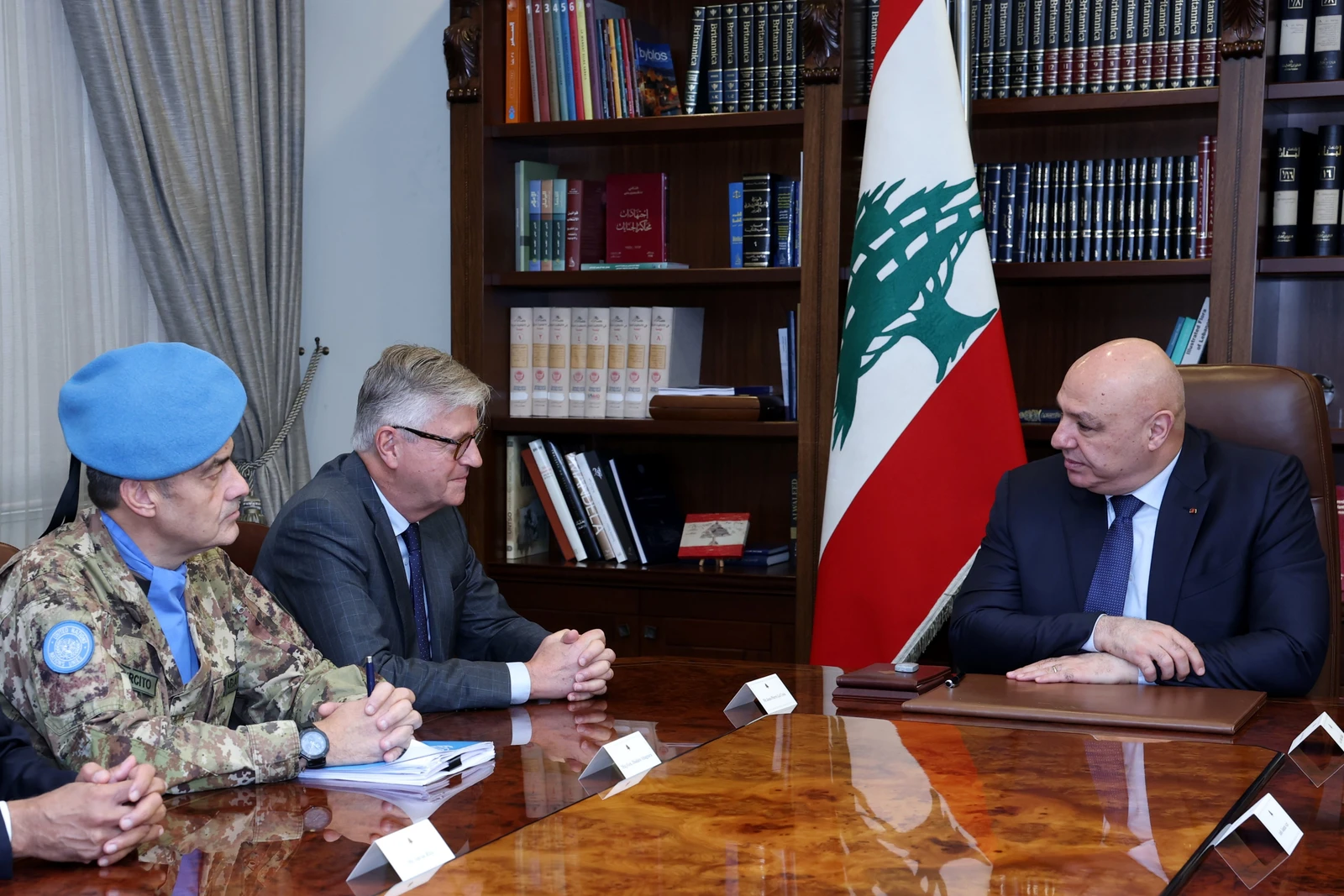
President Joseph Aoun told a parliamentary delegation that Lebanon’s preferred option is that the peacekeepers remain.
“Our first option is to extend UNIFIL’s mandate,” he said. “If that does not happen, the second option is to adopt a formula that guarantees the continued presence of international forces in the south within the required legal framework, alongside and in coordination with the Lebanese army.”
The objective was to support stability and ensure there was no security vacuum, he added.
According to Aoun’s office, the president said that Israel opposed the presence of UNIFIL and had been pushing for it to leave permanently for nearly a year.
“We are demanding that it remain,” Aoun added. “We believe UNIFIL’s presence in the south helps residents remain in their villages and towns and strengthens stability through cooperation and coordination with the Lebanese army.”
The Lebanese official said Aoun raised the issue with the US president, Donald Trump, during their summit in Washington in July but received neither a positive nor a negative response.
The parliamentary delegation also met Prime Minister Nawaf Salam, who similarly said the Lebanese state remained committed to maintaining a UN force in the south, which should perform three core functions: monitoring and reporting, coordination and liaison.
He said he had personally conveyed Lebanon’s position to the UN secretary-general, Antonio Guterres, during his visit to Beirut in March and subsequent discussions. The secretary-general acknowledged Lebanon’s argument that some form of UN presence should remain in southern Lebanon after the departure of UNIFIL, a position that is reflected in the UN’s latest report on the issue, Salam added.
Eighty-six Lebanese MPs have signed a letter calling for UNIFIL’s mission to continue. MP Melhem Khalaf told Arab News that there was “clear parliamentary support for maintaining UNIFIL as a necessary UN umbrella for Lebanon and as an essential element in protecting stability, supporting the army and the state, and preserving an international presence alongside the Lebanese army.”
The aim was to prevent southern Lebanon from once again sliding into a war “whose price would be paid by Lebanon and its people,” Khalaf added.
“This is not an initiative by one political group, sect or region. It is a broad national initiative, and we are seeking to accompany it with outreach to members of the UN Security Council and countries contributing to the international force.”
UNIFIL said on Monday that Israeli military activity in southern Lebanon had increased sharply over the past two weeks, with an average of 137 projectiles fired each day between Aug. 5 and Aug. 16.
Southern Lebanon also experienced a serious escalation over the weekend, including the heaviest Israeli strikes since the ceasefire agreement took effect on June 20. Surprise Israeli airstrikes on targets outside the designated zone reportedly killed 11 people, including women and children, and wounded 19.