- Hundreds arrested and millions in cash, gold and property seized as Baghdad targets corruption across the state
- But analysts warn the campaign may punish officials without confronting the political networks that allow graft to flourish
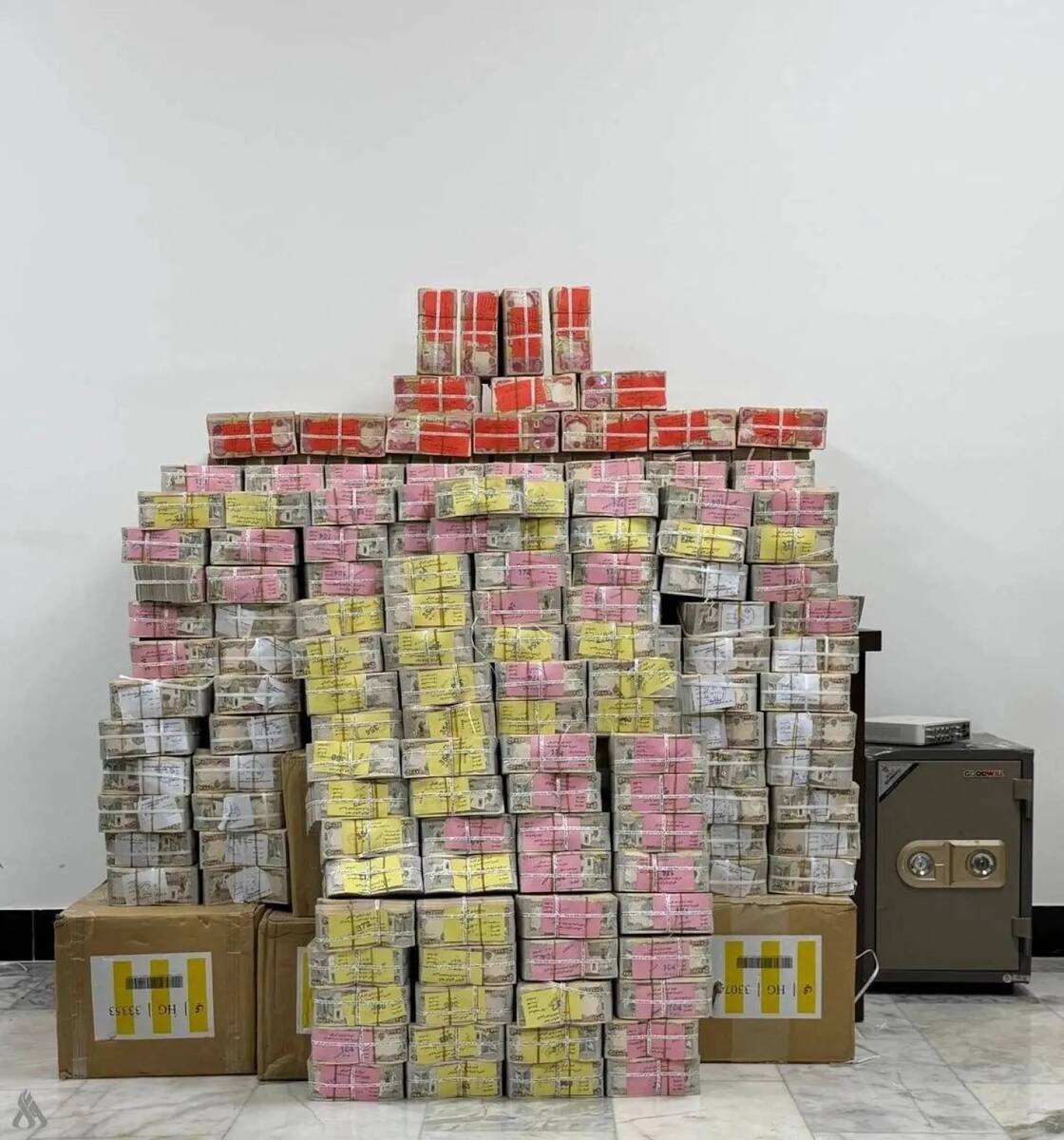
WASHINGTON D.C.: Iraq’s new anti-corruption campaign has produced some of the country’s most dramatic displays of state power in years, with stacks of Iraqi dinars pulled from a drainage pit, hundreds of kilograms of gold seized and handed to the central bank, and security forces moving through Baghdad’s heavily fortified Green Zone.
But as the operation has expanded from a handful of high-profile arrests into a nationwide sweep, the more consequential test is becoming clearer. Can the government turn the spectacle of seizures into something more lasting — recovering public money for the state and securing convictions against those responsible?
Prime Minister Ali Al-Zaidi, who took office in May, has made the campaign a centerpiece of his government, presenting it as an effort to confront a problem that has defined the Iraqi state since 2003.
The expanded operation, known as the “Dawn Crackdown,” began on June 28 with raids across Baghdad and several provinces. At least 210 officials, lawmakers, employees and business figures had been detained between June 28 and Aug. 9, according to a Shafaq News tally based on individual cases.
The campaign has also moved well beyond its original focus on the oil ministry. Investigations have reached electricity, defense procurement, municipalities, state land, customs, aviation and other government institutions.
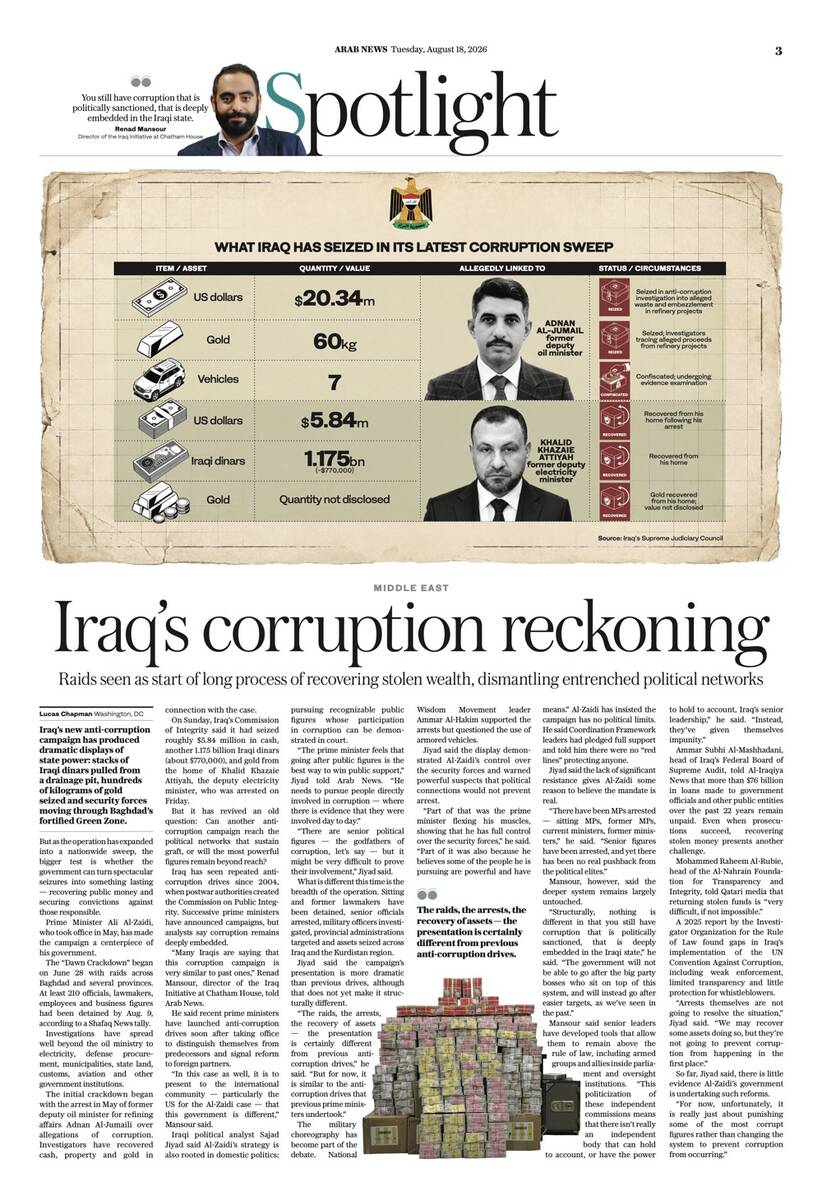
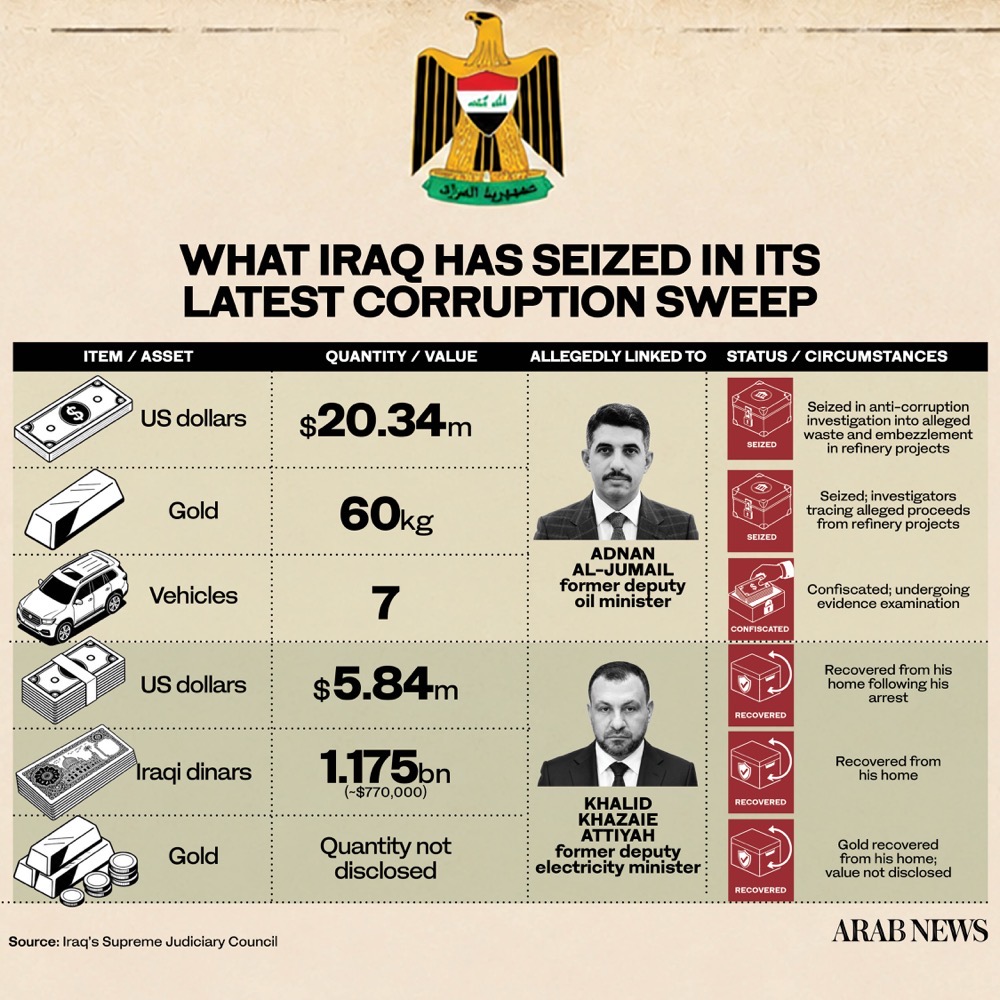
The initial crackdown began with the arrest in May of former deputy oil minister for refining affairs Adnan Al-Jumaili over allegations of corruption linked to refinery projects. Investigators have recovered cash, property and gold in connection with the case.
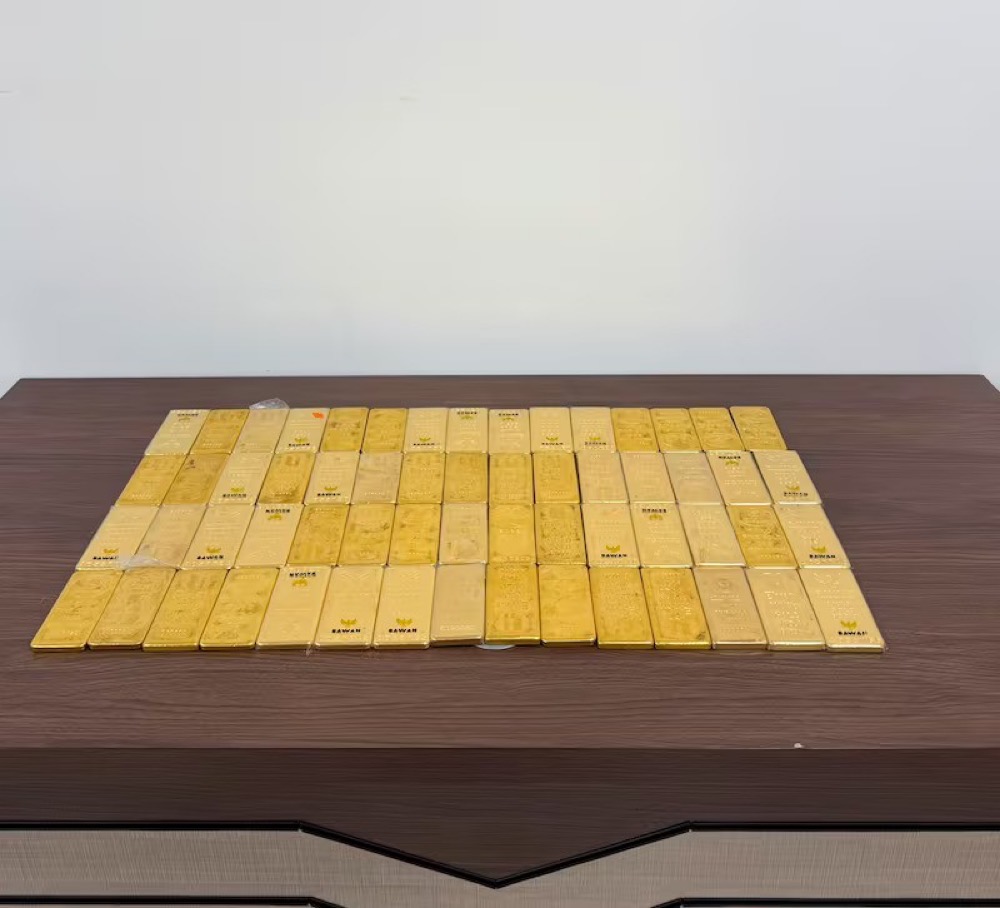
Seizures linked to Al-Jumaili’s investigation have included billions of Iraqi dinars and millions of dollars hidden at different locations, some 60kg of gold, as well as properties and vehicles.
On Sunday, Iraq’s Commission of Integrity said it had seized roughly $5.84 million in cash, another 1.175 billion Iraqi dinars (about $770,000), and gold from the home of Khalid Khazaie Attiyah, the deputy electricity minister for transport and distribution, who was taken into custody on Friday.
In July, the Supreme Judicial Council announced that 358 kilograms of gold had been recovered in coordination with authorities in the Kurdistan Region, while a separate seizure brought the announced total to 375kg.
The scale of the operation has made the campaign difficult to dismiss as a single political purge or isolated corruption case. But it has also revived an old question: can another anti-corruption campaign reach the political networks that sustain graft, or will it stop at officials and intermediaries while the most powerful figures remain beyond reach?
Iraq has seen repeated anti-corruption drives since 2004, when postwar authorities created the Commission on Public Integrity. Successive Iraqi prime ministers have announced initiatives targeting corruption, but analysts say each campaign has faced the same structural problem: Corruption is not simply a criminal matter, but one entrenched in the fabric of Iraqi politics.
“Many Iraqis are saying that this corruption campaign is very similar to past ones,” Renad Mansour, director of the Iraq Initiative at Chatham House, told Arab News.
He said several recent prime ministers have launched anti-corruption drives soon after taking office for overlapping reasons: to distinguish themselves from their predecessors, replace parts of the old guard with their own allies, and signal reform to foreign partners.
“In this case as well, it is to present to the international community — particularly the US for the Al-Zaidi case — that this government is different,” Mansour said.

Iraqi political analyst Sajad Jiyad said the prime minister’s immediate strategy is also rooted in domestic politics: pursuing recognizable public figures whose direct participation in corruption can be demonstrated in court.
“The prime minister feels that going after public figures is the best way to win public support,” Jiyad told Arab News. “He needs to pursue people directly involved in corruption — where there is evidence that they were involved day to day.”
The Al-Jumaili case, he said, appears to fit that approach because of the volume of money and assets recovered and the evidence investigators say connects the former oil official to the alleged crimes.
“There are senior political figures — the godfathers of corruption, let’s say — but it might be very difficult to prove their involvement,” Jiyad said.
Previous governments also promised to confront corruption. Judicial authorities sought to lift the immunity of dozens of lawmakers in 2019 and 2021, while senior officials and businessmen were targeted under Mustafa Al-Kadhimi’s controversial Committee 29.
What is different this time is the breadth and persistence of the operation. Sitting and former lawmakers have been detained, senior oil officials arrested, military officers investigated, provincial administrations targeted and assets seized across federal Iraq and the Kurdistan Region.
Jiyad said the campaign’s presentation is unquestionably more dramatic than those of previous governments, although that does not yet make it structurally different.

“The raids, the arrests, the recovery of assets — the presentation is certainly different from previous anti-corruption drives,” he said. “But for now, it is similar to the anti-corruption drives that previous prime ministers undertook.”
That assessment could change, he added, if the operation produces convictions, recovers substantially more public money, and continues to move against senior figures.
There are already signs of movement on the first of those tests.
In June, Iraq’s Central Anti-Corruption Criminal Court sentenced former General Commission for Taxes director general Osama Hossam Jawdat to 10 years in prison for money laundering, while his wife received a sentence of five years and one month.
The court also ordered a joint fine of about 32 billion dinars and the confiscation of properties, cash, gold jewellery and funds held in banks in Kuwait and Turkiye.
The military choreography has become part of the political debate. National Wisdom Movement leader Ammar Al-Hakim expressed support for the arrests but questioned the use of tanks and armored vehicles.
The sight of tanks rolling through the Green Zone also led some Iraqi political figures to initially wonder whether the deployment signaled a coup.
Jiyad said the display served two purposes. It allowed Al-Zaidi to demonstrate control over the security forces, while warning powerful suspects that armed guards or political connections would not prevent their arrest.
“Part of that was the prime minister flexing his muscles, showing that he has full control over the security forces,” he said. “Part of it was also because he believes some of the people he is pursuing are powerful and have means.”
However, Jiyad said repeatedly deploying tanks in the Green Zone to execute corruption warrants would quickly lose its political effect. “People have now seen that he is serious about arresting even high-profile officials.”
Publicly, Al-Zaidi has insisted the campaign has no political limits. He said leaders of the Coordination Framework — the alliance that forms the backbone of Iraq’s governing coalition — had pledged their full support and told him there were no “red lines” protecting anyone accused of corruption, including those affiliated with the alliance.
Jiyad said the absence of significant resistance from the political establishment gives Al-Zaidi some reason to believe that the mandate is real.
“There have been MPs arrested — sitting MPs, former MPs, current ministers, former ministers,” he said. “Senior figures have been arrested, and yet there has been no real pushback from the political elites.”
That lack of resistance, he said, makes the government’s claim of having no red lines credible within the narrower boundaries of cases the judiciary can realistically prosecute.
“Structurally, nothing is different in that you still have corruption that is politically sanctioned, that is deeply embedded in the Iraqi state,” Mansour said. “The government will not be able to go after the big party bosses who sit on top of this system, and will instead go after easier targets, as we’ve seen in the past.”
Former integrity officials have described the same problem. Former Integrity Commission employee Ghalib Aldaamy told Qatari media in June that corruption is “politically protected” in Iraq and embedded in the nature of the country’s political system.
Mansour said that Iraq’s senior leaders have developed tools that allow them to remain above the rule of law. Some have armed groups, while others have allies inside parliament, oversight bodies, and integrity commissions.
“This politicization of these independent commissions means that there isn’t really an independent body that can hold to account, or have the power to hold to account, Iraq’s senior leadership,” he said. “Instead, they’ve given themselves impunity.”
Beyond the damage to Iraq’s public image, graft has imposed enormous costs on the country’s economy and public finances.
Ammar Subhi Al-Mashhadani, head of Iraq’s Federal Board of Supreme Audit, told Al-Iraqiya News that more than $76 billion in loans made to government officials and other public entities over the past 22 years have yet to be repaid.
A UN Development Programme official told the Irbil-based Rudaw that as much as 20 percent of Iraq’s public funds have been lost to corruption.
Even when prosecutions succeed, recovering stolen money presents another challenge.
Mohammed Raheem Al-Rubie, head of the Al-Nahrain Foundation for Transparency and Integrity, told Qatari media that returning stolen funds from inside or outside of Iraq is “very difficult, if not impossible,” and that the country’s legal code is too outdated to properly address the scale of postwar financial crimes.
Iraqi officials have said they are seeking cooperation from several countries to locate suspects and recover assets abroad, including through Interpol red notices. Authorities have also been examining money and property allegedly moved to countries including Turkiye and France.
A 2025 report by the Irbil-based Investigator Organization for the Rule of Law found serious gaps in Iraq’s implementation of the UN Convention Against Corruption, including weak enforcement of preventive measures and codes of conduct, limited transparency and access to information, and little to no protection for whistleblowers.
The findings suggest that prosecutions alone cannot address the administrative procedures, opaque financial systems and political control that allow corruption to flourish before criminal investigators become involved.
“Arrests themselves are not going to resolve the situation,” Jiyad said. “We may recover some assets doing so, but they’re not going to prevent corruption from happening in the first place.”
So far, however, Jiyad said he had seen little evidence that Al-Zaidi’s government was undertaking reforms on that scale.
“For now, unfortunately, it is really just about punishing some of the most corrupt figures rather than changing the system to prevent corruption from occurring.”