- Newly discovered evidence pushes Abu Agila Masud’s long-awaited US trial back to January
- Case could shed new light on Libya’s role and enduring claims of an Iranian connection
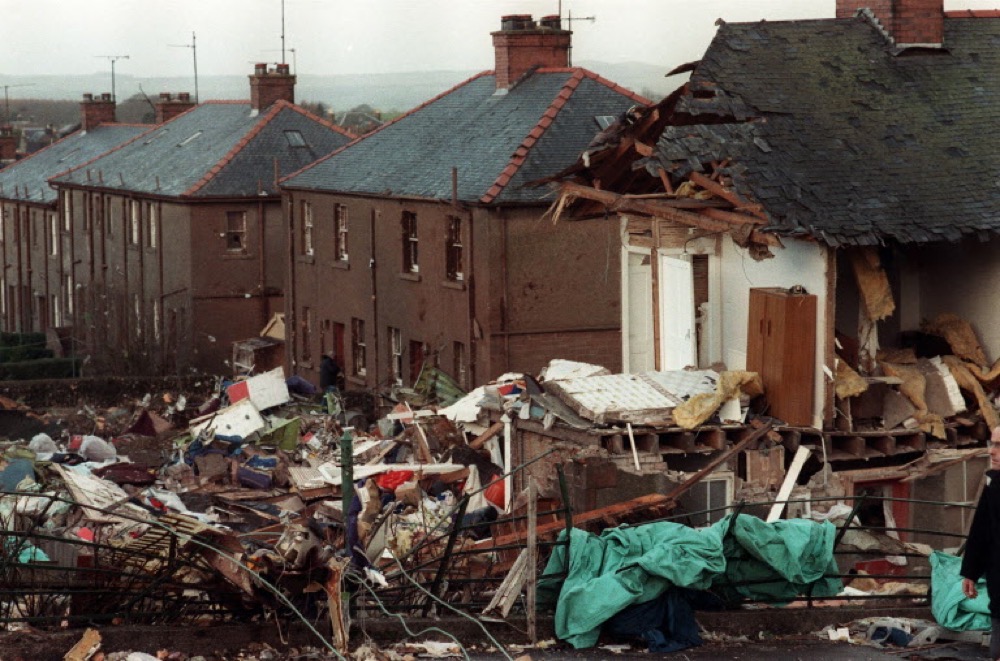
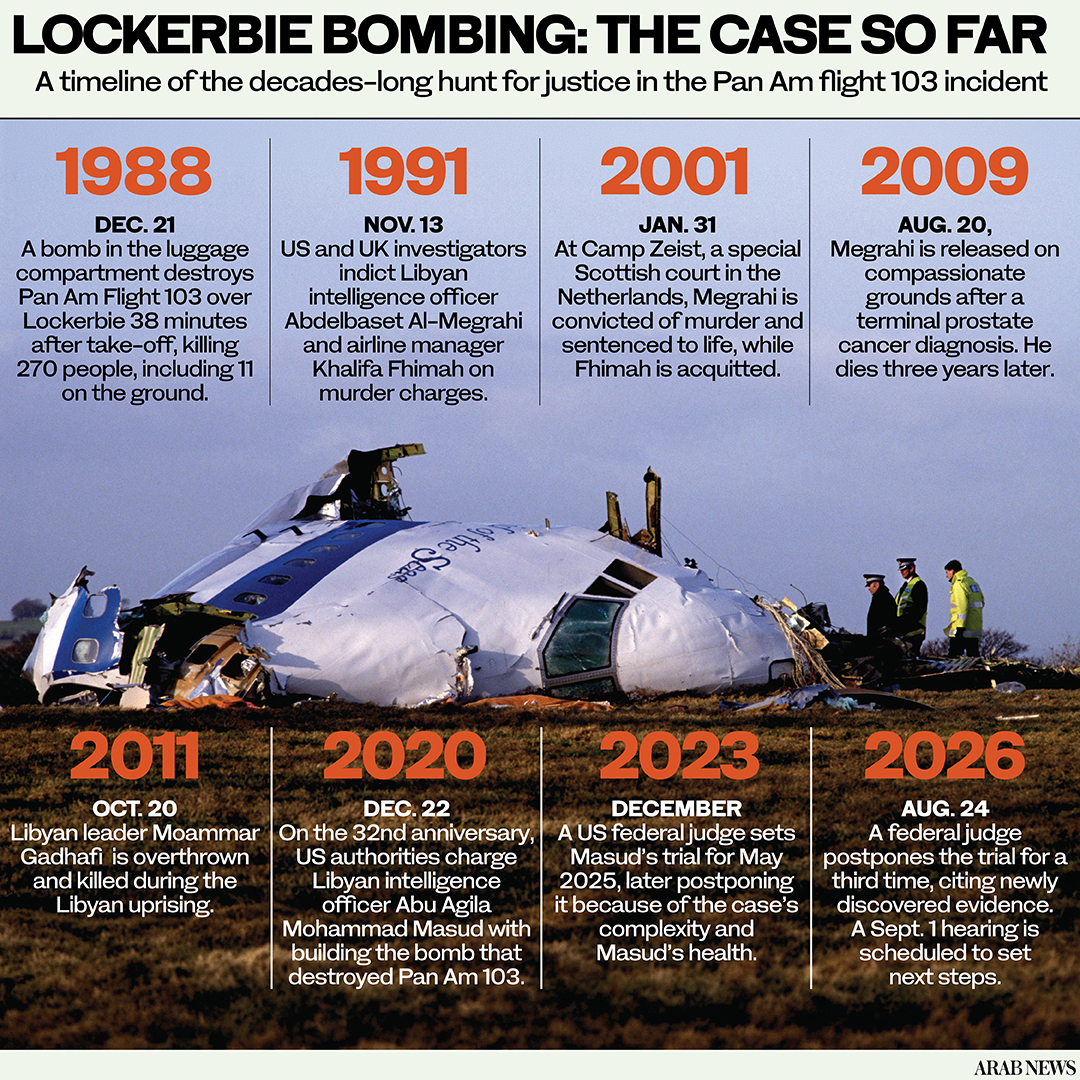
LONDON: It is almost 38 years since Pan Am Flight 103 was destroyed by a bomb, killing all 259 people on board and 11 residents of the Scottish town of Lockerbie, on Dec. 21, 1988.
Now, with the news that the trial of the last remaining suspect in the bombing has been postponed, just days before it was due to start, the long-awaited closure sought by the families of the dead has, once again, been put on hold.
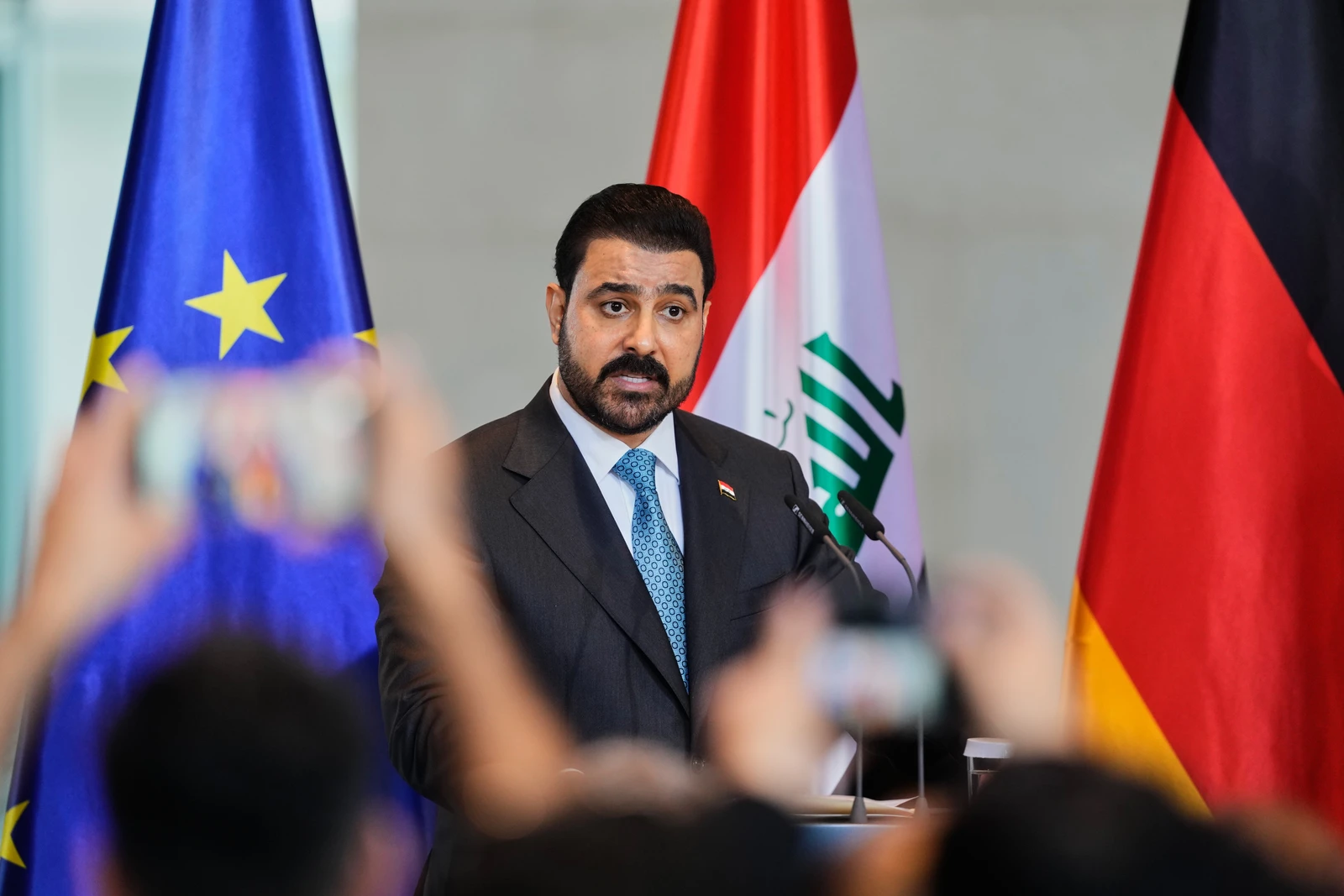
The trial has been delayed because “newly discovered evidence,” previously unknown to either the prosecution or the defense, emerged on Friday.
Regardless, having waited 38 years, the families say that although the postponement comes as a disappointment, they can wait a little longer.
“Obviously, we had hoped that the trial would begin this week,” Stephanie Bernstein, the vice president of Victims of Pan Am Flight 103, whose husband Michael S. Bernstein died in the bombing, told Arab News.
“We have many members of our family group who are elderly. Many of them were preparing to travel to Washington for the trial, and we hope and pray that everyone will remain healthy during the delay. They deserve to be able to see this in the courtroom.
“But our group has worked for almost 40 years now for justice, and if this delay is in the service of finding out about how our loved ones were murdered then we will be patient and we will wait.”
Almost four decades on from the nightmarish night of Dec. 21, 1988, the broad details of the case remain familiar to many.
Most of the victims were Americans — among the 190 killed were 35 students from Syracuse University, travelling home for Christmas following a study trip to Europe — but the citizens of 20 other countries died, including 43 British passengers.
After one of the longest and most complex investigations of its kind, conducted jointly by Scottish police and the American FBI, in May 2000 two Libyans went on trial accused of the bombing and the murder of the 270 victims.
The unique nature of the trial — the two men were tried by three Scottish judges, sitting without a jury and on neutral territory in The Netherlands — was a result of conditions laid down by Libya’s then ruler, Moammar Gadhafi, before he agreed to allow the two accused men to be extradited.
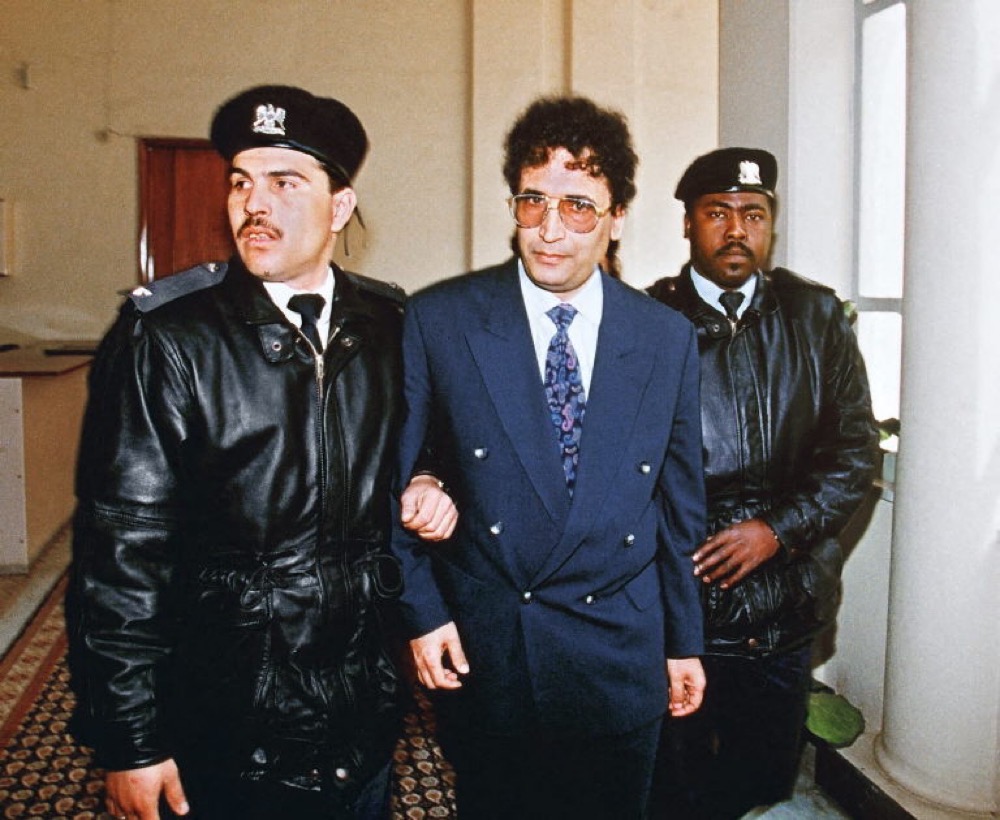
On Jan. 31, 2001, Abdelbaset Al-Megrahi, an alleged Libyan intelligence officer, was founded guilty of 270 counts of murder.
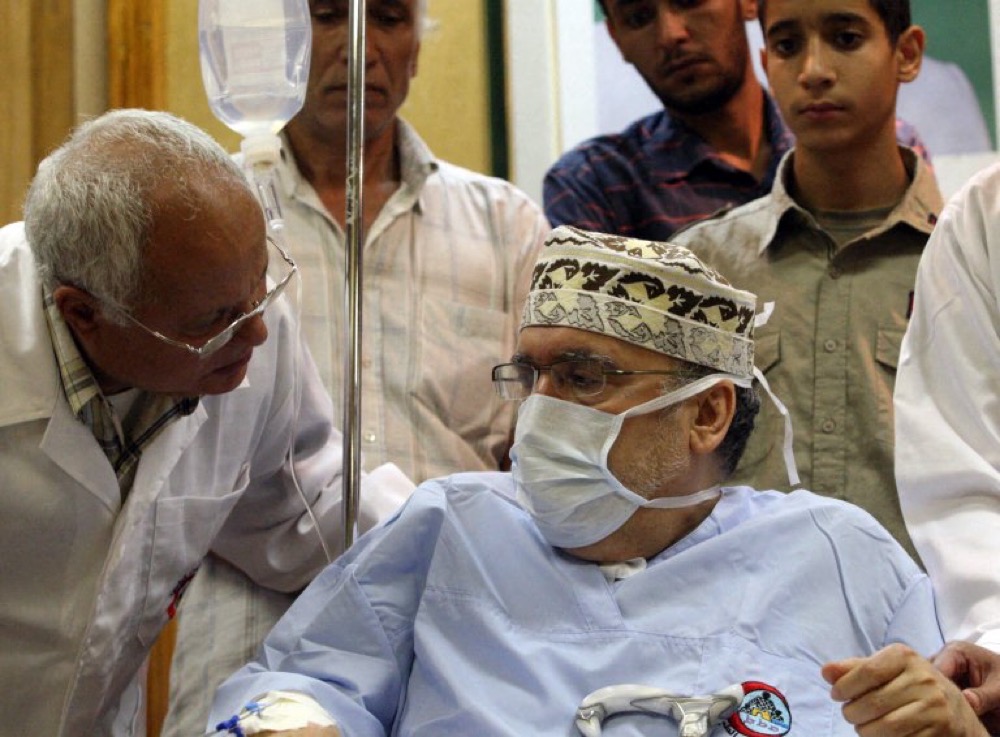
Sentenced to life in prison, after being diagnosed with terminal prostate cancer he was released on compassionate grounds in July 2009 and returned to Libya in July 2009. He died three years later, having always maintained his innocence.
His co-accused, Lamin Khalifah Fhimah, an employee of Libyan Arab Airlines, was found not guilty and returned to Libya a free man in February 2001.
But for the Scottish police, the FBI and the families of the dead, that was not the end of the story. Throughout the investigation, the existence of a shadowy third conspirator had emerged.
Megrahi, the head of security for Libyan Arab Airlines, was accused of having inserted the suitcase carrying the bomb, fitted with a timer, into the baggage system at Malta’s international airport. From there, it traveled on a feeder flight to Frankfurt, where it was loaded on Flight 103 from Heathrow to New York.
The man who made the bomb was said to have been a Libyan intelligence operative known as Abu Agela Masud, but for years his identity could not be established.
Then, in 2017, the FBI received a transcript of an interview with one Abu Agila Mas’ud Kheir Al-Marimi, aka Masud, which had been conducted as part of Libya’s internal investigations into crimes committed against the Libyan people during Gadhafi’s 42-year dictatorship.
Gadhafi was overthrown and killed in 2011. The FBI learnt that Masud had been interviewed on Sept. 12, 2012. It was March 2020 when the FBI and Scottish police were able to interview the Libyan officer who had interrogated Masud, who agreed to testify at any trial.
During the interview, Masud allegedly confessed to having made the Lockerbie bomb, and working with Al-Megrahi and Fhimah to execute the plot. According to an affidavit submitted by an FBI agent in December 2020, “he also admitted his involvement in other plots against citizens of the United States and other western countries.”
The bombing, he allegedly said, had been ordered by the Libyan intelligence service and afterwards Gadhafi had personally “thanked him and other members of the team for their successful attack on the United States.”
Masud was charged, in absentia, on Dec. 21, 2020. Two years later, in December 2022, the US Justice Department announced he was in custody in America, pending trial.
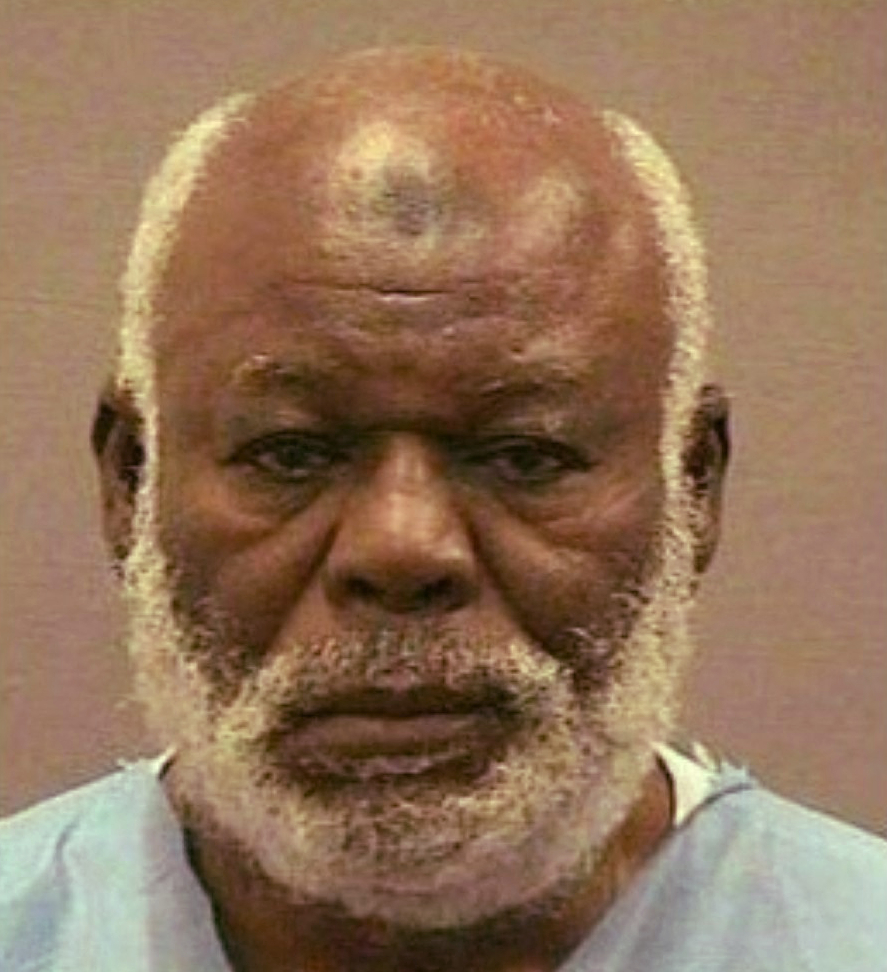
One of the many mysteries of the Lockerbie case that might be solved when the trial finally begins is how Masud found himself in a US jail — there is no extradition treaty between the two countries.
In February 2023, Human Rights Watch called on the US and Libyan authorities to “clarify the legal basis for the abusive arrest and subsequent extradition” of Masud, which had raised “serious due-process concerns.”
One of Masud’s relatives in Libya had told representatives of the group that he had been seized on Nov. 17, 2022, in his home in the Abu Salim district of Tripoli, “by an armed group whose members refused to identify themselves during the arrest, wore no insignias, and came in cars that were unmarked.”
Masud was held briefly in Misrata, 200km east of Tripoli, where his family was allowed to visit him. By Dec. 11, he was in America.
The postponement of Masud’s trial, almost four years on from his extradition to the US, is the third delay in the attempt to try his case.
It will come as a disappointment to the families of the dead, many of whom, in addition to seeking justice, are hopeful that Masud’s trial will resolve for once and for all some of the many competing theories about the bombing of Flight 103.
One of these is that not only was Al-Megrahi innocent of the crime, but also that Libya was not involved in the bombing at all — and that Iran was to blame.
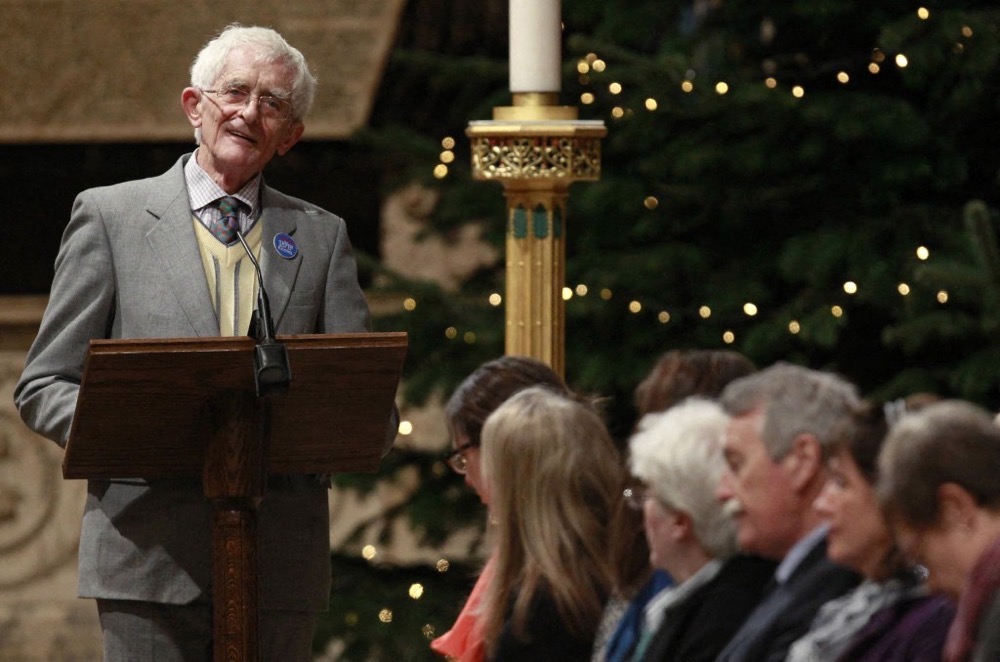
The driving force behind this version of events is Jim Swire, a British doctor who lost his daughter, Flora, on Flight 103, and who has campaigned ever since for what he believes is the truth to come out.
Swire’s story was told in a recent British-made drama series, “Lockerbie: A Search for Truth,” starring Colin Firth.
In his pursuit of that truth, over the years Swire has gone to incredible lengths, including carrying fake bombs onto aircraft to expose lax security, founding a Justice for Megrahi Campaign and even visiting him and the former Libyan dictator Gadhafi in Libya.
Swire, now aged 90, continues to insist that Iran was behind the atrocity, and that a breakaway Palestinian terror group based in Syria — the Popular Front for the Liberation of Palestine - General Command — had carried out the attack on Tehran’s behalf.
The group certainly had form. Using bombs triggered by barometric pressure devices, it had detonated explosives on board two civilian aircraft in 1970, killing 41 people on one and forcing the other to make an emergency landing.
There was also the discovery that before the Lockerbie bombing, German police had raided a PFLP-GC cell in Frankfurt, and discovered explosives hidden in radio-cassette players, similar to the one that contained the bomb planted in a suitcase on Flight 103.
Iran also appeared to have a strong motive for the attack. On July 3, 1988, just over five months before the Lockerbie bombing, a US warship escorting ships through the Strait of Hormuz at the height of the Iran-Iraq War accidentally shot down an Iranian passenger aircraft.
Iran Air Flight 655, bound from Bandar Abbas to Dubai, was struck by two missiles fired by the USS Vincennes. All 290 people on board, including 65 children, were killed.
The US Navy, which later admitted the Vincennes had strayed into Iranian territorial waters off the island of Qeshm when it opened fire, said the crew had mistaken the aircraft for an Iranian fighter jet.
What has never been fully explored, and which the trial of Masud could help to resolve, is the possibility that Libya may have carried out the attack on Flight 103 at Iran's request.
At the time of the attack, Libya was a firm ally of Iran, supplying it with weapons and the only Arab country that had taken its side in its conflict with Iraq.
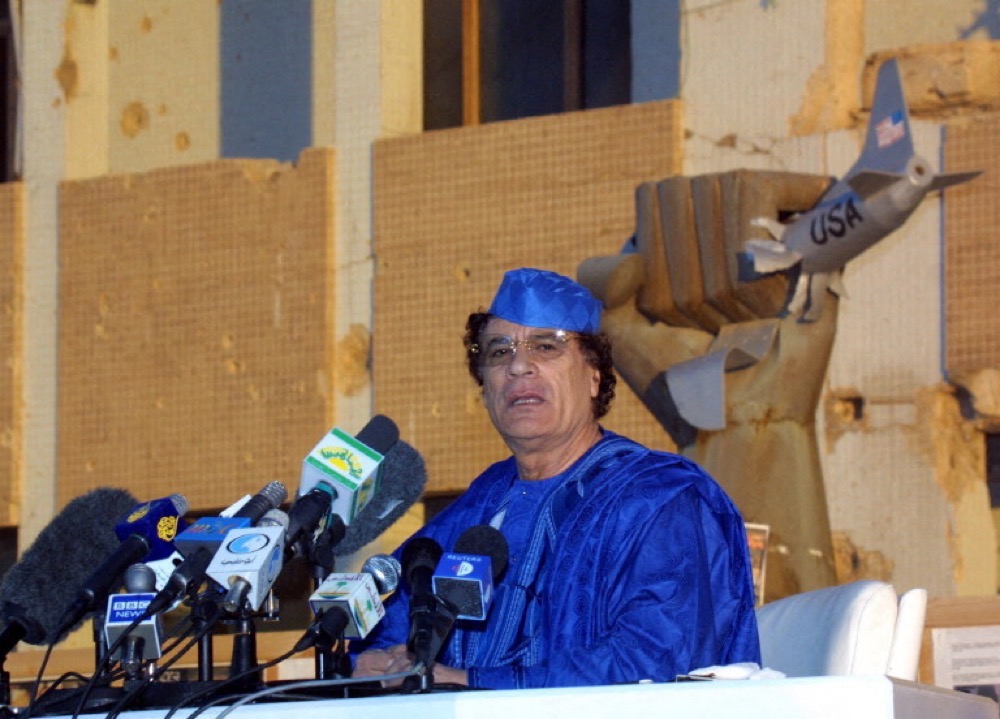
The Libyan leader also had a potential personal motive for revenge.
During US air attacks on the country in 1986, carried out in response to multiple acts of international terrorism that had been carried out by Libya, Gadhafi’s adopted daughter was said to have been killed in a raid on Tripoli.
In the late 1990s, Libya, battered by international sanctions, sought to normalize relations with the US, a process that became inextricably linked to the Lockerbie story.
Writing in 2004, Flynt L. Leverett, a former member of the US State Department’s policy planning unit, revealed that under President Bill Clinton the White House had “made clear that no movement toward better relations was possible until Libya met its responsibilities stemming from the downing of Pan Am Flight 103.”
Mediation by the then Saudi ambassador to the US, Prince Bandar bin Sultan, had “produced a breakthrough: Libya turned over two intelligence officers implicated in the Pan Am 103 attack” for trial by the Scottish court in The Netherlands in 2000.
Ahead of the trial, in 1999 Washington agreed to the suspension of UN sanctions against Libya, and in 2001 the Bush administration “induced the Libyans to meet their remaining Lockerbie obligations.
“With our British colleagues,” Leverett wrote, “we presented the Libyans with a 'script' indicating what they needed to do and say to satisfy our requirements on compensating the families of the Pan Am 103 victims and accepting responsibility for the actions of the Libyan intelligence officers implicated in the case.
“If Libya met the conditions we laid out, the United States and Britain would allow United Nations sanctions to be lifted permanently.”
In 2003, Gadhafi duly authorized the payment of $2.7 billion in compensation, to be shared among the families of the 270 Lockerbie victims.
The payout was not popular in Libya. Following the Gadhafi's overthrow, in 2012 two senior Libyan officials went on trial accused of “squandering public funds.” They were acquitted in 2013.
The stage remains set for the final act in the Lockerbie saga.
In December 2024 a section of the fuselage of Flight 103, which had been painstakingly reconstructed to reveal the location of the bomb and the damage it had caused, was transported from a warehouse in the UK to the US, to form part of the evidence to be presented in the case.
As recently as Aug. 7, a judge sitting in a Washington courtroom rejected an appeal by Masud’s lawyers that his alleged confession should not be admitted in evidence.
Judge Dabney Friedrich was persuaded in part by the in-person testimony in February of the man who had obtained the confession back in 2012. Known only as “Jamal,” the Libyan police officer is now likely to be called as a key witness when the trial finally goes ahead.
Jury selection in the case was due to have started today, Wednesday. Instead, last week “newly discovered evidence,” unknown to either side, emerged and as a result the trial has now been pushed back to a start date in January.
Masud, who is in his mid-seventies, is not in good health. When his trial was first postponed, in June 2025, it was delayed in part because he was receiving treatment for an unspecified health condition.
For the families of the Lockerbie dead seeking justice and some closure in the trial, which could well prove to be the final act in the 38-year saga, time is running out. Some have already died and many of those who remain are now elderly.
Another five-month delay, which will see the passing of the 39th anniversary of the Lockerbie bombing, is yet one more agony among the many they have endured since that hellish night in December 1988.