Changes taking place in the atmosphere and the climate system are the greatest environmental and political challenges of the 21st century.
Largely caused by human activity, the changes taking place in the climate are the cause of global worry today with the UN urging upon all countries to protect environment.
Kyoto protocol and Marrakesh convention were good initiatives in these direction and serious efforts are on to check global warming, which has caused unprecedented rise in sea levels causing worry for island nations to be more specific in pacific nations like Kiribati, Nauru, Fiji, Palau. Maldives has maintained that international climate cooperation is an urgent need.
Setting a goal in this direction, Germany has put itself ahead with the group of leading countries working in this direction and sees itself as a pioneer in environmental and climate protection.
According to a report shared by the German Embassy in Riyadh, Germany is a forerunner in climate and energy policies in the international arena and seeks to achieve ambitious emission-reduction goals.
“With the 2011 decision to opt out of nuclear energy and to decommission the last nuclear power station by 2022 at the latest, Germany is sending out a signal that has been respected throughout the world,” the report said.
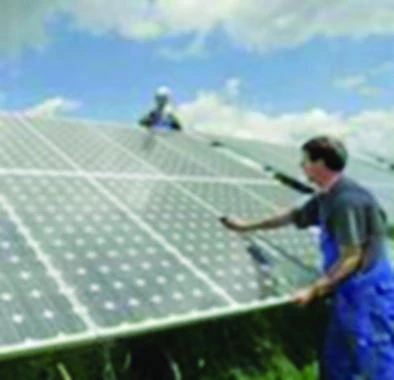
It said the measures in the Integrated Energy and Climate Protection Program taken by Germany not only serve to protect the environment, but also to promote the development of an innovative future industry, which is a real job creator, is highly internationally competitive and increasingly active in foreign markets. Not only that, in 2010 one solar cell in five and every seventh wind turbine came from Germany.
More than 360,000 people work in the renewable energies industry. In addition, there are around one million more jobs in environmental technology, such as water purification, filter technology, recycling and re-naturalization.
Another job driver are companies, which, in times of rising energy prices, are focusing on energy efficiency technologies (power stations with higher levels of efficiency, combined generation of electricity and heat, energy efficient construction, energetic building renovation, and energy-saving cars).
According to information from the International Energy Agency (IEA), Germany is already in the top group of countries, which demonstrate a substantial economic performance with relatively low energy use.
Against the background of the consequences of climate change, which science has described in vivid detail and include increases in temperature, floods, droughts, accelerated melting of the polar icecaps and species extinction, as well as the constantly increasing global consumption of fossil fuels, renewable, climate-friendly alternatives are becoming increasingly more significant.
The availability of wind, water, sun, biomass and geothermal energy is unlimited and they release no emission, which are damaging to the climate.
Renewable energies now make up for more than ten percent of all German energy consumption. With almost 14 percent of global wind energy output, Germany is placed third behind China and the United States, the report said.
Moreover, the North Sea Offshore Initiative, in which Germany and eight other EU member countries have joined forces, sees new potential for its use.
With regard to photovoltaic technology, which is used to turn the sun’s rays into electricity, Germany, with an installed output of 17,300 megawatts, is even placed first ahead of Spain and Japan in 2010. The desertec initiative, which is largely being funded by German companies, is a major European investment in sustainable energy technology.
By 2050, the energy produced by solar power stations in North Africa is intended to cover 15 percent of European electricity requirements.
In the innovative green technologies segment, Germany has set a goal putting itself at the very top worldwide as by 2020 the federal government intends lowering greenhouse gas emissions by 40 percent compared with the 1990 level.
Furthermore, the use of renewable energies is to be consistently expanded and energy efficiency increased further.
The goal is for renewable energies to become the major source of energy supplies.
In an international context too, Germany played a decisive role in getting environmental and climate protection on the agenda.
The Germans, EU and G8 presidencies in 2007 made climate protection objectives and energy policy two of their main goals.
The European Council, with its challenging resolutions to reduce greenhouse gas emissions, and the declaration of the G8 Summit in Heiligendamm, Germany, where heads of state and government pledged “to seriously test” the objective to halve greenhouse gas emissions by 2050, were important steps toward a global answer to climate change.
The climate change conference in Bali in 2007 laid the foundation for the so-called “post-Kyoto process,” which, in addition to the industrial nations increasing their measures, also involves actively, including emerging nations in climate protection.
That is decisive, as according to the Intergovernmental Panel on Climate Change (IPCC), the worldwide emissions of CO2 will have to be halved by 2050 if global warming is to remain under control this century.
Moreover, the EU climate and energy pact is being implemented in the 27 member countries in accordance with national quotas. Germany will make an above-average contribution to reducing greenhouse gases.
Germany forerunner in climate and energy policies