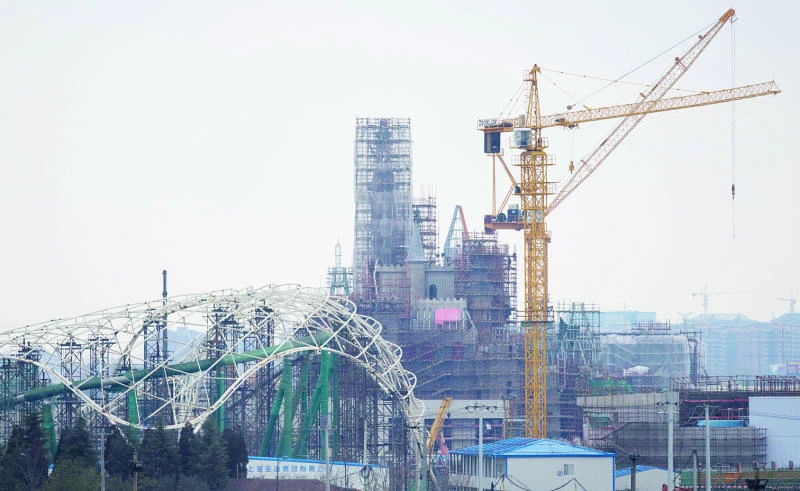
SHANGHAI: The towers of Disney’s planned Magic Kingdom in Shanghai are wreathed in scaffolding and mystery after the US entertainment giant pushed back the opening of its first mainland China theme park to 2016.
On a tightly-guarded, 3.9-square-km site east of China’s commercial hub, a grey turret of the unfinished “Enchanted Storybook Castle” rises into the sky.
There is no Disney branding at the main entrance, only a sign reading: “Shanghai International Tourism and Resort Zone.”
It was originally due to be transformed in time to open this year, but Disney chairman and chief executive Bob Iger last week announced a delay, pushing the opening back to next spring.
He attributed the change to an expansion in the park’s size and number of attractions.
“The artistry, complexity, the magnitude and the detail, it’s all quite astonishing,” Iger said, calling the facility “spectacular.”
But Shanghai authorities have not confirmed any plans to expand the project, and people familiar with it point to it following stricter environmental and labor standards than normal in China.
The studios of Hollywood are competing not just for screen eyeballs in China — whose 1.37 billion people generate the second-largest annual box office in the world — but also theme park visitors.
The Shanghai Disney Resort will be the company’s third in Asia after Tokyo and Hong Kong. But its park in the former British colony can only partly serve the Chinese market, while Universal Studios and DreamWorks Animation are planning rival attractions on the mainland.
For Shanghai, the park represents the city’s tourism future following the World Expo in 2010.
One Chinese academic estimates it will contribute $3.3 billion to Shanghai’s economy every year and account for one percent of the city’s annual gross domestic product.
Disney and its Chinese partner, state-backed Shanghai Shendi Group, broke ground on the park in April 2011.
Chinese construction is normally staggeringly fast, with towering skyscrapers and multi-lane highways changing urban landscapes at extraordinary pace.
But a Shanghai official told AFP that said one delay arose after contaminated soil on the site failed to meet environmental standards, prompting Disney to bring in a foreign contractor to remedy the problem. Workers removed topsoil up to a meter deep.
With the opening of its first resort in mainland China, Disney is banking on Chinese parents willing to spend lavishly on their children and a rising middle class intent on travel.
It has not announced prices for Shanghai, but an adult one-day ticket at the Hong Kong park costs $65, nearly a quarter of China’s average monthly disposable income last year.
When the $5.5 billion Shanghai facility opens, it will boast the biggest Disney castle in the world, a production of “The Lion King” in Chinese and a pirate-themed zone based on the movie franchise “Pirates of the Caribbean.”
An artificial mountain will loom over the park, becoming the highest hill in Shanghai’s Pudong district, and a 420-room Disneyland Hotel is planned in an “elegant Art Nouveau style,” with another based on the “Toy Story” films.
On a commercial level, an adjacent “Disneytown” will have 46,000 square meters of shops, restaurants and a 1,200-seat theater.
He Jianmin of the Shanghai University of Finance and Economics, who has consulted for the city on the tourism zone, forecast the park will initially attract seven million visitors a year, eventually rising to 16 million.
But a site worker sweeping a street said he might not share in the excitement after the park opens.
“The Disney park will definitely be fun, but I don’t know if I will go,” he said. “I don’t know how much tickets will cost.”
Mystery cloaks Disney’s Magic Kingdom in China