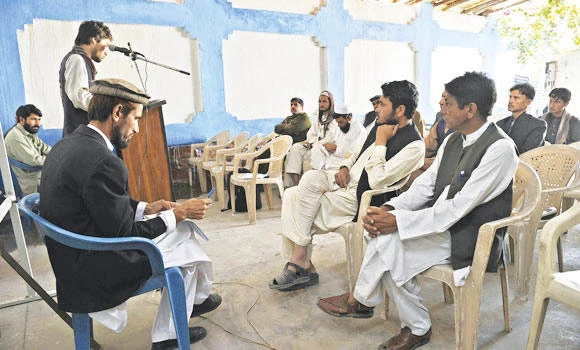
At a relaxed open-air recital, twenty Pashtun poets come together every week to share their dreams of peace, indifferent to the drones and helicopters in the Afghan skies above.
Jalalabad is regarded as the heartland of Afghan poetry in a region better known for its warriors than its wordsmiths, on a plateau south of the Himalayan mountains of the Hindu Kush.
Meeting every Friday — a day of rest in Afghanistan — the poet’s circle consists of men in long traditional white, grey, black or brown Afghan shirts who sit on plastic chairs in a courtyard covered by vine leaves tumbling over a bamboo roof.
They take it in turns to speak from behind a makeshift wooden lectern, their words offering strength and hope in dealing with life in a country ravaged by war for over three decades.
Their language, Pashto, is the dominant tongue in the south and east of the country.
Poet’s circle member Baryali Baryal said humor is the best antidote to the relentless stress of living with war.
“We have been in war for three decades, so everybody is sad, suffering from different problems,” he said.
“So since it’s war, I write funny poems. People are unhappy, so I think if they sit five minutes with us and we make them laugh, they will feel happy.”
With a large, earth-colored Afghan shawl on his shoulders, Baryali took his place at the pulpit and began describing life on the streets of Jalalabad, to the laughter and applause of his audience.
Baz Mohammad Abid has several collections of poetry to his name.
“Three decades of war has strengthened our poetry and created more poets,” he said.
His poem “Unity” evokes dreams of peace and reconciliation in a population devastated, divided and exhausted by conflict.
“Peace and unity will come to our country again / From every Afghan mouth comes the words peace and unity / We will stay peaceful if we remain united / We will live peacefully in a house built on unity.”
With quiet composure, Abid says such messages are the “duty” of a poet.
“The presence of the poet is for this purpose: Being constructive to society. In these times, where we need more peace and love, it is the duty of a poet to write or create poems for peace, and love.”
Sometimes referred to as the “City of Poets,” Jalalabad is full of places where poetry can be discovered, with many small basement bookstores providing quiet refuge from the noisy, rickshaw-crammed streets.
“Most visitors come to buy religious books or textbooks, but there are also many who are looking for poetry,” said Zainullah, a bookseller.
Jalalabad’s university has a reputation for being highly conservative, but the poetry courses it offers are full up.
Pashtun poets dream of peace in Jalalabad