In a region of 300 million people stretching from Morocco to Syria, Arab writers share the glory of a literary language, which has helped unite them. However, many writers feel uncomfortable with a monolithic “Arab” identity. In any case, innovative writers want to be appreciated as individual talents rather than standard-bearers for a language, gender or culture. This is the case with the Saudi novelist, Raja Allem whose style has been described as “a kind of Saudi magic realism”. She does not represent Saudi women, “I only represent myself,” she says.
Arabic novels just like fiction literature in the rest of the world are a reflection of society’s values, traditions and lifestyle. A novel not only expresses the changes in people’s lives but it is also an effective way to address people’s problems, concerns and suggest solutions.
According to Hifzur Rahman, the author of “Social Trends in Saudi Novels 1930-2000, “The Saudi experience of novel writing has gone through three phases: the beginning, technical maturity and advancement, finally rejuvenation and modernization”.
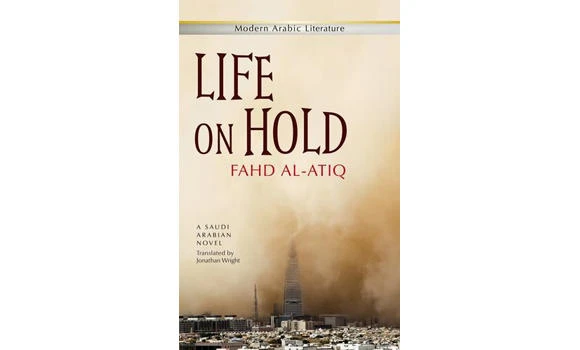
Fahd Al-Atiq’s novels belong to the third phase, a period dating from the 1990s, which is characterized by progress in terms of style, technique and content. His novel, “Life on Hold” which was first released in 2004 as “Ka’in mu’ajjal,” has recently been translated into English by Jonathan Wright, and published by The American University in Cairo Press. Riyadh and its atmosphere are at the heart of this short, and intense novel.
The first sentence announces the tone of the book. “The days are all much alike here”. These words are repeated again on the following page: “In this city of masks, the days have been much the same in their tedium since distant times. Even the faces look alike, and everyone looks aimlessly into the faces of others. But what is behind all these looks, all these masks?”
“Life on Hold” is about lifting the veil and revealing the faces behind the masks. The author opens the heart of Riyadh and explores its mind through the character of Khaled. As the protagonist witnesses the society moving from neighborhoods with mud houses to suburbs with new concrete houses, he notices that, “Society has split into two camps, one camp adopting the slogan that God is strict in punishment, the other insisting that God is forgiving and merciful, and everything naturally ended with the words God Almighty has spoken truly”.
This dichotomy is also very apparent when the author compares life in the not so distant past and life in the newly built concrete villas mushrooming in the suburbs. Fahd AL-Atiq has captured the soul of Riyadh and he excels in describing both, the city’s elusive atmosphere and life in the old days, the “dreamy Najdi life of simplicity and poverty”.
“In this neighborhood the streets were more important than the houses. They came to know that later, when boredom at home drove them to escape into the streets, where they could act out their small dreams of rebellion and shake off their inhibitions. The streets were long and narrow, lined with mud-brick houses attached to each other, of about the same height, and the wooden doors were mostly half-open, so that the voices of the neighbors mingled with the voices of the household as if they were all one happy family,” writes Al-Atiq.
A life of monotony and boredom engulfs the distant suburbs where people are isolated from each other. There are no more visits from neighbors and relatives like in the old days. People are also continuously on the run. The city has become a behemoth “hive of activity without producing anything real and without the most basic elements of real life”.
However, this new prosperity, this economic surge, and the plethora of malls, safe havens of frenzied consumerism cannot hide the city’s origin, a city born from the desert where clouds of dust are always on hold. The highlight of this novel is a sensational description of a mighty dust storm, which actually shrouded the Saudi capital several years ago.
“The dust that had long lain stirred and started to chase after the small spiraling gusts of air. The circle widened and the dust rose to form a red pillar that filled much of the vat sky on the edge of the city, driven by a wind that was brutal and increasingly frenzied. It spun like a woman looking for a lost love. The air raged in the depths of the city, pounding it from all sides, as if it wanted to swallow the city up with a whistling, angry and harsh. The dust fell in abundance on the stunned residents, coating the roofs of the houses and mosques, shrouding the city in darkness, then moving on, crossing the streets and the pavements, the lanes and people’s faces, covering the walls, the trees, and the ancestral tombs, covering everything, driven by some obscure malignant impulse…”
“Life on Hold” is all about the search of one man for the truth. Khaled believes the truth is elusive but he is willing to question the veracity of this statement. Page after page, we follow the protagonist in his quest. At the end of the novel, the young hero discovers that the elusive truth he has been chasing from the beginning is still elusive.
Fahd Al-Atiq has written a compelling novel. “Life on Hold” is the third Saudi novel published by AUC Press. The two previous ones are “Wolves of the Crescent Moon” and “Munira’s Bottle” both written by Youssef Al-Mohaimeed.
Saudi novels have come of age. There are many talented Saudi writers especially female writers who deserve greater recognition and exposure. This is the case with Omaima Al-Khamees, Laila Al-Juhni, and Raja Allem to name but a few. I can only hope that the AUC Press will publish their novels in the near future.
Revealing faces behind masks