It takes courage to serve as a soldier, but for Saudi Arabian army officer Abdulnasser Gharem, perhaps his biggest challenge has been his fight to express himself as an artist. Now at the rank of colonel, he looks back at the early days of his army career and reflects that his artistic efforts were not understood. “In the beginning it was terrible — it was so hard. It has taken me 18 years to convince them that what I am doing is right,” he said.
But ironically, he added, it was his army training and discipline that gave him the fortitude to persevere. “I learned from the army to take a long-term view; that’s why I didn’t stop or allow anyone to direct me.”
Gharem was talking at an exhibition of his work at the Edge of Arabia gallery in Battersea, London. He has an ability to take an unflinching look at life around him and convey his viewpoint whether through the canvas, video or performance art. He places great importance on people developing their own vision of the world, based on broad learning and freethinking. This attitude was forged by his feelings of frustration at the lack of resources and knowledge available to him as a young man.
“At that time the religious influence was very strong. We had only one source of knowledge — so how could you educate yourself? There were no other channels for learning,” he said. He applied for art college but his application was ignored. “I was good at drawing but they didn’t care,” he recalled. Also, he said, as the eldest son in a family of 11 children, there were great pressures on him to follow a conventional career path. That’s why he joined the army — like many young men from his city.
It was in the early 1990s that the Internet transformed his world. “I started to discover what other artists were doing and the mediums they were using. I remember I used to sit in front of the screen for up to nine hours at a time. It used to take ages to download just one image,” he remembered. He used the Internet to study. “I taught myself philosophy and history and studied art. Then I thought, ‘you can say something through art. It’s a powerful medium,’” he said. All of this self-education was taking place against the backdrop of the 1990-91 Gulf War.
He believes that thinking independently is important, but observed that many people around him just toed the line. “They just listened to what the government told them. They didn’t realize at that time that they had the right to their own view,” he said.
Above all, he said, his approach is humanitarian rather than political or ideological. In 2007, he came across families living among the ruins of their demolished village in the Al-Oshaima district of Jazan province, near the border with Yemen. He stopped to talk to the villagers and learn about their problems. He discovered that Al-Oshaima had once been a thriving village but that the government had requisitioned the houses to accommodate the expansion of a nearby petroleum plant. Thirty years ago the villagers were promised compensation for the loss of their homes. Due to the lengthy delay in payment, by today’s value the compensation would amount to an insignificant sum. It was certainly not enough to buy a new home and start a new life.
Gharem’s multi-media collage and six-channel video entitled “Manzoa” offers a stark insight into the plight of the villagers whose homes had been bulldozed. “Manzoa” translates as ‘It will be taken away,’ or ‘It will be demolished’. This is the message painted on the walls of the houses ear-marked for demolition. When Gharem first came across the fishing village the villagers — who had come to fear anyone who looked like an official — regarded him with suspicion and distrust.
To gain their trust, Gharem wore a T-shirt on which he had printed “It will be taken”. By this action he showed solidarity with the villagers who began to share with him details of their long ordeal.
In the video installation old black and white film of the men folk dancing in their village in the happy days prior to the demolition is juxtaposed with elders sitting amongst the rubble of their homes and talking about what happened.
An old man says, “No-one cares whether I’m living or not living — it’s become dog-eat-dog.” Another adds, “I was sleeping at home with my family and woke up to find them disconnecting the electricity. They told us that they had listed our home and that we had 24 hours before it would be bulldozed.” Of the compensation, one villager, a former fisherman, says, “What I received wasn’t even enough to buy fish.”
One of the most moving artworks depicting the plight of the villagers is entitled, “Manzoa — House Number 1, 2013”; it is a found object collage made up of the house numbers of the demolished homes.
For Gharem, his breakthrough as an artist came in 2007 when he decided that in the absence of any art gallery to showcase his work, he would simply take his art to the street. The sight of a tree completely shrouded in plastic wrapping thus confronted passers-by. On closer inspection they saw that a man was also encased in the wrapping. Suddenly, the man emerged from the cocoon like a butterfly and people shouted, “What are you doing!?” Gharem explained that he was drawing attention to a major ecological problem. The tree that he had enveloped in plastic was an imported species from Australia, which unfortunately had spread disease to the native Saudi trees. This fact was then debated in the street and became a talking point about the importance of not messing with the eco-system.
Gharem recalled: “People started to engage and then I knew what I was doing. It gave me the confidence to continue. Art is a powerful medium.”
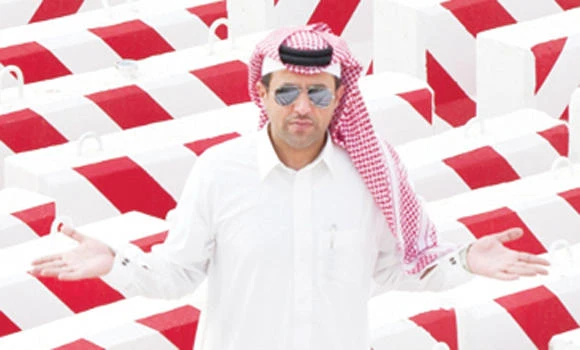
Another of his works shows a concrete roadblock. When you look closer you can read a message that says: “Don’t trust concrete.” He recalled that after the 9/11 destruction of the World Trade Center in New York, these roadblocks sprang up in major cities in Saudi Arabia. “These barriers were everywhere — around the US Embassy and the hotels,” he said. It was explained that the barriers were in place to protect people, but Gharem saw them in a different light. “You can’t protect people from ideology by putting up concrete barricades. You have to develop education, encourage people to think and give them their freedom. That’s the way to protect people,” he said.
In 2011 a sculptural installation by Gharem entitled ‘Message/Messenger’ was sold at Christie’s in Dubai for $842,500 (SR3,159,712), one of the highest prices paid for a work of art by a living Arab artist. Today, collectors seek after Gharem’s work and he has recently been invited to stage an exhibition of his art collection in Saudi Arabia. Gharem is an inspiration to artists everywhere who strive to have a voice in a world so often dominated by bureaucracy and rigid doctrines.
Email: [email protected]