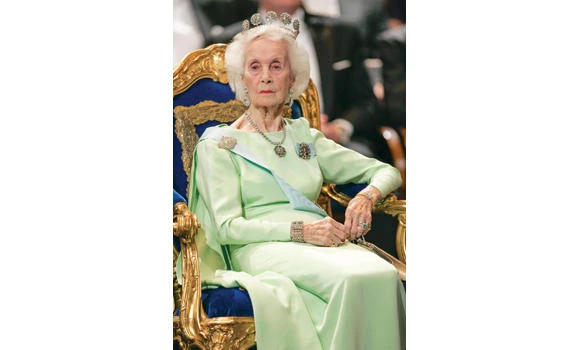
STOCKHOLM: Flags flew at half-mast across Sweden yesterday as the country mourned the death of Princess Lilian, a Welsh-born commoner who stole Swedes’ hearts by waiting three decades to marry her lifelong love Prince Bertil.
Born Lilian Davies in the Welsh coalmining town of Swansea in 1915, the princess died at her Stockholm home on Sunday at the age of 97, surrounded by the royal family. She had suffered from Alzheimer’s.
Prince Bertil, the uncle of King Carl XVI Gustaf, died in 1997. The couple never had children.
Lilian’s sacrifices for her prince endeared her to Swedes, who were gripped by the romantic love affair.
Sweden’s two leading dailies, Svenska Dagbladet and Dagens Nyheter, featured pictures of the white-haired princess on their front pages and dedicated several pages to her life, hailing her patience and spry sense of humor in equal measure.
She was like a grandmother to the current royal family, and was often seen together with them at official functions until 2010.
“The princess was very much loved by our family ... the kids always appreciated the princess’ funny pranks,” King Carl XVI Gustaf said in a comment referring to his now-grown daughters Victoria and Madeleine and son Carl Philip.
During World War II, Lilian worked at a factory in London making radio sets. Her husband, Ivan Craig, whom she married in 1940, had been drafted into the army.
In 1943, she met Prince Bertil at the posh Les Ambassadeurs club in the British capital, where he was stationed at the Swedish embassy.
The couple’s romance flourished, and she moved in to his London flat after hers was damaged in air raid.
She divorced in 1945 on amicable terms, her husband having also met someone new while abroad.
But in 1947, the unthinkable happened. Bertil’s eldest brother, Crown Prince Gustaf Adolf, died in a plane crash, leaving behind an infant son who would one day inherit the throne. The prince’s father, King Gustaf VI Adolf, refused to give his blessing to a marriage between Bertil and Lilian, so as not to jeopardize the future of the monarchy.
Sweden’s fairytale princess dies at 97