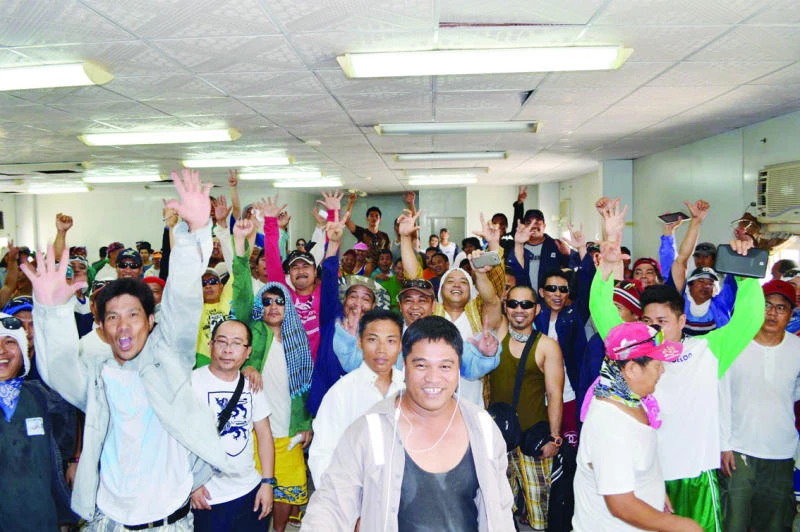
As many as 950 overseas Filipino workers (OFWs) have reportedly gone on strike over the last two months in protest of an alleged contract breach by their employer and rampant labor rights violations, according to the Filipino migrant rights group Migrante-Middle East (M-ME).
According to Riyadh-based M-ME regional coordinator John Leonard Monterona,, OFWs working for the Al-Mojil Group of Companies (MMG), a subcontractor for a leading oil company, have been on strike for the third month in a row following the failure of a month-long negotiation with their employer, who they said did not comply with the terms and conditions of their employment contracts.
But Philippine Labor Attache Alejandro A. Padaen in Alkhobar has another version. He corrected the number of OFWs involved in the ‘stop work’ protest. “As of today, there are around 530 workers who have been affected and not more than 900 as stated in your e-mail,” he clarified.
“If you are referring to the MMG workers in the Jubail Camp, please be informed that they did not stop working” Paden told Arab News, adding “They are not really working as they already completed their respective contracts and are just waiting for their repatriation, which is the main issue in this case.”
In his e-mail, the official clarified that the problem MMG’s inability to repatriate these people with their full benefits was because of the company’s financial condition.
He said that the company offered to pay the benefits of those who are willing to go home. The payment would be routed through their designated banks in the Philippines on a staggered basis for a period of three to six months. “The company has been repatriating workers who agreed to this proposal in batches,” Padaen added.
Monterona said the OFWs were victims of contract violations, such as delayed payment of salaries and non-renewal of iqamas (residence IDs). Others, who have been working for up 10 to 15 years, were not given end-of-service benefits (ESB). They were also not allowed to go on vacation, though they had already successfully completed their one-year contract and some of them were deployed to sites with no job assigments.
The community leader noted that the OFWs from five various job sites have stopped working since July 2014. They include workers at the MMG Jubail Camp 2, which had 500 OFWs and the MMG Yanbu campsite, which had 100 OFWs, while the MMG WASIT SK camp had 150 OFWs, the MMG Shaybah campsite 100 OFWs and the MMG-Dhahran campsite 100 OFWs.
According to Monterona, the MMG-OFWs’ complaint was brought to the attention of the Philippine Labor Overseas Office (POLO) in Alkhobar in June 2014, “but there was no prompt or timely intervention until the distressed OFWs were forced to stop working the following month to press their employer to honor the terms and conditions of their contract.”
The POLO official, however, has denied the allegation, saying it is not true that there was no prompt intervention from their end. “We have been meeting with the company almost every week to follow up on their repatriation and explore possible solutions since the problem came to our attention last February.
Monterona has challenged the POLO official’s claim. “The Department of Labor and Employment (DoLE), its labor offices in the Kingdom, and the Philippine Overseas Employment Administration (POEA) failed to safeguard our OFWs labor contracts amid rampant employers’ violations in as much as they failed to provide assistance to distressed OFWs,” he observed.
Filipino workers protest against contract breach