Fishing and fish trading off the coast of Saudi Arabia, a profession that dates back almost 3,000 years, is no longer the job of choice for the average Saudi, and the reason why nationalization of the fishing industry stands at almost zero percent.
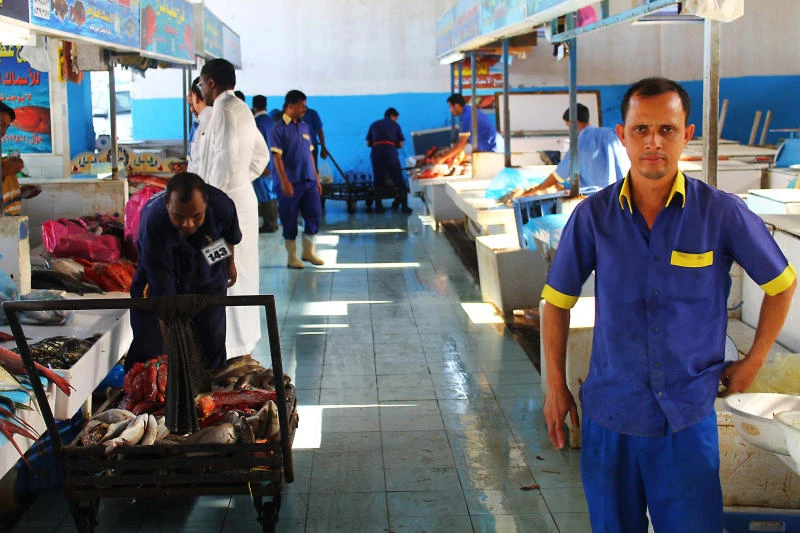
Most of the manpower in this field comes from other countries, especially Bangladesh. The fish market in Jeddah has popularly become known as “Bangala” owing to the large number of Bangladeshis in the industry.
Economic experts and businessmen in the region have stated that the domination of non-Saudis in the fish market sector has become one of the most challenging national issues, much to the annoyance of both consumer and investor.
A tour by Arab News to the Central Fish Market in Jeddah showed that many business owners and investors demand that the fishing profession, which is historically associated with the birth of the city of Jeddah and its people, should be replaced by Saudis at all levels. That said, they clarified that this process must be implemented systematically through defined mechanisms.
Salem Bahatab, a Saudi wholesale fish company owner, told Arab News that fishing is a physically demanding profession requiring fishermen to work long hours and that they sometimes may have to stay on a boat at sea for several days at a time.
Bahatab also said that veteran Saudi fishermen have relinquished this profession to other commercial and industrial businesses due to economic progress in the Kingdom and the industrial boom.
“I don’t think it will be easy nationalizing the fish market because we have an extreme scarcity of qualified Saudi workers who can take over the existing workforce,” Bahatab said. “While it is true that the Ministry of Agriculture stipulates that a fish shop can issue only nine visas for expatriate workers and must have one Saudi worker among them, the reality is that you will find very few Saudis at the fish market.”
In fact, many fishermen would probably be considered within the “red” (unsatisfactory) range of the Nitaqat system, preventing them from visa renewal and incurring of high penalties.
“Yet we still see the market as it was 25 years ago,” he said.
Mohammad Shoui’e, a worker at a company investing in the fish market, said that it would be difficult to hire Saudis workers for such jobs due to the pungent odor of fish that has to be tolerated on a daily basis.
In addition, low wages offer no incentive to work in the industry. “Nevertheless, with a planned and strict long-term scheme, the profession can attract more nationals,” Shoui’e added.
In spite of the existence of a monitory office within the central market, price-tampering still prevails. Fish customer Abu Saud said that in addition to hygiene inspections, there should also price inspectors for salesmen with no direct supervision.
Mustafa Karim, another regular shopper at the central market, said that quality control on the produce is also absent. Salesmen can market frozen fish as fresh produce or sell fish and shrimp from waste ponds.
“Many buyers cannot tell the difference. It is an unacceptable violation that can have an adverse effect on health,” Karim said.
Prices of fish such as “najil” have soared to SR 110 per kilo, up SR 30 from only a few months ago.
Naeem Iqbal, a Bangladeshi worker at one of the shops, justified the price hikes.
“We raise fish prices relative to how much we’ve paid for the produce from fishermen,” Iqbal said. “Wholesalers, in fact, determine prices.” While many do not raise prices, many foreign salesmen exploit the demand for fish, especially during the summer season.
“Workers decided to raise the price of fish following the price hike in meat,” Merdad said.
Adel Abdullah Sham’a, the deputy head of the fishermen group, said:
“Nationalization of this industry will not be successful unless Saudis change their misconceptions,” Sham’a said. “What many Saudis are not aware of is that investor turnover in the fish market can be much higher than expected. Income can be as high as SR 10,000 after gaining experience.”
Khalid Al Shwaiki, director-general of the Cooperative Society of Fishermen, said that “There around 5,000 foreign workers in the fish market, 85 percent of whom are at least 55 years old. We target the low-income segment of society for those wishing to supplement their monthly revenue through part-time work.”
A project entitled “Reviving and Maintaining the Fishing Profession” is chaired by Prince Khalid Al-Faisal and supported and sponsored by governmental bodies. The project has about 270 members.
“There will be a special joint committee working on eliminating obstacles and misconceptions about the fishing profession among Saudi youth and which will issue licenses,” he said.
Abu Shoosha also said that the society runs special training programs on fishing and sailing in collaboration with the private and public sectors. The project benefits from research on fisheries and helps to transform them into practical courses and training programs available for free.
“Furthermore, a special fishing institution, which is considered the first of its kind in the Gulf region, has recently been constructed with equipment and facilities.
The first training course at the institution kicked off in May 2011 with around 100 trainees. The trainers were provided with an integrated training system and 50 boats equipped with GPS and specially designed for training. Each boat costs about SR 250,000.”
A special website for the project was set up and 370 nationals have applied and joined the courses following an announcement in local dailies.
Fishing no longer a profession of choice