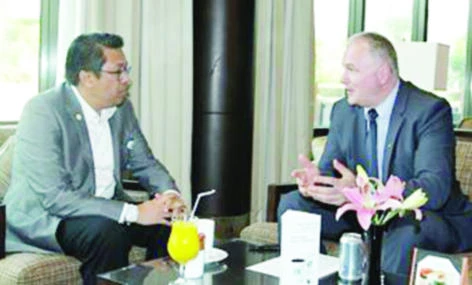
RIYADH: Hungary is seeking to cooperate further with the Kingdom in various economic sectors including renewable energy and education.
This is according to Laszlo Szabo, deputy minister at the Hungarian ministry of foreign affairs and trade, who is visiting the country with 20 government and private sector representatives.
Szabo said Saudi Arabia was a very important player in the Arab world and international community, and that Hungary wanted to cement the “good political collaboration for decades” with better business ties for mutual benefit.
He said that Saudi was one of the countries in the Middle East with the most developed infrastructure. “Of course the scarcity of water is a big risk and we believe we can help with our expertise. Renewable energy is one of the areas where we would like to cooperate,” he said.
Szabo said that Hungary had become a major destination for investors over the past few years, and has one of Europe’s fastest growing economies despite the global economic slowdown.
“We followed our own economic direction and basically have our own policies. We encourage companies to invest and employ more people,” he said. “We have a flexible labor code and were also among the first to introduce income tax.”
“We really wanted to make sure that we boosted our economy, so rather than wait for the support we actually began running ahead of the game. Basically we were able to attract 14 percent more investment last year.”
He said Hungary offers 450 different courses to study for Saudis and other foreigners in English. The Saudi government has sponsored 20 students to come to the Kingdom, while 200 Saudis have gone to Hungary, he said.
“We hosted the first group of Saudi students who graduated last year from a Hungarian university. I believe the more people we have graduating from each other’s schools the more we will be able to attract people from a business perspective.”
He said Hungary’s schools can also offer studies in physics and nuclear reactors. “As much as 65 percent of our electric comes from nuclear energy and we do have a lot of expertise and decades of experience.” He said diversification of energy sources and income was important for all countries. Based on my knowledge, 90 percent of Saudi income comes from oil and 75 percent of the total income of the government is dependent on oil. So the more diverse your economy, the less it will depend on oil.”
“That’ll probably bring more wealth and more security and stability for the country. This is exactly what we have been trying to achieve in Hungary as well but unfortunately we don’t have the natural resources. We have only very limited gas and our oil and gas supplies mostly depend on Russian pipes that come through Ukraine ...”
“We would like to diversify our energy supply and not only depend on Russian oil. That’s why for us renewable energy such as solar and wind, nuclear energy and alternative sources of gas and oil are all very important.”
On visas, he said the country issued 2,000 last year and planned to do more this year because of closer ties between the two nations. There are now visa offices in Riyadh, Jeddah and Alkhobar, he said.
Hungary seeks closer ties with KSA