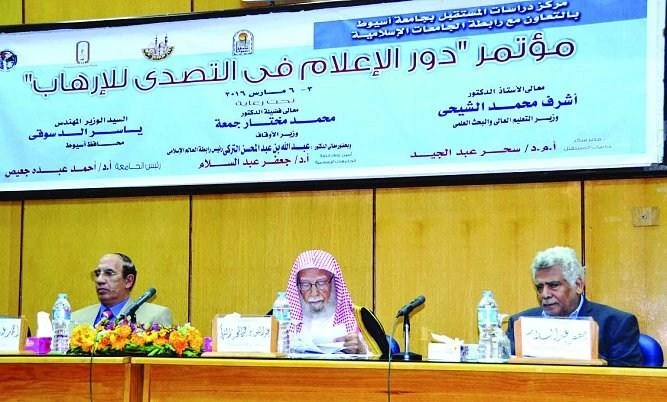
RIYADH: A conference on combating terrorism, which concluded in Egypt on Saturday, hailed the tireless efforts of Custodian of the Two Holy Mosques King Salman for fighting terror and extremism to preserve the unity of Arab and Islamic nations.
The three-day International Conference on the Role of Media in Countering Terrorism, held at the University of Assiut, Egypt, was presided over by Secretary-General of the Muslim World League and Chairman of Islamic Universities Association Abdullah Al-Turki.
Egypt's Minister of Higher Education and Scientific Research Ashraf Mohammed Al-Shihi and Endowments Minister Mukhtar Jumua also attended the conference.
The conference called the Muslim World League to hold a seminar for journalists and scholars of modern technology to find ways to prosecute terrorists through the Internet and digital media. It was felt that through the promotion of media education programs in Arab and Islamic countries, the ugly face of terrorism could be identified and then wiped out for the greater good of the nation.
While stressing the ethical values of journalism, it was strongly felt that the freedom of opinion and expression should be in accordance with the values of Islam and its rulings, with regard to terrorist operations, and the media should abstain from publishing distorted facts to promote the spread of terrorism and extremism.
The body also urged integrated efforts between the media, and educational and religious institutions in the Muslim world to develop a strategy to combat terrorism and respond to the plan to find security solutions.
Last year, the Muslim World League held a similar conference in Makkah in which Muslim scholars said terrorism is not linked to any religion or region, and can only be defeated by a coalition of moderate forces across the world.
In a declaration issued at the Muslim World League conference in Makkah, it was said: “The elimination of terrorism and religious extremism will not be achieved by the spread of Islamophobia or fighting against Islam. It can only be achieved by cooperation with Muslim countries, scholars and their institutions.”
“Freedom is highly valued in Islam but it is linked to responsibility and should not be used as justification for abusing and blaspheming other religions,” the declaration said.
The declaration stated that the Holy Qur’an condemns all forms of terror and extremist tendencies. It also called for the launch of an Islamic court of justice, a comprehensive strategy to cut off funding to terrorist groups, the promotion of trust between people and their leaders, anti-corruption policies, poverty alleviation and job creation projects, and the protection of human rights.
The declaration called on Muslim leaders, scholars, youths, the media and governments to fight terrorism, with an emphasis on tackling underlying causes and circumstances.
It urged governments in the Muslim world to ensure justice for all by implementing Islamic law, institute policies that would prevent division based on religion and ethnicity, and promote solidarity between Islamic countries.
They should also use school curricula to instill moderate values in the minds of young Muslims and ensure conflict resolution is based on similar principles.
King Salman hailed for efforts to combat terror