Saudi Arabia and heavyweight Gulf oil producers are showing no sign of deliberately cutting exports to address oversupply and support prices that slipped to a four-year low below $83 a barrel last month, according to a survey.
Sources in the Reuters survey said that the shutdown of the Khafji oilfield, jointly run by Saudi Arabia and Kuwait, slightly curbed Kuwaiti output but has not affected Saudi production as the Kingdom holds a vast amount of capacity in reserve.
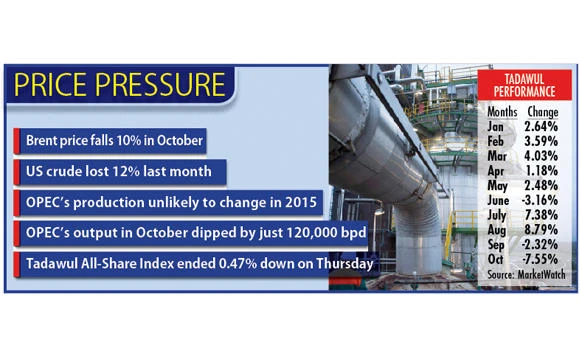
“Oil did play a role in the recent plunge in the Saudi stock exchange (Tadawul),” John Sfakianakis of Ashmore Group told Arab News, reacting to recent market developments.
The Tadawul All-Share Index (TASI) also extended declines on Thursday, with the main index falling 0.5 percent. Shares in Saudi Basic Industries Corp. (SABIC) dropped 1.2 percent and Al-Rajhi Bank lost 0.6 percent.
The insurance sector was hit particularly hard after rising to a six-year intraday high in the previous session. It fell 1.3 percent despite insurers posting strong third-quarter earnings.
However, Mediterranean And Gulf Insurance And Reinsurance Co. added 1.4 percent after its third-quarter profit surged more than tenfold.
Sfakianakis added: “As oil prices seem to be stabilizing around these levels, the market should read this positively. Year to date the Saudi stock market's 17.57 percent growth is quite good.”
He also said: “With the National Commercial Bank’s (NCB) IPO going to an end soon, we just having to complete the earning seasons to see how the market reacts from here on.”
According to NCB, the retail portion of its SR22.5 billion initial share sale had attracted investor interest amounting to more than double the amount on offer.
The IPO reached 281.1 percent by the end of the 13th day, according to the financial advisers and lead managers GIB Capital and HSBC Saudi Arabia. About 904,000 investors bought shares at a total value of SR37.95 billion.
Basil Al-Ghalayini, CEO of BMG Financial Group, said: "The positive news of NCB's IPO oversubscription will enhance the attitude toward this mega offering which is expected to witness even further increase over the weekend before the closing date on Sunday.”
He said: "Obviously, once listed, the financial sector weighting within Tadawul index will be significantly increased which ultimately further deepen the overall market."
Al-Ghalayini added: “"Obviously, the global oil prices decline had its negative impact on traders' sentiments. The sharp division between OPEC members, driven by political agendas of the super powers, is making things even more difficult for investors and traders to plan their trading programs.”
Oil prices, meanwhile, dropped on Friday and were headed toward their fourth consecutive monthly fall.
US and Brent crude fell by almost a dollar to put them both on pace for the steepest monthly decline since May 2012, and the longest monthly losing streak since 2008.
Oil impact feared in KSA market fall