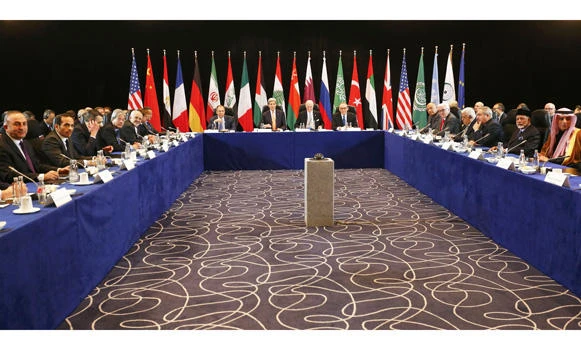
MUNICH, Germany: Daesh militants will only be defeated if Syrian President Bashar Assad is removed from power and this goal will ultimately be achieved, Saudi Foreign Minister Adel Al-Jubeir said on Friday.
Speaking at a security conference in Munich, Al-Jubeir called Assad the “single most effective magnet for extremists and terrorists in the region” and said his removal was crucial for restoring stability.
“That’s our objective and we will achieve it,” he said. “Unless and until there is a change in Syria, Daesh will not be defeated in Syria, period,” he added.
Assad defiant
In Damascus, Assad has vowed to recapture the whole of Syria and keep “fighting terrorism” while also negotiating an end to the war, as international pressure mounts for a cease-fire.
His defiant stance, in an exclusive interview with AFP released Friday, doused hopes of an imminent halt to hostilities, which world powers are pushing to take effect within a week.
Assad said the main aim of a Russian-backed regime offensive in Aleppo province that has prompted tens of thousands of people to flee was to cut the rebels’ supply route from Turkey.
He said his government’s eventual goal was to retake all of the country, large swathes of which are controlled by rebel forces or the Daesh jihadist group.
“It makes no sense for us to say that we will give up any part,” he said in the interview conducted on Thursday in Damascus.
Assad said it would be possible to “put an end to this problem in less than a year” if opposition supply routes from Turkey, Jordan and Iraq were severed.
But if not, he said, “the solution will take a long time and will incur a heavy price.”
Assad said he saw a risk that Turkey and Saudi Arabia, key backers of the opposition, would intervene militarily in Syria.
World powers agreed Friday an ambitious plan to cease hostilities in Syria within a week, but doubts soon emerged over its viability, especially because it did not include or Al-Qaeda’s local branch.
Saudi & UAE special forces
US Defense Secretary Ash Carter earlier said he expected both Saudi Arabia and the United Arab Emirates to send special operations forces to Syria to help local opposition fighters in their drive to retake the city of Raqqa from Daesh militants.
Carter, who has long sought greater participation of Sunni Arab allies in Syria, did not disclose how many commandos he expected them to deploy nor the timing of those deployments.
But he suggested they would play a major role taking back Raqqa, the IDaesh’s defacto capital, from the militants.
“We’re going to try to give opportunities and power to ... particularly Sunni Arabs in Syria who want to re-seize their territory back from ISIL, especially Raqqa,” Carter told reporters traveling with him in Brussels.
Carter made the remarks after talks with his UAE and Saudi counterparts on Friday and Thursday respectively.
Cease-fire call
US Secretary of State John Kerry said there were “no illusions” about the difficulty of implementing a nationwide “cessation of hostilities” as he announced the deal in Munich alongside Russian Foreign Minister Sergei Lavrov.
Lavrov underlined that “terrorist organizations” such as Daesh and Al-Qaeda-affiliated Al-Nusra Front “do not fall under the truce, and we and the US-led coalition will keep fighting these structures.”
Russia says its more than four-month-old bombing campaign in Syria targets Daesh and other “terrorists,” but critics accuse Moscow of focusing on mainstream rebels.
The Munich deal went further than expected, with Lavrov talking about “direct contacts between the Russian and US military” on the ground, where the powers back opposing sides in the five-year-old conflict.
The 17-nation International Syria Support Group also agreed that “sustained delivery” of humanitarian aid will begin “immediately.”
But after Assad’s forces this month nearly encircled Aleppo, Syria’s second city, several nations put the onus on Moscow to implement the deal.
“Through its military action on the side of Assad’s regime, Russia had recently seriously compromised the political process. Now there is a chance to save this process,” German foreign ministry spokeswoman Christiane Wirzt said.
“What is important now is embracing this opportunity, stopping the airstrikes, ceasing targeting civilians and providing humanitarian access,” added Turkish Foreign Minister Mevlut Cavusoglu on Twitter.
Analysts remained skeptical about the chances of ending a war that has killed more than 260,000 people and displaced more than half the population.
“There are huge question marks,” said Julien Barnes-Dacey of the European Council on Foreign Relations.
Aleppo offensive
Peace talks collapsed earlier this month over the offensive on Aleppo, which has forced at least 50,000 people to flee and killed an estimated 500 people since it began on February 1.
A key Syrian opposition body, the High Negotiations Committee, said Friday it was up to rebels on the ground whether to implement the deal.
Kerry said talks between the opposition and the regime would resume as soon as possible, but warned that “what we have here are words on paper — what we need to see in the next few days are actions on the ground.”
Russia and the West remain starkly at odds on several issues, particularly Moscow’s failure to focus its bombing on IS.
“So far Russia has mainly targeted opposition groups and not ISIL (IS) and intense air strikes against different opposition groups in Syria have actually undermined efforts to reach a negotiated peaceful resolution,” said NATO chief Jens Stoltenberg, speaking at the Munich Security Conference on Friday.
“We need a lasting cease-fire, we need help to the civilians, we need a political negotiated solution,” he said.
Saudi FM says Assad will ultimately be ousted