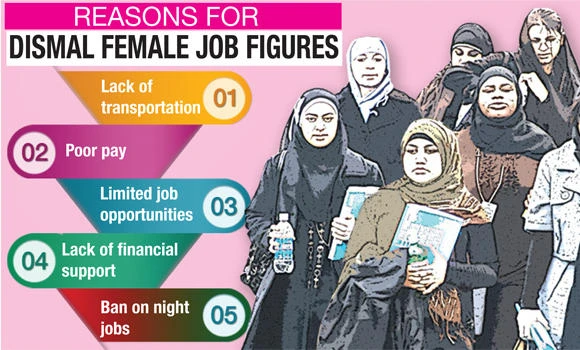
JEDDAH: A lack of appropriate work environment for Saudi women in some sectors in addition to poor pay and lack of transportation top the list of factors that impede female employment.
The Ministry of Labor, represented by the Department for Developing the Work Environment for Women, as well as the General Organization for Technical Development and Vocational Training, specified a number of other factors, such as high attrition rate, limited job opportunities and a lack of financial support, that get in the way of women's employment, a local publication reported.
According to the Director of the Department for Developing the Work Environment for Women, May Al-Anqari, the declining rates of feminization should be dealt with through workshops run by the specialized agency at the Ministry of Labor on the issue of feminizing women's stores.
Al-Anqari rejected the claim that the salaries of Saudi women are the lowest in the Gulf region.
The participants in the campaign for creating suitable work environments for women in the private sector demanded an explanation for the reasons behind stopping the financial support extended by the Human Resources Development Fund.
Sumaia Al Khaldi, the head of the Women's Department at the fund, said: “The system has not been working for four months, but the payments will soon be resumed."
Shoroq Al-Khulaifi from the department briefed the audience on the night jobs women cannot work at, saying: “The regulations prevent women, Muslims or non-Muslims, from working in 24 professions because such jobs do not suit the nature of women."
Maryam Al-Shahri explained the requirements for women’s work in industrial establishments: “If women work on the production line, all workers must be women and their number should not be less than 10, or must constitute at least one-third of the total workforce on the production line. Work at factories before 6 in the morning and after 5 in the evening is totally prohibited".
Nora Al-Hudaib from the General Organization for Technical Development and Vocational Training gave a briefing on the programs offered by the organization for female students, including the vocational rehabilitation program for high school students, which is being undertaken with the cooperation of the Ministry of Education.
May Al-Anqari also spoke about the preferred working environment based on the results of a study done by the World Bank. The study focused on lucrative salaries, working hours, holidays, skills development, health care, transportation, child care centers, good relations with the employers, privacy and independence and other work related issues, she explained.
Unsuitable work environment gets in the way of female employment