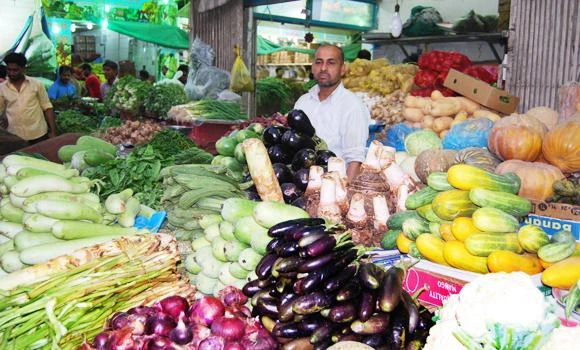
Saudization of the vegetable market is resulting in an estimated daily loss of SR4 million according to Moatasem Abu Zinada, the chief of commission agents at the Jeddah Central Vegetable and Fruits Market.
In a statement to Arab News, Abu Zinada said the vegetable traders did not find fault with the process of Saudization. The traders’ complaint, on the other hand, is against the new stipulation that non-Saudi customers are banned from buying in bulk as opposed to their Saudi counterparts. “Non-Saudis are only allowed to buy two or three boxes of any product complying with an earlier circular which stipulated that only a Saudi could be a wholesale buyer,” Abu Zinada said.
He wondered why this cumbersome stipulation was only being implemented in Jeddah, saying that the “real losers of the ban on bulk purchases by expatriates would be the Saudi farm owners and farmers.”
The losses to Saudi farmers would be difficult to compensate because over half the buyers are expatriates who come from distant cities such as Madinah, Yanbu and Rabigh to buy large quantities of vegetables and fruits at cheap rates from the Jeddah market.
“The new regulations have limited the number of expatriates frequenting the Jeddah central market resulting in lower prices of the produce which do not cover its sowing and harvesting costs,” he said.
Abu Zinada also raised an objection against the installation of the barbed wire to check on expatriates carrying more than three boxes of vegetables. “Such practices are discouraging and not suited to the status and reputation of the central market,” he said attributing the unfavorable practices and resulting crisis to the inexperience of the new Saudization committee of the Labor ministry striving to nationalize the vegetable market.
In efforts to achieve Saudization, the new committee has issued an order to have a Saudi official at each stall and have the workers wear uniforms displaying separate work cards for each establishment in the center. There is also a fence surrounding the market with entrance and exit gates.
An official of the Saudization committee said the committee was following the instructions of the Jeddah governor’s office with the aim of Saudizing both traders and customers. According to the current regulations, sale of vegetables and fruits is a trade reserved for Saudis only.
The official pointed out that the ban on bulk sales to non-Saudis is an old order and it would be extended to all other markets if its implementation in Jeddah proves to be a success.
He added that the barbed wire fencing has been introduced to halt the practice of expatriate workers illegally entering the market to operate as traders. He said the Saudization committee had noticed that a number of expatriate laborers were working illegally as stall owners conducting their own trade operations in the market. He added that the committee would also recommend that the market be closed at a particular hour during the night similar to other markets which close at 10 p.m.
The official hoped that the traders would cooperate instead of grumbling or issuing threats against the committee which is motivated by the intention to serve the interest of the nation.
Member of Food Stuffs Committee at the Jeddah Chamber of Commerce and Industry Jabbar A-Beeshi said: “The Saudization committee is being provocative but it doesn’t realize that most of the customers at the central market are expatriates who are representatives of restaurants, hotels, hypermarkets and hospitals not only in Jeddah but also in Madinah, Yanbu, Jazan, Taif and Makkah.”
He added that the crisis triggered by the new committee would cause short supply of several vital products. About 50 percent of the customers in the central market are expatriates, and their exit from the market would mean losses of millions to businessmen, who will, in turn, move to other central markets in the Kingdom. He wondered if the Saudization committee realized that the bulk of the SR150 to SR170 million worth of fruits and vegetables imported to the Kingdom goes to the Jeddah Central market and that there is no way to compensate for this loss.
Muhammad Al-Johani, another trader at the central market feared that an average loss of SR4 million per day would drive the businessmen to shutter their business in Jeddah and to look for other central markets in cities such as Riyadh, Madinah and the Eastern Province and that the consumer would be the final victim of the new regulations.
Meanwhile, Abu Zinada said that a meeting would be convened in a few days to convince the authorities about the difficulties faced by the traders and the customers in the central market following the implementation of the new regulations.
Vegetable market losing millions following limits on purchases by expats