- Championship generated $6.4m in estimated ‘Social Value’ across global race cities during the 2024/25 season, annual report says
LONDON: Formula E recently released its 2024/25 Season Sustainability Report, highlighting a 241 percent year-over-year surge in social impact, with its Driving Force STEM and Sustainability Education program reaching 61,678 pupils.
Presented with the Public Investment Fund, the program connects electric racing with real-world sustainability challenges, using classroom and digital learning alongside live workshops in Jeddah, Miami, and London.
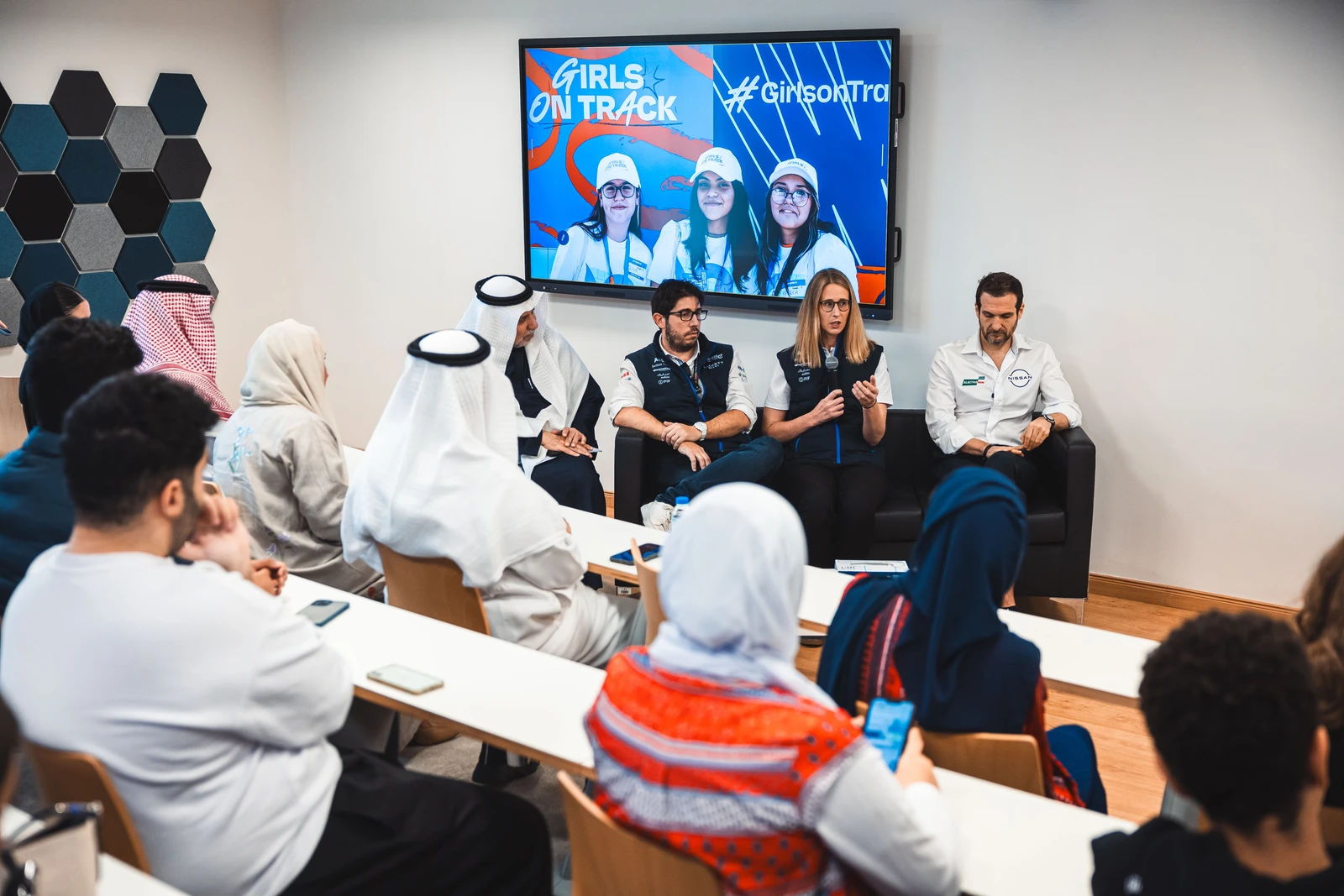
Science, technology, engineering and math has been an ongoing focus for the championship, with Formula E previously partnering with the University of Business and Technology ahead of its first season racing in Jeddah in 2024/25, to host a panel discussion with STEM students.
Representatives from Formula E, Nissan Formula E Team and UBT participated in a wide-ranging discussion covering sustainability, innovation, women’s initiatives, STEM and the diverse career opportunities available in motorsport.
Anchored by the championship’s social impact strategy, the report demonstrates how electric racing translates purpose on the track into measurable social value in host cities across the world.
During the 2024/25 season, Formula E impacted 86,007 people, more than tripling its reach from the previous season.
Working alongside 960 local community partners, Formula E deployed a socio-economic framework developed with Deloitte that identified an estimated $6.4 million in total social value contribution.
Beyond social contribution, the 2024/25 season reinforced Formula E’s broader sustainability leadership.
Additionally, Formula E became the first sport globally to achieve certification under the BSI Net Zero Pathway, which is aligned with ISO 14064 and IWA 42 international guidelines.
Julia Palle, vice president of sustainability, Formula E, said: “Our mission has always been about accelerating progress. While carbon calculation is grounded in direct physical measurements, quantifying human impact requires a different set of tools.
“In season 11, we set out to bring that same standard of accountability to our social footprint, working with Deloitte to build an evidence-based framework to measure our work.”
Aligned with international standards, the framework validates Formula E’s emissions data and long-term reduction targets.
There is a planned 50 percent reduction in scope one and two emissions and a 27.5 percent reduction in Scope Three emissions by 2030, alongside a 90 percent total reduction target by 2050 at the latest.
For the fourth consecutive year, Formula E was named the world’s most sustainable sport by the Global Sustainability Benchmark in Sport.
Outperforming 78 global sports organizations with an overall score of 85 percent (compared to an industry average of 57 percent), Formula E earned top marks across both environmental and social categories.