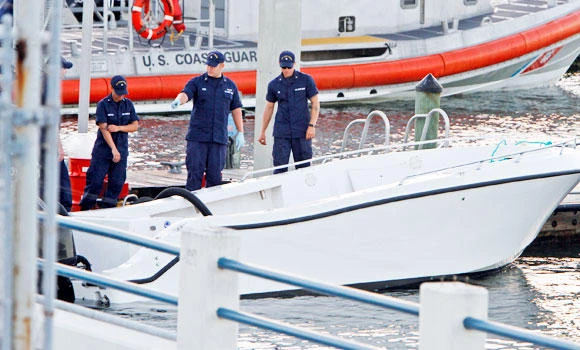
MIAMI BEACH, Florida: Ten people were found clinging to the hull of a small boat that capsized early Wednesday in the waters off South Florida, trapping the bodies of four dead women and one survivor struggling to breathe in a tiny pocket of air beneath it.
One of the survivors called the 911 US emergency dispatch number on a cellphone, alerting authorities to their location 11 km east of Miami.
“Sadly, and tragically, we did find four females, adults, underneath the boat that had perished,” said Coast Guard Cmdr. Darren Caprara.
The survivor found when Coast Guard officials flipped over the boat was suffering seizures, and he was taken by boat to a Miami Beach hospital, officials said. He was treated and released to federal law enforcement.
The rest of the survivors were in good condition and were taken into custody aboard a Coast Guard vessel while authorities investigated whether they were part of a human smuggling operation. It was not immediately clear whether they would be brought to the US or sent back to their home countries.
“Well, obviously, 15 people on a boat, transiting in the middle of the night with no life jackets is a very, very unsafe condition,” Caprara said.
Caprara said that authorities were working to confirm that the people on the boat were Haitian and Jamaican.
“That’s still a lengthy process that involves contacting other countries and doing some investigatory research,” Caprara said.
The small white recreational boat with its center console missing was towed to dry land. It had been overloaded and lacked lifejackets, Caprara said.
It was not immediately clear whether those on the boat that capsized Wednesday were migrants fleeing their home countries. However, the circumstances made it seem likely that they were part of a global phenomenon of people taking desperate risks to escape poverty and instability, said David Abraham, who teaches immigration law at the University of Miami School of Law. In a case earlier this month, hundreds of migrants packed into smugglers’ boats that capsized on their way from Africa to Europe.
“It should be no surprise to anyone so long as the disparity between the poorest place in the Western Hemisphere and the richest place in the hemisphere is so grave and the distances covered are considered worth the risk,” Abraham said.
Migrants from Haiti, Cuba and other Caribbean countries routinely attempt to illegally enter the US by reaching Florida’s coast in overloaded or unseaworthy vessels, often through established smuggling networks that include islands in the Bahamas and Turks and Caicos.
In the fiscal year that ended Sept. 30, the Coast Guard picked up 508 Haitians and 1,357 Cubans at sea. Since the new fiscal year began Oct. 1, the Coast Guard has reported picking up 93 Haitians and 117 Cubans.
4 dead after boat capsizes off Florida