India will have a new government in place by June 1 as the world’s largest democracy will have general elections in a record nine phases, beginning on April 7.
The counting of votes will take place on May 16 and results for all 543 seats in the Lok Sabha are expected to be out the same day.
Elections for legislative assemblies of three Indian states — Andhra Pradesh, Odisha and Sikkim — will be held simultaneously with the polls for the 16th Lok Sabha. Eventually, it would mean four states as Telangana, India’s 29th state, is to be carved out from Andhra Pradesh. Telangana is expected to come into being shortly after the polls.
This will be India’s 16th general election and as many as 814 million voters will be eligible to vote, 100 million more than in the previous general election in 2009.
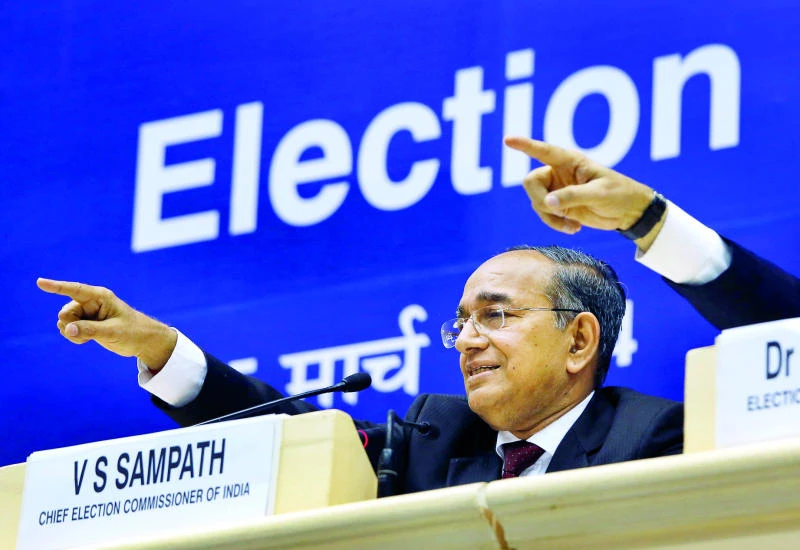
Here is the poll schedule, announced on Wednesday morning by Chief Election Commissioner V Sampath: Phase 1 (7 April): 2 states, 6 constituencies; Phase 2 ( 9 April): 5 states, 7 constituencies; Phase 3 (10 April): 14 states, 93 constituencies; Phase 4 (12 April): 3 states, 5 constituencies; Phase 5 (17 April): 13 states and union territories, 122 constituencies; Phase 6 (24 April): 12 states, 117 constituencies; Phase 7 (30 April): 9 states, 89 constituencies; Phase 8 (7 May): 7 states, 64 constituencies; and Phase 9 (12 May): 3 states, 41 constituencies.
For the first time in Indian general elections, the Indian voter will be having a unique option of expressing dissatisfaction with all the candidates in the fray by pressing the ‘None of the Above’ (NOTA) button on the electronic voting machine.
However, a headache for the Election Commission will be how to deal with the exit polls telecast live by major TV channels immediately after the polling. The problem is that since the polling is to be held in nine phases, subsequent phases polling will be affected and influenced by results of exit polls of the earlier phases.
One credible and effective way of dealing with this problem would be to ban exit polls for the first eight phases. The authorities are likely to do this just as they had done in November-December 2014 assembly polls in five states where the ruling Congress received a thrashing at the hands of the main opposition party, the Bharatiya Janata Party (BJP) in three states and from the debutant Aam Aadmi Party (AAP) in Delhi where the BJP had emerged as the largest single party but short of majority.
The Election Commission’s announcement of poll schedule today and promulgation of the Model Code of Conduct with immediate effect sets the stage for a very interesting dance of democracy which will be watched with lot of interest all over the world.
No Indian general election has been so close as the upcoming one promises to be. The BJP is sensing a never-before victory and the opinion polls and surveys corroborate the rightist party’s optimism.
It will be a high stake gamble for BJP’s prime ministerial candidate Narendra Modi, the chief minister of Gujarat. If he does not perform as per the party’s expectations and predictions of political pundits, he may well lose control over his native state Gujarat also.
The Congress, which has been ruling India for past one decade as the leading party of the United Progressive Alliance (UPA) coalition, is in for its worst election defeat if recent surveys are to be believed. But there are many a slip between the cup and the lip for the Opposition to decimate India’s Grand Old Party.
The Congress party’s Plan B, if Plan A for retaining power fails, would be to deny the BJP an outright victory and prevent Modi from becoming the Prime Minister. The Congress is trying to do this by sewing up alliances with regional parties like it has done in Maharashtra with Nationalist Congress Party (NCP) and in Bihar with Lalu Prasad Yadav’s Rashtriya Janata Dal (RJD).
However, the Congress is yet to fortify itself completely as it has thus far failed to forge crucial alliances in two states — Tamil Nadu (which along with the union territory of Puducherry sends 40 MPs in the Lok Sabha) and Uttar Pradesh (80 Lok Sabha seats). Congress talks with DMK in Tamil Nadu have failed to bear a result so far.
The biggest game-changer for the Congress, if it were to come about, will be its pre-poll alliance with Mayawati’s Bahujan Samaj Party (BSP).
This will be the mother of all pre-poll alliances, if it were to come about.
The Indian political scene is still changing rapidly. The upcoming Indian general election promises to be a cliffhanger cricket match where the last ball of the game is the decider! Watch this space!
• The writer is a New Delhi-based journalist who tweets
@Kishkindha