LUANADA: Rescuers intensified their search efforts Friday in the Angolan town of Lobito, where torrential rains have killed at least 64 people, including 35 children.
“We have provisional reports of 64 dead, but the work of searching for the missing and dead is still ongoing,” said Eugenio Laborinho, a representative from the interior ministry, told the local press.
A day earlier, the official Angop news agency had reported a lower death toll. Laborinho said the situation was critical but under control, calling on the navy, police, firefighters and other volunteers to redouble their efforts to clean the city of the water and sludge brought in by the rains.
Heavy storms hit Lobito, a coastal town about 500 kilometres south of the capital Luanda, late Wednesday night.
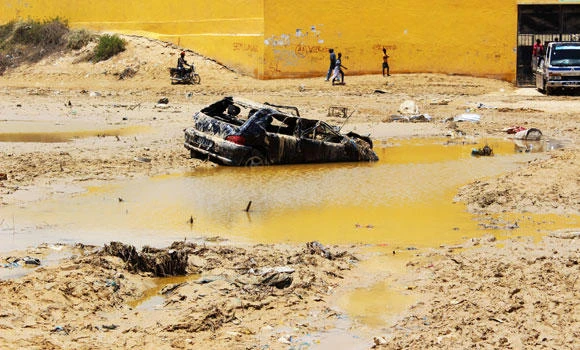
“The water streamed down the slope at full speed, destroying everything in its path and flooding the low-lying areas of the city close to the shoreline,” a firefighter in Lobito said.
The storm destroyed at least 119 homes, while 46 houses lost their roofs. Eight schools were flooded.
“The landscape is desolate. There is mud and debris everywhere,” said Paulo, a Lobito resident. “The authorities are busy draining the water that has accumulated.”
“The whole city is in mourning and the residents are in shock,” said Alberto Ngalanela, provincial secretary of main opposition party Unita. “One family lost seven members in the drama, another four.”
All morning, victims’ relatives arrived pairs at the city’s two hospitals to identify the bodies and take them home for burial.
Condolence messages poured in from President Jose Eduardo dos Santos, political parties, the Catholic Church and civil society, while the government daily newspaper mourned the event as a “tragedy.”
“We must take care of the survivors, those who have lost everything, by providing meals and medical and psychological care,” said activist Jose Patrocinio in Lobito.
Authorities promised the survivors tents, while laying part of the blame for the tragedy on the town’s informal layout and high population density.
“The residents built their homes right on the river bank, despite warnings from the authorities,” local official Amaro Ricardo was quoted as saying by local media reports.
Violent storms come to Angola every spring, causing landslides and floods that hit the country’s poor neighbourhoods the hardest.
Al-Murabitoun, a rebel group run by leading Algerian militant Mokhtar Belmokhtar, has claimed responsibility for the nightclub assault.
The group said it had struck partly to avenge Ahmed El-Tilemsi, one of its commanders killed by the French army in Mali in December.
But it added that the attack was mainly a response to recent cartoons of the Muslim prophet Mohammed, “whom the miscreant West insulted and mocked.”
The group was referring to images published by Paris satirical magazine Charlie Hebdo, which saw 12 people killed at its offices by two Islamist brothers, part of three days of jihadist attacks in Paris that left 17 people dead overall.
Counter-terrorism teams from Paris and Belgium have been involved in the investigation, backed by police from MINUSMA, the UN peacekeeping mission in Mali.
The focus has been on a dozen terrorist groups and individuals, according to sources close to the case, including a Russian and Malian dual national who has not been located, and the alleged driver, whom sources say is disabled.
The attack was the first to target Westerners in Bamako, but Mali’s vast desert north is riven by ethnic rivalries and an Islamist insurgency, and has seen numerous militant attacks on security forces.
Fears over security mounted further on Sunday when a Chadian peacekeeper and two Malian children were killed when militants shelled a UN base in the northeastern rebel stronghold of Kidal.
Militants controlled an area of desert the size of Texas for more than nine months until a French-led military intervention in 2013 that drove them from key towns in the region.
Mali’s Tuareg-led rebels are in meetings in Kidal to decide whether to sign a peace deal already accepted by the government and smaller armed groups.
Between 150 and 200 mainly Tuareg figures from across the north, as well as Mauritania, Niger, Libya and Algeria, are taking part in the talks, expected to last until at least Saturday.
The meeting began four days after UN chief Ban Ki-moon urged the main rebel alliance, known as the Coordination, to sign a peace deal penned in Algeria on March 1.
The Malian government signed the agreement, along with some northern pro-Bamako armed groups, but the rebels have asked for more time.
A Malian diplomat who spoke on condition of anonymity told AFP this week that the rebels are under pressure from European states to join the peace deal.
Angola rains kill 64, half of them children