NEW DELHI: The second-biggest party in India’s ruling coalition announced yesterday it was withdrawing from the government, heightening the risk of early elections before their scheduled date next year.
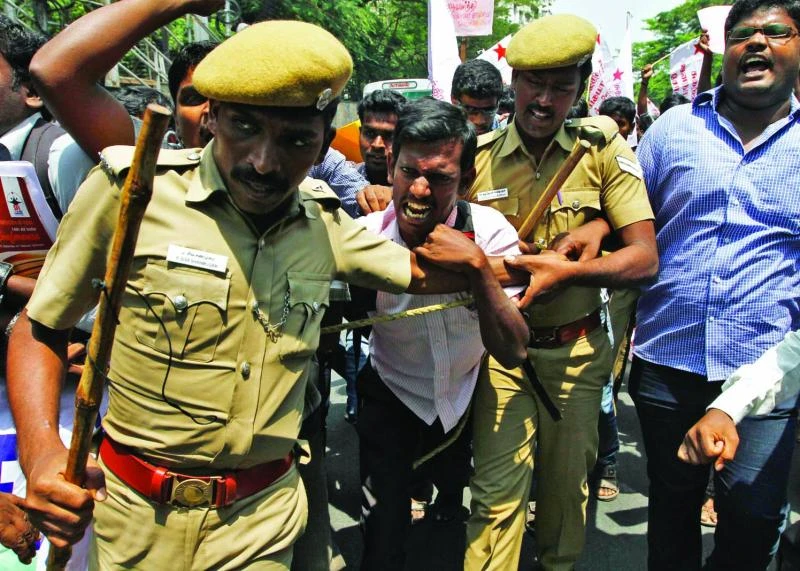
The Dravida Munnetra Kazhagam (DMK), a regional party from the state of Tamil Nadu, had been pressuring the government to condemn Sri Lanka for alleged war crimes against ethnic minority Tamils during the island’s civil war.
Party leader Muthuvel Karunanidhi told a press conference in the city of Chennai that his party would pull out of the left-leaning United Progressive Alliance (UPA) coalition which has been in power since 2009.
“If we continue to remain in the government, it will be the most harmful to Tamil people as the government is not doing anything useful to solve the crisis,” said Karunanidhi.
Unless a solution is found — and the DMK has threatened in the past to withdraw — the government would be more vulnerable to falling before the scheduled date for elections in the first half of 2014.
The UPA is dominated by the Congress party run by the Gandhi political dynasty and has technically been a minority in Parliament since September when another regional party withdrew.
It has so far successfully marshaled support from outside allies to pass legislation, and analysts said the DMK’s loss would be unlikely to trigger polls in the short term.
“No one expects the government to fall, but the drop in numbers will affect its stability,” Parsa Venkateshwar Rao, a political columnist for the DNA daily newspaper, said.
The DMK, which depends on Tamil voters who have close ties to their counterparts in Sri Lanka, is the second-biggest coalition member with 18 Members of Parliament and has five mostly junior positions in cabinet.
Finance Minister P. Chidambaram told reporters yesterday the government remained “stable” and he said Karunanidhi might be persuaded to stay if Parliament passed a resolution condemning Sri Lanka.
Parliamentary Affairs Minister Kamal Nath said: “We are not looking at early elections. We are confident of the numbers with the DMK or without the DMK.” The uncertainty comes amid a sharp slowdown in economic growth, which has slipped to decade lows, and could affect the government’s declared intention to introduce more pro-market reforms.
Shares on the Bombay Stock Exchange closed down 1.48 percent at 19,008.1 points despite a cut in interest rates announced by the central bank.
The power of regional parties with narrow agendas has risen steadily in India over in recent years, with often unwieldy coalitions a feature of national politics since Congress lost its outright majority in Parliament in 1989.
Chidambaram was among three senior ministers who rushed to Chennai at the weekend to seek common ground with the DMK as the government tried to balance domestic political needs against a desire not to antagonize a neighbor.
Karunanidhi had warned that he would withdraw unless the government supported a resolution at the United Nations Human Rights Council in Geneva that condemned “genocide and war crimes” in Sri Lanka.
Sri Lankan forces ended a decades-long civil war with a 2009 onslaught against Tamil Tiger separatists which has since been dogged by war crimes allegations.
The UN estimated that some 40,000 people were killed in the final months of the war, while rights groups put the death toll even higher. Sri Lanka denies that its forces killed civilians.
Dozens of Buddhist monks staged a demonstration outside the Indian embassy in Sri Lanka on Tuesday to protest attacks on pilgrims visiting Tamil Nadu, which is separated from Sri Lanka by a narrow waterway.
Parliamentary affairs think-tank PRS Legislative Research said India’s UPA coalition would control 221 seats without the DMK, short of the required 271 for a majority.
But if outside allies such as the regional Samajwadi Party (22 seats) and Bahujan Samaj Party (21 seats) along with independents (nine seats) continued their support, the government was safe, it said.
Political columnist B.G. Verghese said the move was typical political brinkmanship by the DMK. “I see the pull-out as a lot of bluff and blackmail by the DMK,” he told AFP.
“I don’t see any threat to the Congress government. Minority governments have functioned in the past and done very well.”
Coalition partner’s pullout rocks UPA