MESETAS, COLOMBIA: Colombia’s leftist FARC rebel force declared its disarmament complete on Tuesday after half a century of war against the state, bringing Latin America’s oldest civil conflict close to an end.
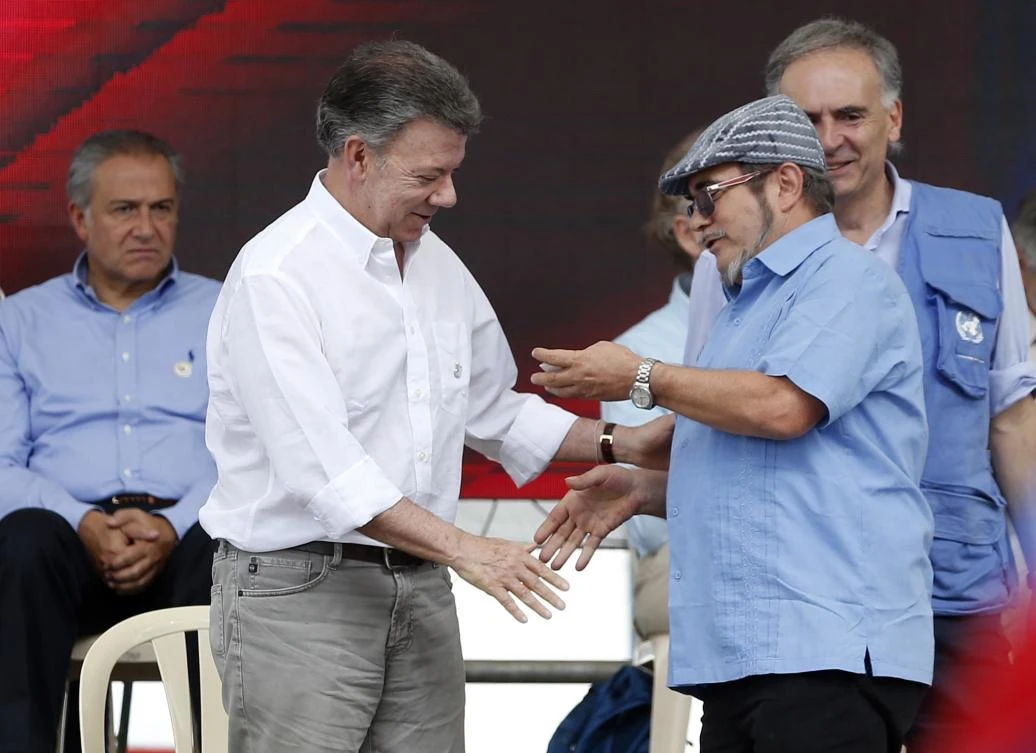
“Farewell to war. Farewell to arms, welcome to peace!” said commander Rodrigo Londono, alias Timochenko, in a speech in the central town of Mesetas, site of one of the group’s demobilization camps.
“Today, we are not letting Colombia down. Today, we are laying down our weapons.”
The move is a key part of efforts to end the long territorial and ideological conflict under a 2016 peace accord.
The accord was at first narrowly rejected by Colombians in a referendum last year before it was redrafted and pushed through congress.
Since then, the process has been blighted by ongoing violence involving other armed groups.
United Nations monitors said Monday they “have the entirety of the FARC’s registered individual arms stored away.”
That excluded some arms that were exempted for transitional security at rebel demobilization camps until August 1.
Separately, the UN mission is destroying other weapons and munitions stashed in remote hiding places which the FARC have surrendered to the monitors.
Colombia’s President Juan Manuel Santos, who won a Nobel Peace Prize for helping forge the accord, said “the peace is real and irreversible,” in a speech following Timochenko’s.
“Today... is a special day that we will never forget, the day when we swapped weapons for words,” he said.
“The laying down of arms is a symbol of the new country that we can be.”
The former fighters are now due to make the transition into civilian life. The Revolutionary Armed Forces of Colombia (FARC) will transform into a political party after a congress in August.
Critics such as conservative political leader Alvaro Uribe said the peace accord was too lenient on FARC members.
Some of them will get amnesties or reduced sentences for crimes committed during the conflict.
The FARC and the government have promised to stamp out the drug production that has fueled the conflict.
The state promised to develop alternative sources of revenue for growers of coca, the raw ingredient of cocaine.
The FARC launched its uprising in 1964 to fight for land rights and protection for poor rural communities.
The conflict drew in leftist guerrillas, right-wing paramilitary groups and state forces.
It has left 260,000 people confirmed dead, more than 60,000 missing and seven million displaced.
The FARC has pledged to use its assets to compensate victims.
The accord promises land and credit lines for rural communities, with millions of dollars of investment.
“It marks the end of the main guerrilla group in the western hemisphere,” said Jorge Restrepo, director of the conflict analysis center CERAC.
“It marks the beginning of the post-conflict period... and of a difficult process of reconciliation in the country.”
Santos says he wants to seal a “complete peace” by reaching a deal with the country’s last active rebel group, the leftist National Liberation Army (ELN), which has some 1,500 members.
The ELN started talks with the government in February, but has been blamed for ongoing confrontations with state forces.
It kidnapped two Dutch journalists on June 19 and freed them five days later.
Officials say remnants of right-wing paramilitary groups are also fighting the ELN for control of the drug trade.
Three women were killed in a bombing at a crowded shopping center in Bogota on June 17. That was blamed on a fringe extremist group, the Revolutionary People’s Movement (MRP).
“Farewell to war. Farewell to arms, welcome to peace!” said commander Rodrigo Londono, alias Timochenko, in a speech in the central town of Mesetas, site of one of the group’s demobilization camps.
“Today, we are not letting Colombia down. Today, we are laying down our weapons.”
The move is a key part of efforts to end the long territorial and ideological conflict under a 2016 peace accord.
The accord was at first narrowly rejected by Colombians in a referendum last year before it was redrafted and pushed through congress.
Since then, the process has been blighted by ongoing violence involving other armed groups.
United Nations monitors said Monday they “have the entirety of the FARC’s registered individual arms stored away.”
That excluded some arms that were exempted for transitional security at rebel demobilization camps until August 1.
Separately, the UN mission is destroying other weapons and munitions stashed in remote hiding places which the FARC have surrendered to the monitors.
Colombia’s President Juan Manuel Santos, who won a Nobel Peace Prize for helping forge the accord, said “the peace is real and irreversible,” in a speech following Timochenko’s.
“Today... is a special day that we will never forget, the day when we swapped weapons for words,” he said.
“The laying down of arms is a symbol of the new country that we can be.”
The former fighters are now due to make the transition into civilian life. The Revolutionary Armed Forces of Colombia (FARC) will transform into a political party after a congress in August.
Critics such as conservative political leader Alvaro Uribe said the peace accord was too lenient on FARC members.
Some of them will get amnesties or reduced sentences for crimes committed during the conflict.
The FARC and the government have promised to stamp out the drug production that has fueled the conflict.
The state promised to develop alternative sources of revenue for growers of coca, the raw ingredient of cocaine.
The FARC launched its uprising in 1964 to fight for land rights and protection for poor rural communities.
The conflict drew in leftist guerrillas, right-wing paramilitary groups and state forces.
It has left 260,000 people confirmed dead, more than 60,000 missing and seven million displaced.
The FARC has pledged to use its assets to compensate victims.
The accord promises land and credit lines for rural communities, with millions of dollars of investment.
“It marks the end of the main guerrilla group in the western hemisphere,” said Jorge Restrepo, director of the conflict analysis center CERAC.
“It marks the beginning of the post-conflict period... and of a difficult process of reconciliation in the country.”
Santos says he wants to seal a “complete peace” by reaching a deal with the country’s last active rebel group, the leftist National Liberation Army (ELN), which has some 1,500 members.
The ELN started talks with the government in February, but has been blamed for ongoing confrontations with state forces.
It kidnapped two Dutch journalists on June 19 and freed them five days later.
Officials say remnants of right-wing paramilitary groups are also fighting the ELN for control of the drug trade.
Three women were killed in a bombing at a crowded shopping center in Bogota on June 17. That was blamed on a fringe extremist group, the Revolutionary People’s Movement (MRP).