SIMFEROPOL, Ukraine: In a referendum watched closely around the world, residents in Ukraine’s strategic Crimean Peninsula voted Sunday on whether to demand greater autonomy or split off and seek to join Russia. The vote has been condemned as illegal by the United States and European countries.
The referendum comes two weeks after Russian-led forces seized control of Crimea, a predominantly ethnic Russian region on the Black Sea that hosts a key Russian naval base. Its residents say they fear the new Ukrainian government that took over when President Viktor Yanukovych fled to Russia last month will oppress them.
Ukraine’s new prime minister insisted again Sunday that neither Ukraine nor the West will recognize the referendum, which they say is being conducted at gunpoint.
“Now, on the territory of the autonomous republic of Crimea under the stage direction of the Russian Federation, a circus performance is underway: The so-called referendum,” Prime Minister Arseniy Yatsenyuk told a government meeting. “Also taking part in the performance are 22,000 Russian troops, who with their guns are trying to prove the legality of the referendum.”
Russia raised the stakes Saturday when its forces, backed by helicopter gunships and armored vehicles, took control of a Ukrainian village outside Crimea — the first military move beyond the peninsula of 2 million people. The Russian forces also took control of a nearby natural gas distribution station, claiming the need to prevent possible terrorist acts.
Serhiy Astakhov, a spokesman for Ukraine’s Border Guard, said on Sunday that Ukrainian forces retook control of the village late Saturday after negotiations with the Russian forces, but the Russian still controlled the gas plant.
If the referendum passes, Russia faces the prospect of quick sanctions from Western nations. So far, however, Russian President Vladimir Putin has vigorously resisted calls to pull back in Crimea. At the United Nations, Russia vetoed a Security Council resolution declaring the referendum illegal, and China, its ally, abstained in a sign of Moscow’s isolation on the issue.
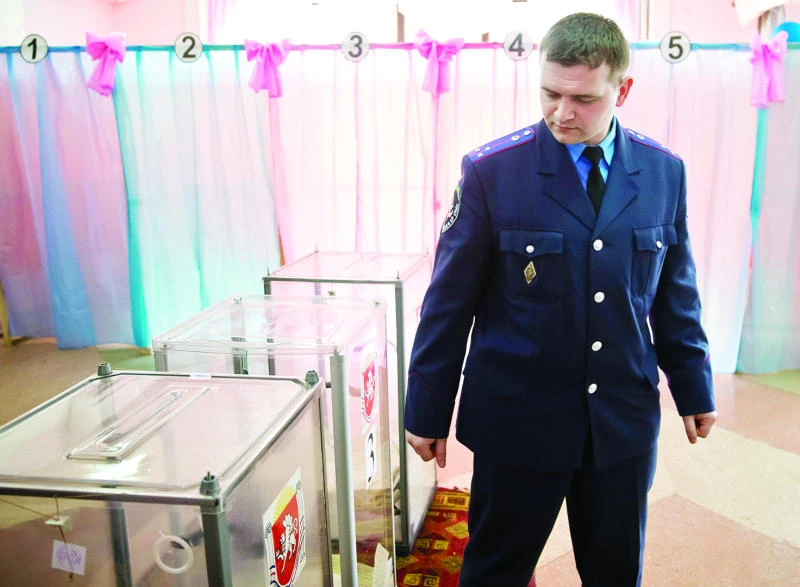
In Sevastopol, Crimea’s key port and the site of the Russian naval base, more than 70 people surged into a polling station within the first 15 minutes of voting Sunday.
Crimea’s pro-Russia authorities say if Ukrainian soldiers resolutely occupying their garrisons on the peninsula don’t surrender after Sunday’s vote, they will be considered “illegal.”
But Ukraine’s acting defense minister, Igor Tenyuk, remained defiant and Crimea’s large Tatar Muslim minority still fiercely opposes any annexation to Russia.
Voters were seen casting their ballots even before the official start of Crimea’s referendum on Sunday at a polling station in Sevastopol in one of several possible irregularities.
The White House says that if Putin doesn’t back down in Crimea, he will face penalties from the West that will hurt the Russian economy and diminish Moscow’s influence in the world.
German Chancellor Angela Merkel told Russian President Vladimir Putin more Organization for Security and Cooperation in Europe (OSCE) observers should be sent to Ukraine, a plan he welcomed, Merkel’s spokesman said on Sunday.
“The chancellor proposed swiftly expanding the existing OSCE presence in Ukraine and sending a bigger number of observers into hot spots, especially in East Ukraine,” Merkel’s spokesman Steffen Seibert said in a statement about a phone call between the two leaders.
“The Russian president viewed this initiative positively. He promised he would instruct Foreign Minister (Sergei) Lavrov accordingly.” This should be agreed with as broad as possible support at an OSCE meeting in Vienna on Monday.
Merkel also condemned a Russian attempt on Saturday to try to enter a spit of land belonging to Kherson, a region adjacent to Crimea, Seibert said in the statement.
In another development, hackers brought down several public NATO websites, the alliance said on Sunday, in what appeared to be the latest escalation in cyberspace over growing tensions over Crimea.
The Western military alliance’s spokeswoman, Oana Lungescu, said on social networking site Twitter that cyber attacks, which began on Saturday evening, continued on Sunday, although most services had now been restored.
“It doesn’t impede our ability to command and control our forces. At no time was there any risk to our classified networks,” another NATO official said.
NATO’s main public website (www.nato.int), which carried a statement by Secretary-General Anders Fogh Rasmussen saying that Sunday’s referendum on Crimea’s status would violate international law and lack legitimacy, worked intermittently.
The so-called “distributed denial of service” (DDoS) attack, in which hackers bombard websites with requests causing them to slow down or crash, also hit the site of a NATO-affiliated cyber security center in Estonia. NATO’s unclassified e-mail network was also affected.
A group calling itself “cyber berkut” said the attack had been carried out by patriotic Ukrainians angry over what they saw as NATO interference in their country.
The claim, made at www.cyber-berkut.org, could not be independently verified.
Crimea holds referendum to split from Ukraine